Adelaide vs Other Australian Cities for International Students: Pros and Cons

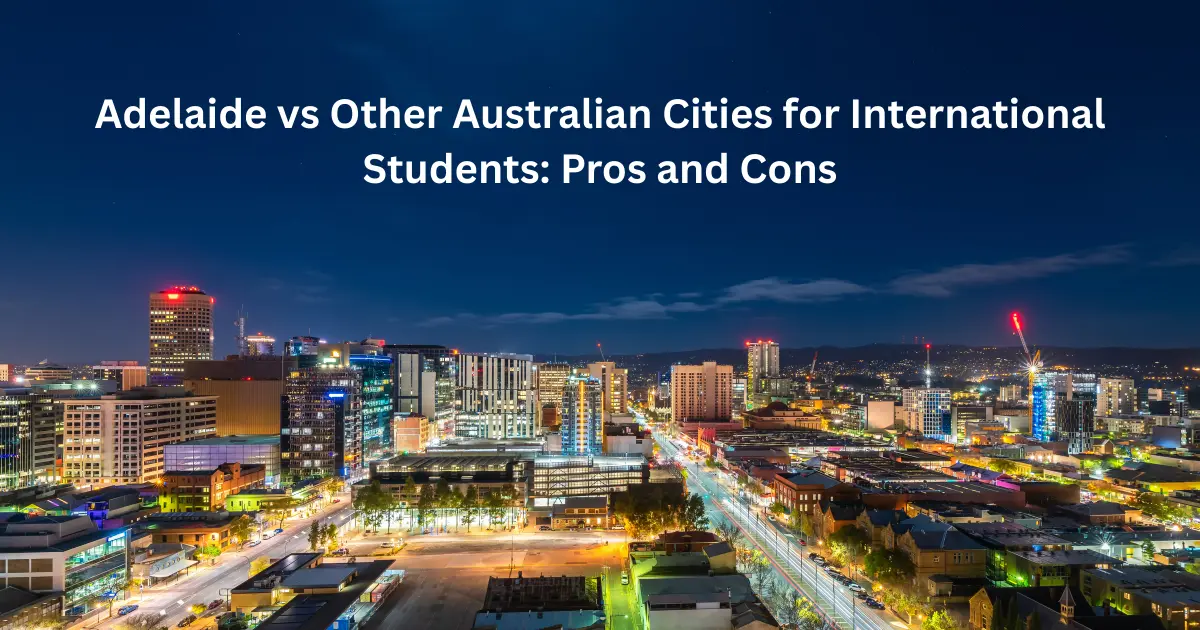
Adelaide vs other Australian cities for international students is a comparison I wish I’d thought harder about before choosing Melbourne. Don’t get me wrong. I love Melbourne. But when I look at my bank balance and calculate what I’ve spent on rent over the past 18 months, I sometimes wonder what life would’ve been like if I’d picked Adelaide instead.
I have three close friends studying in Adelaide. One at University of Adelaide doing computer science, one at UniSA doing cybersecurity, and one at Flinders doing nursing. Every time we compare notes, the same themes come up: they pay hundreds less in rent each month, they found part-time work faster, and they’re not constantly stressed about money the way students in Melbourne and Sydney are.
But Adelaide also has trade-offs. Smaller job market. Fewer people. Less happening on weekends. It’s not for everyone.
So here’s an honest breakdown of Adelaide vs other Australian cities for international students, covering costs, jobs, lifestyle, universities, and migration pathways. I’ll compare Adelaide directly with Melbourne, Sydney, Brisbane, and Perth so you can figure out what actually matters for your situation.
The Quick Overview
Before diving deep, here’s the summary version. If Adelaide sounds interesting after this, keep reading for the details.
Choose Adelaide if: You want lower living costs, a calmer lifestyle, easier part-time job hunting, better PR pathway prospects, and you’re okay with a smaller city that moves at a slower pace.
Choose Melbourne or Sydney if: You want maximum career opportunities, a huge international student community, world-class nightlife and culture, and you can afford the premium cost of living.
Choose Brisbane if: You want a middle ground between affordability and opportunity, warmer weather year-round, and a growing job market without the intensity of Sydney or Melbourne.
Choose Perth if: You want the affordability and regional benefits similar to Adelaide, but prefer a larger city with beaches and a mining-adjacent economy.
Now let’s break each of these down properly.
Cost of Living: Where Adelaide Wins Convincingly
This is Adelaide’s biggest advantage, and it’s not even close. The cost of living difference between Adelaide and the eastern capitals is substantial.
Rent Comparison
Rent is the single biggest expense for any student, and it’s where Adelaide saves you the most money.
Adelaide: A room in a share house typically costs $150 to $220 per week. Studios and one-bedroom apartments range from $280 to $380 per week. You can live reasonably close to universities or the CBD without paying a premium.
Melbourne: Share house rooms run $200 to $300 per week in suburbs with decent transport links. Studios in inner areas start around $350 and go up to $500 or more. Living affordably usually means living far from the city.
Sydney: The most expensive market in Australia. Share house rooms cost $250 to $350 per week. Studios rarely go below $400, and $500+ is common in areas near universities. Many students live an hour or more from campus to afford rent.
Brisbane: More affordable than Sydney and Melbourne, but prices have risen sharply in recent years. Share house rooms typically cost $180 to $260 per week. Still cheaper than the southern capitals, but the gap with Adelaide remains.
Perth: Similar to Adelaide in many ways. Share house rooms run $160 to $240 per week. Perth was extremely cheap a few years ago, but prices have increased. Still more affordable than the east coast capitals.
To put real numbers on this: if you’re paying $180 per week in Adelaide versus $280 per week in Melbourne, that’s $100 per week difference. Over a two-year Masters, that’s roughly $10,400 in rent savings alone. That’s real money that could reduce your financial stress or how many hours you need to work.
For detailed breakdowns, check out my guides on cost of living in Adelaide for international students and cost of living in Melbourne.
Other Living Costs
Rent isn’t the only thing that’s cheaper in Adelaide.
Groceries: Roughly similar across cities for supermarket staples, but Adelaide has cheaper fresh produce at the Central Market. Eating out is noticeably cheaper than Melbourne and Sydney.
Transport: Adelaide’s public transport is simpler and cheaper than Melbourne’s extensive network. A monthly pass costs less. Many students also cycle because the city is flat and compact.
Utilities: Electricity and gas costs are comparable across cities, though Adelaide homes tend to be slightly cheaper to heat and cool due to smaller average dwelling sizes.
Entertainment: Going out, movies, events, and general socialising costs less in Adelaide. Melbourne and Sydney have more options but charge premium prices for everything.
Total Monthly Budget Comparison
Here’s a realistic monthly budget for a single international student in each city.
Adelaide: $1,800 to $2,200 per month (rent, food, transport, utilities, basic entertainment)
Melbourne: $2,400 to $3,000 per month for a similar lifestyle
Sydney: $2,600 to $3,200 per month, and that’s being careful
Brisbane: $2,100 to $2,600 per month
Perth: $1,900 to $2,400 per month
These are estimates based on modest living. You can spend less by being extremely frugal, or much more by living comfortably. But the relative differences hold true.
For budgeting help, read my guide on how much money you need per month as a student in Australia.
Job Market: The Trade-Off
This is where Adelaide’s disadvantages show up. The job market is smaller, which affects both casual work and professional career prospects.
Part-Time and Casual Jobs
Surprisingly, many Adelaide students report finding casual jobs faster than their counterparts in Melbourne and Sydney. Here’s why.
Less competition: Adelaide has fewer international students overall, which means less competition for entry-level jobs. In Melbourne, a single retail job posting might get 200 applications. In Adelaide, it might get 50.
Smaller networks, tighter community: Adelaide’s hospitality and retail scene is smaller but more connected. Word of mouth matters more. Once you know people, opportunities come through referrals.
Regional businesses: Adelaide has more small independent businesses relative to chains. These often prefer hiring locally and are more willing to give students a chance.
That said, there are simply fewer jobs overall. If you’re very specific about what you want, or if the job market tightens, Adelaide’s smaller size becomes a limitation.
For job hunting strategies, check out my guide on part-time job market in Adelaide for international students.
Professional and Graduate Jobs
This is where Adelaide falls behind significantly.
Melbourne and Sydney dominate Australia’s professional job market. The big consulting firms, major banks, tech companies, and corporate headquarters are concentrated in these two cities. Graduate programs are larger and more numerous. If you’re studying business, finance, IT, or engineering with plans to work for a major company, Melbourne and Sydney offer far more opportunities.
Brisbane is growing fast, especially in tech and infrastructure. It’s becoming a genuine alternative to the southern capitals for certain industries.
Perth has a strong job market tied to mining, resources, and engineering. If your field connects to these industries, Perth is excellent. Otherwise, options are more limited.
Adelaide has a smaller professional job market. Defence, space, and health tech are growing sectors. The government is a major employer. But the sheer volume of graduate roles and corporate opportunities is lower than the big cities.
Here’s the honest truth: if your primary goal is maximising career opportunities immediately after graduation, Melbourne or Sydney gives you the best odds. If you’re willing to work a bit harder to find opportunities, or you’re flexible about starting in a smaller company before potentially relocating, Adelaide can still work.
For more on finding professional work, read my guide on finding graduate roles in Australia as an international student.
Universities: Quality Across the Board
All Australian cities have reputable universities. Adelaide’s options are strong.
Adelaide's Universities
University of Adelaide: Group of Eight research university. Strong in engineering, health sciences, wine and agriculture, and computer science. Good reputation globally. This is the flagship institution.
University of South Australia (UniSA): Practical, industry-focused programs. Strong in business, IT, health, and education. Known for graduate employability and industry connections.
Flinders University: Good for nursing, medicine, social sciences, and psychology. Has a more relaxed campus feel. Strong health and medical research.
Three solid universities with different strengths. For most fields of study, you can find a quality program in Adelaide.
For details on Adelaide’s universities, check out my guide on best suburbs in Adelaide for students near universities.
How Other Cities Compare
Melbourne has the highest concentration of top universities: University of Melbourne, Monash, RMIT, Deakin, Swinburne, La Trobe. More options, more specialisations, more competition.
Sydney has University of Sydney, UNSW, UTS, Macquarie, Western Sydney. Similar depth to Melbourne with strong options across most fields.
Brisbane has University of Queensland (Go8), QUT, Griffith. Fewer options than Melbourne and Sydney, but still strong programs.
Perth has UWA (Go8), Curtin, Murdoch, Edith Cowan. Good options, especially for mining-related fields and health.
The quality of education at Adelaide’s universities is comparable to similarly ranked institutions elsewhere. The difference is in scale and the surrounding ecosystem, not educational quality.
For comprehensive university comparisons, see my guide on Masters in IT and Computer Science across Australian universities.
Lifestyle: Different Vibes for Different People
This is subjective, but important. Where you study isn’t just about money and jobs. It’s where you’ll live for two or more years.
Adelaide's Lifestyle
Adelaide is often called a “big country town.” That’s both a compliment and a criticism depending on who you ask.
The pace is slower. Things close earlier. There’s less urgency. People are generally more relaxed. If you come from a hectic city and want calm, this is appealing. If you thrive on energy and activity, it might feel boring.
It’s easy to get around. Adelaide is compact and flat. You can cycle most places. Public transport is simpler to navigate than Melbourne’s sprawling network. Traffic isn’t the nightmare it is in Sydney.
Nature is accessible. Beaches, hills, wine regions, and national parks are close by. Weekend trips to the Barossa Valley or Adelaide Hills are easy and affordable.
The food and wine scene is underrated. Adelaide has excellent restaurants, a famous central market, and world-class wine regions nearby. It’s not Melbourne’s cafe culture, but it’s genuinely good.
It’s quieter socially. Fewer events, smaller nightlife scene, less happening on any given weekend. You need to make more effort to build a social life because there’s less ambient activity.
For more on Adelaide life, read my guide on cheap and free things to do in Adelaide for students.
Melbourne's Lifestyle
Melbourne is Australia’s cultural capital. Endless cafes, live music, street art, festivals, sport, diverse neighbourhoods, and a massive international student community. There’s always something happening. The downside is cost, crowds, and a competitive energy that some find exhausting.
For Melbourne specifics, see my ultimate guide to living in Melbourne for international students.
Sydney's Lifestyle
Sydney has beaches, harbour views, and natural beauty that’s hard to match. It feels more glamorous than other cities. But it’s expensive, traffic is terrible, and the social scene can feel more superficial. The international student community is huge but fragmented across a sprawling metro area.
For Sydney details, check out my ultimate guide to living in Sydney for international students.
Brisbane's Lifestyle
Brisbane offers warm weather year-round, a growing food and bar scene, proximity to the Gold Coast and Sunshine Coast, and a more laid-back vibe than Sydney. It’s growing rapidly and feeling more like a proper city. The subtropical climate is either a major plus or too hot, depending on your preferences.
For Brisbane information, see my guide on living in Brisbane for international students.
Perth's Lifestyle
Perth is isolated but beautiful. Stunning beaches, great weather, and a relaxed pace. It can feel disconnected from the rest of Australia. The social scene is smaller, and you might feel far from everything. But if you value outdoor lifestyle and don’t mind the distance, Perth has a lot to offer.
For Perth details, read my guide on living in Perth for international students.
Weather and Climate
This matters more than people admit when choosing where to study.
Adelaide: Mediterranean climate. Hot, dry summers (December to February can hit 40°C regularly). Mild, wet winters. Very sunny overall. If you dislike extreme heat, summer in Adelaide is challenging.
Melbourne: Famously unpredictable. Four seasons in one day is a cliche because it’s true. Cool to cold winters, warm summers with occasional heatwaves. More rain spread throughout the year.
Sydney: Mild and humid. Warm summers, mild winters. More consistent than Melbourne but can be uncomfortably humid in summer.
Brisbane: Subtropical. Hot and humid summers with storms. Mild, dry winters. If you dislike humidity, Brisbane summers are tough.
Perth: Similar to Adelaide. Hot, dry summers. Mild, wet winters. Very sunny. Mediterranean climate.
If you’re from a tropical country, Brisbane’s humidity might feel familiar. If you’re from somewhere cold, Melbourne’s winters won’t bother you. Adelaide and Perth suit people who prefer dry heat and sunshine.
For Adelaide weather specifics, read my guide on weather in Adelaide: seasons, heat, and adjusting as a newcomer.
Migration and PR Pathways
This is increasingly important for international students, and it’s where Adelaide has a significant advantage.
Regional Status and Extra Points
South Australia, including Adelaide, is classified as regional for migration purposes. This provides several benefits.
Additional points: You can claim extra points on skilled migration applications for studying and living in regional areas. Currently, this can be 5 to 15 additional points depending on your circumstances.
State nomination opportunities: South Australia actively nominates skilled workers in occupations the state needs. The nomination requirements are often more accessible than NSW or Victoria.
Designated Area Migration Agreements: Some regional areas have special arrangements that create additional pathways.
Longer post-study work visas: Students who study in regional areas may be eligible for longer post-study work visa durations.
How Other Cities Compare
Melbourne and Sydney: Not classified as regional. No extra points for location. State nomination is possible but highly competitive with stricter requirements.
Brisbane: Queensland offers state nomination, but Brisbane itself is not regional. Some surrounding areas are.
Perth: Western Australia is classified as regional, similar to South Australia. Perth offers comparable migration benefits to Adelaide.
If permanent residency is a major goal, Adelaide and Perth have structural advantages that Melbourne and Sydney don’t offer. This doesn’t guarantee PR, as the system is complex and changes frequently, but it improves your odds.
For more on this topic, see my guide on Adelaide as a good choice for regional study options.
The International Student Community
The size and nature of the international student community differs significantly between cities.
Adelaide
Smaller overall international student population. The community is tighter-knit because there are fewer people. You’ll likely know other students from your country and make connections faster. University communities feel more intimate.
The downside is less diversity of experience and fewer cultural events or community organisations compared to larger cities.
Melbourne
Massive international student population. One of the highest in the world. You’ll find communities from almost every country, with established cultural organisations, events, restaurants, and support networks. But you can also feel anonymous in the crowd.
Sydney
Similar to Melbourne in terms of size, but the community is more geographically spread out across a larger metro area. Strong communities exist but require more effort to connect with.
Brisbane and Perth
Medium-sized international student communities. Growing, but still smaller than Melbourne and Sydney. Decent cultural diversity without the overwhelming scale.
Student Support and Services
All Australian universities provide support services for international students. The quality is generally consistent, but the feel differs.
Adelaide’s universities are known for more personalised support. Smaller numbers mean staff often know students by name. Getting help doesn’t require navigating massive bureaucracies.
Melbourne and Sydney universities have extensive support services but can feel impersonal. You’re one of thousands, and getting individual attention sometimes requires persistence.
This is a generalisation, and individual experiences vary. But if you value a more intimate academic environment where you’re not just a number, Adelaide’s universities tend to deliver that.
Summary: Pros and Cons Side by Side
Adelaide
Pros: Significantly lower cost of living, especially rent. Less competition for casual jobs. Calmer, more relaxed lifestyle. Regional migration benefits and extra PR pathway points. Smaller classes and more personalised university experience. Easier to get around, flat and compact city. Quality universities with strong programs. Excellent food and wine scene.
Cons: Smaller professional job market. Fewer graduate program opportunities. Less happening in terms of nightlife and events. Can feel boring if you want constant stimulation. Extreme summer heat. Smaller international student community. Further from other major cities.
Melbourne
Pros: Largest job market for most industries. Huge international student community. Endless culture, food, events, and entertainment. Most university options and specialisations. Excellent public transport network.
Cons: Expensive rent and cost of living. High competition for jobs and university places. Can feel overwhelming and competitive. Unpredictable weather. No regional migration benefits.
Sydney
Pros: Major job market, especially finance and professional services. Beautiful harbour and beaches. Huge international student community. Strong universities.
Cons: Most expensive city in Australia. Terrible traffic and sprawl. Long commutes. No regional migration benefits. Can feel superficial and status-driven.
Brisbane
Pros: Growing job market and economy. More affordable than Sydney and Melbourne. Warm weather year-round. Close to beaches and natural attractions. Good universities.
Cons: Humidity can be oppressive. Still smaller job market than southern capitals. Not regional for migration purposes. Less cultural depth than Melbourne.
Perth
Pros: Affordable like Adelaide. Regional migration benefits. Beautiful beaches and outdoor lifestyle. Strong resources sector. Good universities.
Cons: Isolated from rest of Australia. Smaller job market outside resources. Can feel disconnected. Long flights to visit other cities or travel home.
Making Your Decision
Here’s how I’d think about choosing between Adelaide and other cities.
Choose Adelaide if:
Your budget is limited and lower costs would reduce financial stress. PR is a significant goal and you want migration advantages. You prefer a calmer lifestyle over constant activity. You’re studying nursing, health sciences, or fields where Adelaide has strong employment. You don’t need to be in a major corporate hub immediately after graduation. You want a more intimate university experience.
Choose Melbourne if:
Career opportunities in major companies are your top priority. You’re studying fields where Melbourne dominates (finance, consulting, tech, creative industries). You want maximum options for everything. You have the budget to afford higher costs. You thrive in busy, competitive environments.
Choose Sydney if:
You want the beach and harbour lifestyle. Finance or professional services are your target industries. You don’t mind paying premium prices for the Sydney experience. Natural beauty matters more than affordability.
Choose Brisbane if:
You want a middle ground between affordability and opportunity. Warm weather is important to you. You’re interested in growing industries like tech and infrastructure. You want access to Gold Coast and natural attractions.
Choose Perth if:
You want Adelaide-level affordability with regional benefits. Mining, resources, or engineering are your field. Beach lifestyle appeals to you. You don’t mind being far from other cities.
Frequently Asked Questions
Is Adelaide too boring for international students?
It depends on your personality and expectations. Adelaide is quieter than Melbourne and Sydney with less nightlife and fewer large-scale events. But “boring” is subjective. Many students appreciate the calmer pace, easier friendships, and proximity to nature. If you need constant stimulation and a packed social calendar, Adelaide might feel slow. If you value quality of life over quantity of activities, it can be ideal. Visit first if you can, or talk to current students about their honest experience.
Can I get a good job after studying in Adelaide?
Yes, but with caveats. Adelaide has a smaller job market than Melbourne and Sydney. Local employers recruit from local universities, and industries like defence, health tech, and government are growing. However, if you’re targeting big corporate graduate programs or major tech companies, you may need to relocate or apply remotely to eastern states. Many Adelaide graduates do find good jobs locally, but you should be realistic about the market size.
How much money can I save by studying in Adelaide instead of Melbourne?
Over a two-year Masters, the savings can be substantial. Rent alone might save you $8,000 to $12,000 total. Add cheaper transport, food, and entertainment, and total savings could reach $15,000 to $20,000 compared to Melbourne, or even more compared to Sydney. That’s money that reduces family burden, decreases how much you need to work, or builds savings for your future.
Is Adelaide good for PR and permanent residency?
Adelaide offers structural advantages for PR pathways that Melbourne and Sydney don’t have. As a regional area, you can claim extra points on skilled migration applications. South Australia also actively nominates skilled workers. This doesn’t guarantee PR, as immigration policy changes frequently and individual circumstances vary. But if PR is a significant goal, Adelaide improves your odds compared to non-regional cities.
What industries are growing in Adelaide?
Defence and space industries are major growth areas, with significant government investment. Health technology and medical devices are strong. Renewable energy is expanding. Education and research remain steady. Wine and agriculture continue to be important. Tech is growing but remains smaller than eastern capitals. If your field aligns with these sectors, Adelaide’s job market is more promising than the overall statistics might suggest.
Should I visit Adelaide before deciding to study there?
If you can afford it, yes. Adelaide has a distinct feel that’s different from other Australian cities. Visiting lets you experience the pace, the scale, and the vibe firsthand. Talk to current students, explore the neighbourhoods near universities, and see if it feels right for you. If visiting isn’t possible, try to connect with current Adelaide students online and ask honest questions about their experience.
Final Thoughts
Adelaide vs other Australian cities for international students comes down to priorities. Adelaide offers genuine advantages in cost, lifestyle, and migration pathways. Melbourne and Sydney offer maximum opportunity and excitement at premium prices. Brisbane and Perth sit somewhere in between with their own unique characteristics.
There’s no universally correct answer. I know students who chose Adelaide and love it. I know students who chose Adelaide to save money and regretted missing out on Melbourne’s energy. I also know students in Melbourne who are constantly stressed about rent and wish they’d chosen somewhere cheaper.
The best choice is the one that aligns with your specific situation. Your budget, your career goals, your personality, your migration plans. Think honestly about what matters most to you, not what sounds most impressive to others.
If you’re still exploring your options, check out my comparison of cost of living across Brisbane, Adelaide, and Perth and my guide on deciding between capital cities and regional cities for study.
Adelaide vs other Australian cities for international students is a decision that will shape your experience in Australia. Take the time to get it right.