WA School Holidays 2026: Complete Term Dates & Calendar
Western Australia school holidays 2026 follow a four-term structure with specific dates set by the Department of Education WA. The school year begins in late January and concludes in mid-December, featuring autumn, winter, and spring breaks between terms, plus an extended summer holiday period.
Additionally, WA families need to understand the complete term calendar to plan holidays, childcare arrangements, and family activities effectively. The state’s school calendar typically differs from other Australian states, making it essential for parents to know the exact dates well in advance.
Furthermore, public schools, Catholic schools, and independent schools may have slight variations in their holiday schedules. This comprehensive guide covers all four terms, holiday periods, and important planning considerations for Western Australian families. You can also check our guides for NSW school holidays 2026 and other state calendars for comparison.
TL;DR
- Four terms run from late January to mid-December 2026 with three holiday breaks
- Department of Education WA sets standard dates, but Catholic and independent schools may vary
- Summer holidays extend from December 2026 into February 2027 for the longest break
- Early planning helps families book holidays, arrange childcare, and budget for school break periods
Western Australia School Holiday Dates 2026 Overview
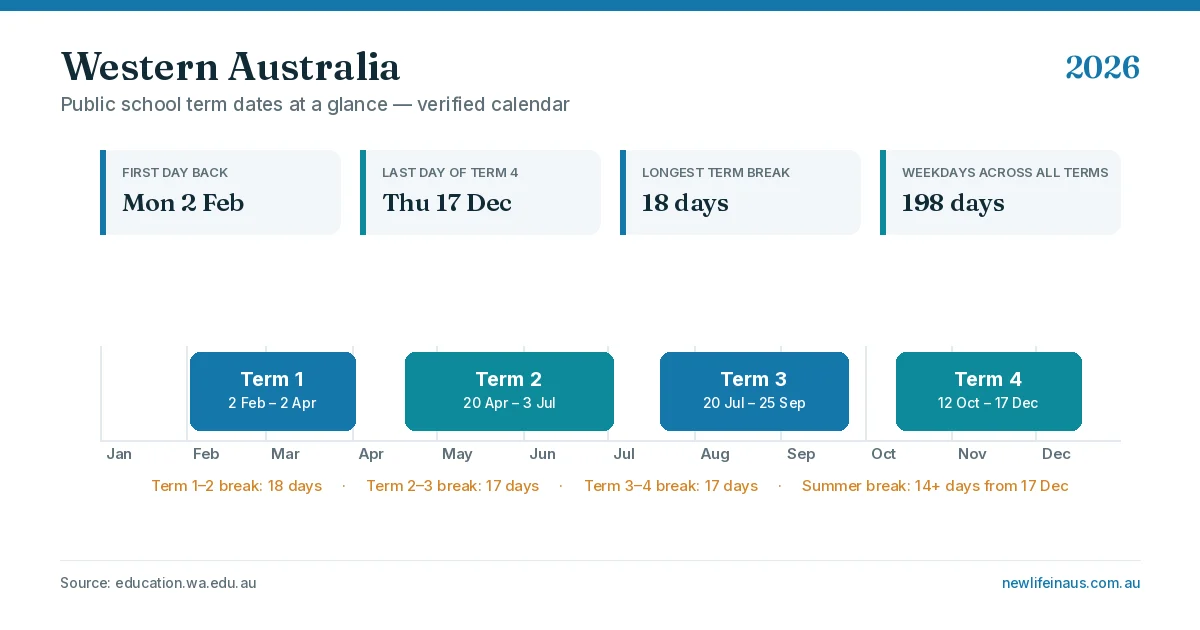
Western Australia’s 2026 school calendar follows the established four-term system with carefully planned holiday periods throughout the year. Moreover, the Department of Education WA has structured these dates to provide balanced learning periods and adequate rest breaks for students and teachers alike.
| Term | Start Date | End Date | Holiday Period |
|---|---|---|---|
| Term 1 | Monday, 2 February 2026 | Friday, 10 April 2026 | Autumn Holidays: 13-25 April |
| Term 2 | Monday, 28 April 2026 | Friday, 3 July 2026 | Winter Holidays: 6-18 July |
| Term 3 | Monday, 21 July 2026 | Friday, 25 September 2026 | Spring Holidays: 28 Sept-10 Oct |
| Term 4 | Monday, 13 October 2026 | Thursday, 17 December 2026 | Summer Holidays: 18 Dec-31 Jan |
Additionally, each term break provides approximately two weeks of holiday time, except for the summer vacation which extends for six weeks. These extended summer holidays allow families to plan major trips and provide students with substantial recovery time before the new academic year begins.
Compared to the 2025 school calendar, the 2026 dates show minimal variation in structure but differ by specific weekdays due to calendar progression. Furthermore, Term 1 2026 commences three days later than the previous year, while Term 4 concludes on the same relative date in December.
Importantly, these dates apply to government schools across Western Australia as the standard framework. However, Catholic Education WA and independent schools may implement slight variations to accommodate their specific educational calendars and religious observances.
Parents should note that pupil-free days and staff development days may extend holiday periods at individual schools. Similarly, some schools schedule additional closure days around public holidays, particularly during Term 2 when several long weekends occur in quick succession.
For comprehensive planning across Australia, families can compare these WA dates with NSW school holidays 2026, Victoria school holidays 2026, and QLD school holidays 2026 to coordinate interstate travel and family visits effectively.
Term 1 2026 Dates and Holidays
Term 1 2026 commences on Monday, 3 February 2026 for Western Australia government schools. This start date positions the first term three days later than the corresponding 2025 opening, providing families with additional summer holiday time for post-Christmas recovery and vacation planning.
The academic term runs continuously until the Easter holiday break, which occurs from Friday, 3 April to Monday, 13 April 2026. During this period, schools close for eleven consecutive days, incorporating both Good Friday and Easter Monday public holidays alongside the traditional two-week school break structure.
Term 1 concludes on Friday, 10 April 2026, immediately before the Easter holidays begin. Subsequently, this timing allows families to plan extended Easter getaways without conflicting with school attendance requirements, while students receive adequate rest before Term 2 activities commence.
The autumn holiday break extends for two weeks and two days, running from Saturday, 11 April through Sunday, 26 April 2026. Moreover, this extended break period accommodates both Easter celebrations and ANZAC Day observances, creating natural family time opportunities during the cooler autumn months.
| Event | Date | Duration |
|---|---|---|
| Term 1 Start | Monday, 3 February 2026 | – |
| Easter Break | Friday, 3 April – Monday, 13 April | 11 days |
| Term 1 End | Friday, 10 April 2026 | – |
| Autumn Holidays | Saturday, 11 April – Sunday, 26 April | 16 days |
Notably, the Term 1 schedule spans ten weeks and two days of instructional time, providing sufficient duration for curriculum delivery while maintaining manageable learning blocks. Additionally, this structure aligns with other Australian states, though specific dates vary – families can reference NSW school holidays 2026 and Victoria school holidays 2026 for interstate coordination planning.
Term 2 2026 Dates and Mid-Year Break
Term 2 commences on Monday, 27 April 2026, immediately following the autumn holiday period. Furthermore, this commencement date strategically positions the term start after both Easter celebrations and ANZAC Day observances, ensuring uninterrupted learning momentum throughout the second academic quarter.
The term begins with ANZAC Day falling on Saturday, 25 April 2026, which means schools avoid public holiday disruptions during the opening week. Additionally, this timing allows students to participate in community ANZAC commemorations during their holiday break rather than missing instructional time.
Public Holiday Impacts During Term 2
Western Australia Day occurs on Monday, 1 June 2026, creating the primary public holiday interruption within Term 2. Consequently, schools close for this state-specific celebration, providing students and families with a long weekend approximately five weeks into the term.
No other major public holidays disrupt Term 2 instruction, allowing for consistent learning delivery throughout the winter months. Moreover, this uninterrupted period enables teachers to cover substantial curriculum content before the mid-year break arrives.
Term 2 Conclusion and Winter Holiday Duration
Term 2 concludes on Friday, 3 July 2026, marking the end of the first semester for Western Australian students. Subsequently, this conclusion date triggers the commencement of winter holidays, providing families with extended break opportunities during the cooler months.
The winter holidays extend for two weeks, running from Saturday, 4 July through Sunday, 19 July 2026. During this period, students enjoy fourteen consecutive days away from classroom instruction, while schools conduct professional development and facility maintenance activities.
| Event | Date | Duration |
|---|---|---|
| Term 2 Start | Monday, 27 April 2026 | – |
| WA Day | Monday, 1 June 2026 | 1 day |
| Term 2 End | Friday, 3 July 2026 | – |
| Winter Holidays | Saturday, 4 July – Sunday, 19 July | 14 days |
Term 2 spans ten weeks of instructional time, matching Term 1 duration for balanced academic delivery. Similarly, families planning interstate travel can coordinate with QLD school holidays 2026 and Tasmania school holidays 2026 for synchronized family activities across state boundaries.
The winter break timing accommodates school infrastructure upgrades and staff professional development programs. Therefore, this mid-year pause supports both student well-being and educational system improvements before Term 3 activities resume in late July.
Term 3 2026 Dates and Spring Break
Term 3 commences on Monday, 20 July 2026, immediately following the winter holiday break. This term begins with cooler weather conditions, gradually transitioning into warmer spring temperatures as students progress through their studies.
Western Australia’s Term 3 operates as the shortest academic term of the school year, spanning exactly nine weeks of instruction. Consequently, this condensed timeframe requires efficient curriculum delivery while maintaining educational quality standards throughout the period.
The term concludes on Friday, 18 September 2026, marking the end of third-term activities. Subsequently, schools prepare for the spring holiday break, allowing students and staff to recharge before the final term begins.
Spring Holiday Break Period
Spring holidays commence on Saturday, 19 September 2026 and extend through Sunday, 4 October 2026. During this sixteen-day break, families enjoy extended opportunities for travel and recreational activities as warmer weather arrives across Western Australia.
The spring break duration exceeds winter holidays by two additional days, providing extra time for family activities. Moreover, this extended period accommodates school maintenance projects and teacher preparation for the crucial final term ahead.
| Event | Date | Duration |
|---|---|---|
| Term 3 Start | Monday, 20 July 2026 | – |
| Term 3 End | Friday, 18 September 2026 | 9 weeks |
| Spring Holidays | Saturday, 19 September – Sunday, 4 October | 16 days |
Term 3’s abbreviated length allows for intensive focus on core curriculum areas before assessment periods intensify. Additionally, families planning interstate coordination can reference NSW school holidays 2026 and Victoria school holidays 2026 for synchronized travel arrangements during the spring break period.
The spring holiday timing coincides with optimal weather conditions for outdoor activities and family adventures. Therefore, this strategic placement supports student well-being while providing adequate preparation time for Term 4’s academic challenges and year-end assessments.
Term 4 2026 and Summer Holiday Break
Term 4 commences on Monday, 5 October 2026, marking the final academic period for Western Australian schools. This crucial term encompasses year-end assessments, graduation ceremonies, and the completion of annual curriculum requirements across all year levels.
Different year levels conclude their academic year on varying dates to accommodate specific educational needs. Year 12 students finish on Friday, 27 November 2026, allowing time for final examinations and ATAR preparation. Meanwhile, Years 7-11 complete their studies on Friday, 11 December 2026, extending their learning period by two additional weeks.
Primary school students from Kindergarten to Year 6 finish on Thursday, 17 December 2026. Consequently, this staggered finish system enables schools to focus resources on each cohort’s specific requirements during the critical end-of-year period.
Summer holidays begin immediately following each year level’s conclusion date. Furthermore, these extended holidays provide the longest break in the academic calendar, offering families substantial time for travel, relaxation, and preparation for the following year.
| Year Level | Term 4 Start | Final Day | Holiday Duration |
|---|---|---|---|
| Year 12 | Monday, 5 October 2026 | Friday, 27 November 2026 | 8 weeks |
| Years 7-11 | Monday, 5 October 2026 | Friday, 11 December 2026 | 10 weeks |
| K-Year 6 | Monday, 5 October 2026 | Thursday, 17 December 2026 | 10.5 weeks |
The summer holiday period extends well into 2027, with most students returning to school in early February. Additionally, this six-to-seven-week break aligns with traditional Australian summer vacation patterns, supporting family tourism and recreational activities during peak season.
Parents planning interstate travel can coordinate with NSW school holidays 2026 and Victoria school holidays 2026 for synchronized family arrangements. Similarly, Tasmania school holidays 2026 provide additional coordination opportunities for multi-state families.
Term 4’s structure accommodates intensive assessment periods, particularly for senior students preparing for university entrance. Therefore, the varied finish dates ensure each year level receives appropriate attention during this critical academic period while maximizing summer holiday benefits for all students.
Public vs Private School Holiday Differences
Western Australia’s education sector operates under three distinct systems, each managing holiday schedules with varying degrees of flexibility. Consequently, families must navigate different calendar structures depending on their chosen educational pathway.
Department of Education WA Standard Dates
Public schools across Western Australia follow standardized holiday dates established by the Department of Education WA. These institutions must adhere strictly to the official calendar, ensuring consistency across all 800+ government schools throughout the state.
Government schools cannot deviate from prescribed term dates without departmental approval. Therefore, public school families enjoy predictable scheduling that aligns with state-wide planning initiatives and resource allocation.
Catholic Education WA Variations
Catholic Education Western Australia maintains substantial alignment with government school dates while retaining limited flexibility for religious observances. Most Catholic schools follow identical term structures, though some variations occur around significant religious holidays.
Catholic schools typically extend holidays by 1-2 days for major religious celebrations, particularly around Easter and Christmas periods. Additionally, some Catholic institutions schedule professional development days differently, creating minor variations in student attendance requirements.
Independent Schools' Flexibility
Independent schools possess the greatest scheduling autonomy, with many institutions creating customized academic calendars. These schools can adjust term lengths, holiday durations, and start dates based on their educational philosophy and community needs.
Elite independent schools often commence terms 1-3 days earlier than government schools, maximizing instructional time. Furthermore, some prestigious institutions extend certain holidays to accommodate international student travel or specialized programs.
Common Differences in Start/Finish Dates
| School Sector | Term 1 2026 Start | Term 4 2026 End | Typical Variation |
|---|---|---|---|
| Public Schools | Monday, 3 February | Thursday, 17 December | Fixed dates |
| Catholic Schools | Monday, 3 February | Friday, 18 December | ±1-2 days |
| Independent Schools | Friday, 31 January | Friday, 11 December | ±3-5 days |
Independent schools frequently finish earlier in December, allowing families extended summer travel opportunities. Meanwhile, these institutions may also start later in January, particularly those with significant international student populations requiring extended travel time.
Parents coordinating across different school sectors should verify specific institutional calendars well in advance. Moreover, families with children in multiple school types often face complex scheduling challenges requiring careful holiday planning and childcare arrangements.
Planning Tips for WA School Holidays 2026
Successful holiday planning requires strategic preparation months before Western Australia school holidays 2026 commence. Therefore, families who book accommodations and activities early secure better rates and availability. Additionally, popular destinations fill rapidly during peak holiday periods, making advance planning essential for memorable family experiences.
Booking Family Holidays During School Breaks
Smart families begin their holiday booking process 6-12 months before desired travel dates. Consequently, early bookings often secure savings of 20-40% compared to last-minute reservations. Furthermore, premium accommodations and family-friendly resorts typically offer early bird discounts for advance bookings.
Peak holiday periods demand even earlier planning, particularly for Christmas holidays and April school breaks. Meanwhile, shoulder seasons during July winter holidays provide excellent value for budget-conscious families. Popular destinations like Queensland experience high demand during WA winter breaks when families seek warmer climates.
- Book accommodation 6-12 months ahead for peak periods
- Compare prices across multiple booking platforms
- Consider package deals combining flights and accommodation
- Check cancellation policies before confirming bookings
- Set price alerts for preferred destinations
Childcare Considerations During Holidays
Working parents must arrange alternative childcare during school holiday periods when regular routines cease. Subsequently, vacation care programs fill quickly, requiring early enrollment to secure spots. Moreover, many childcare centers offer specialized holiday programs featuring excursions and activities.
Grandparents and extended family often provide valuable childcare support during longer holiday breaks. However, families should discuss arrangements well in advance to ensure availability. Additionally, some employers offer flexible working arrangements during school holidays, allowing parents to balance work and childcare responsibilities.
Community centers and sports clubs frequently organize holiday programs for children aged 5-14 years. These programs typically cost $40-80 per day and include supervised activities, meals, and excursions. Furthermore, specialized camps focusing on sports, arts, or STEM subjects provide educational entertainment during extended breaks.
Popular Holiday Destinations and Timing
Western Australian families traditionally favor interstate destinations during winter holidays, seeking warmer climates in Queensland and New South Wales. Conversely, summer holidays see increased domestic tourism within WA, with coastal destinations experiencing peak demand. International travel peaks during Christmas holidays when families have extended time for overseas adventures.
| Holiday Period | Popular Destinations | Peak Booking Season |
|---|---|---|
| April Holidays | Bali, Thailand, Local beaches | January-February |
| July Holidays | Queensland, Northern Territory | March-April |
| September Holidays | Local attractions, Short breaks | June-July |
| Christmas Holidays | Europe, USA, East Coast Australia | June-August |
Families considering interstate travel should compare NSW school holidays and Victoria school holidays to identify optimal travel windows. Additionally, Tasmania’s holiday dates often differ slightly, creating opportunities for less crowded destinations during peak mainland holiday periods.
Budget Planning for Holiday Periods
Effective holiday budgeting requires families to allocate 15-25% of their annual discretionary income toward vacation expenses. Therefore, establishing a dedicated holiday savings account helps families accumulate funds systematically throughout the year. Additionally, automatic transfers of $50-200 weekly create substantial holiday funds without impacting daily expenses.
Australian families spend an average of $4,200 annually on domestic holidays and $8,500 on international travel
Smart budgeting involves tracking all holiday-related expenses including accommodation, transport, meals, activities, and shopping. Furthermore, families should allocate 10-15% additional funds for unexpected expenses or spontaneous activities. Credit card rewards programs and frequent flyer points can significantly reduce holiday costs when used strategically.
Budget-conscious families often choose shoulder season travel dates, securing savings of 30-50% compared to peak periods. Meanwhile, house-swapping arrangements and vacation rental properties provide cost-effective alternatives to traditional hotel accommodation. Additionally, preparing some meals during holidays reduces dining expenses while maintaining flexibility for special restaurant experiences.
- Create separate savings accounts for different holiday goals
- Track expenses using budgeting apps or spreadsheets
- Compare total costs including hidden fees and extras
- Consider travel insurance to protect holiday investments
- Research free activities and attractions at destinations
Frequently Asked Questions
When do Western Australia school holidays start in 2026?
The first school holidays in 2026 are the Autumn Holidays, running from 13-25 April 2026. The school year begins on Monday, 2 February 2026, and the longest break is the Summer Holidays from 18 December 2026 to 31 January 2027.
Are WA school holiday dates the same for all schools?
No, while government schools follow the Department of Education WA dates exactly, Catholic schools and independent schools may have slight variations in their holiday schedules. Always check with your specific school for their exact calendar.
How long are the summer holidays in Western Australia 2026?
The summer holidays are the longest break, extending for six weeks from Thursday, 17 December 2026 to Monday, 31 January 2027. This provides families with substantial time for major trips and recovery before the new academic year.
Do WA school holidays differ from other Australian states?
Yes, Western Australia’s school calendar typically differs from other Australian states. It’s essential to compare WA dates with NSW, Victoria, and Queensland school holidays when planning interstate travel or family visits.
What should parents consider when planning around school holidays?
- Book holidays early as accommodation prices increase during school break periods
- Arrange childcare well in advance for working parents
- Budget for additional costs during holiday periods
- Check for pupil-free days that may extend holiday periods at your school
- Consider public holidays that may affect Term 2 scheduling
How many weeks are each term break in WA 2026?
Each term break provides approximately two weeks of holiday time:
- Autumn Holidays: 2 weeks (13-25 April)
- Winter Holidays: 2 weeks (6-18 July)
- Spring Holidays: 2 weeks (28 Sept-10 Oct)
- Summer Holidays: 6 weeks (18 Dec-31 Jan)
When does Term 4 end in Western Australia 2026?
Term 4 ends on Thursday, 17 December 2026 for WA government schools. This marks the beginning of the summer holidays, which continue until the new school year starts in February 2027.
Are there any pupil-free days that extend the holidays?
Yes, individual schools may schedule pupil-free days and staff development days that can extend holiday periods. Some schools also add closure days around public holidays, particularly during Term 2. Check with your specific school for their complete calendar including these additional days.