NSW School Holidays 2026: Complete Calendar & Term Dates

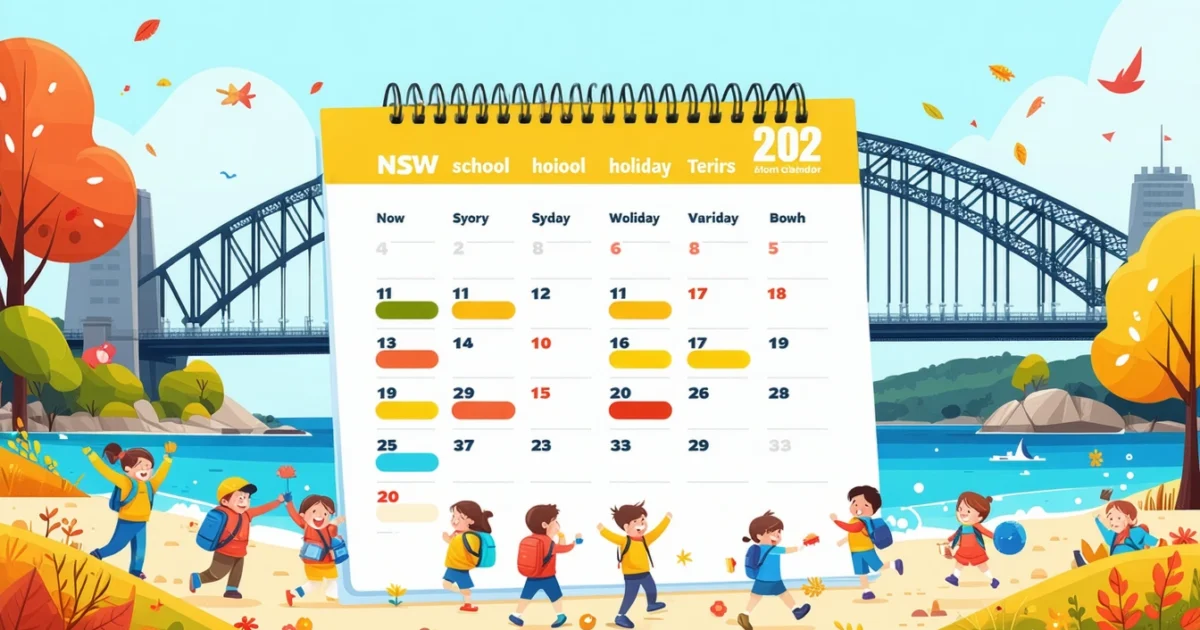
NSW school holidays 2026, straight from the NSW Department of Education’s own calendar, checked against its published CSV file rather than copied from another holidays website: Term 1 runs from Monday 2 February to Thursday 2 April (Western Division schools start a week later, on Monday 9 February). Term 2 is Wednesday 22 April to Friday 3 July. Term 3 is Tuesday 21 July to Friday 25 September. Term 4 is Tuesday 13 October to Thursday 17 December.
That sounds simple enough, except the Department also publishes a second, narrower set of dates it calls “school holidays” — and those don’t quite line up with the gap between terms, because they exclude the Easter public holidays and the school development days tacked onto either end. Below is every date, the difference between “no school” and “official holidays,” the Eastern/Western split, and where the two NSW school holiday pages elsewhere on this site fit in.
The short version
- Term 1: Mon 2 Feb – Thu 2 Apr 2026 (Eastern) · Mon 9 Feb – Thu 2 Apr (Western)
- Term 2: Wed 22 Apr – Fri 3 Jul 2026
- Term 3: Tue 21 Jul – Fri 25 Sep 2026
- Term 4: Tue 13 Oct – Thu 17 Dec 2026
- Department-labelled “school holidays”: Autumn 7–17 Apr · Winter 6–17 Jul · Spring 28 Sep–9 Oct · Summer 18 Dec 2026 – 27 Jan 2027 (Western: to 3 Feb 2027)
- ⚠️ Those “school holidays” dates are narrower than the actual break. Easter public holidays and school development days sit either side and aren’t included in the Department’s own holiday label — explained in full below.
- Source: education.nsw.gov.au/schooling/calendars/2026, page last updated 30 June 2026. Checked against the Department’s own CSV calendar file, not a secondary source.
- Catholic, independent and other non-government NSW schools set their own calendars and can differ by 1–2 weeks — see our separate Catholic school holidays guide.
NSW school terms 2026 — the full table
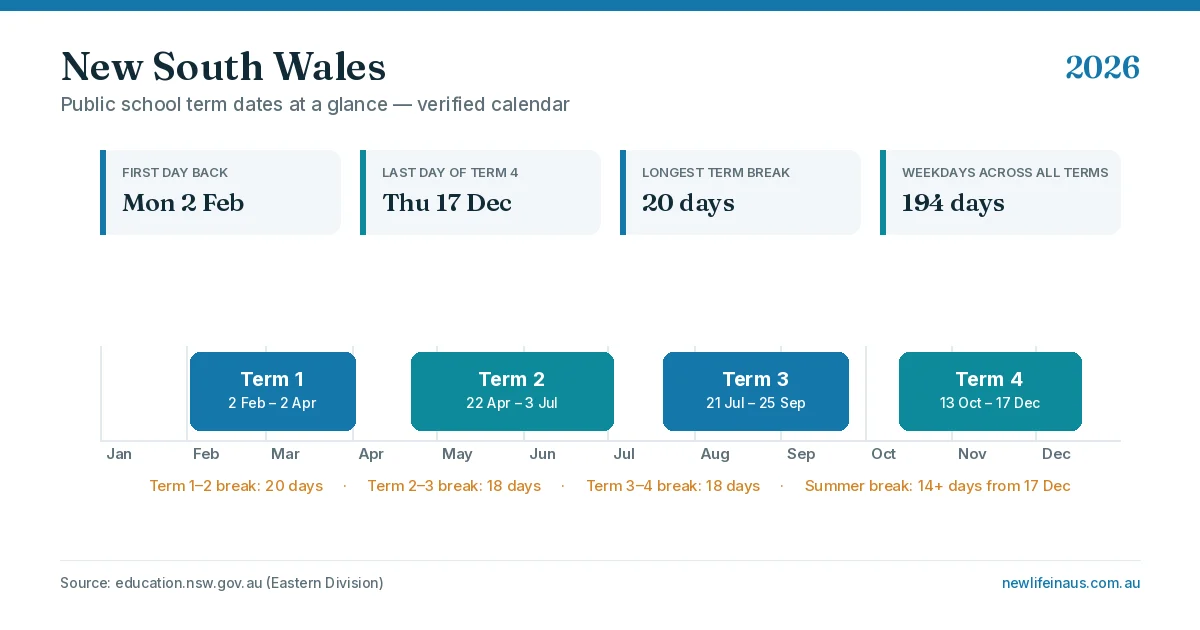
These are the first and last days students attend, for the Eastern Division — which is every NSW public school except the small group of far-west schools covered in the next section. Each term also carries the Department’s own week count, taken directly from its calendar file, which is a useful check if your school ever tells you something different.
| Term | First day | Last day | Span | Department week count |
|---|---|---|---|---|
| Term 1 | Monday 2 February | Thursday 2 April | 60 days | 10-week term (Week 1 is school development days only) |
| Term 2 | Wednesday 22 April | Friday 3 July | 73 days | 11-week term |
| Term 3 | Tuesday 21 July | Friday 25 September | 67 days | 10-week term |
| Term 4 | Tuesday 13 October | Thursday 17 December | 66 days | 10-week term |
“Span” above is the raw calendar-day count from first day to last day, including weekends inside the term — it is not a count of days your child is physically at school, since every Saturday and Sunday within a term is still a non-school day. The Department’s own week-count label (10-week or 11-week term) is the more useful figure if you want to compare term lengths.
Western Division: the later start
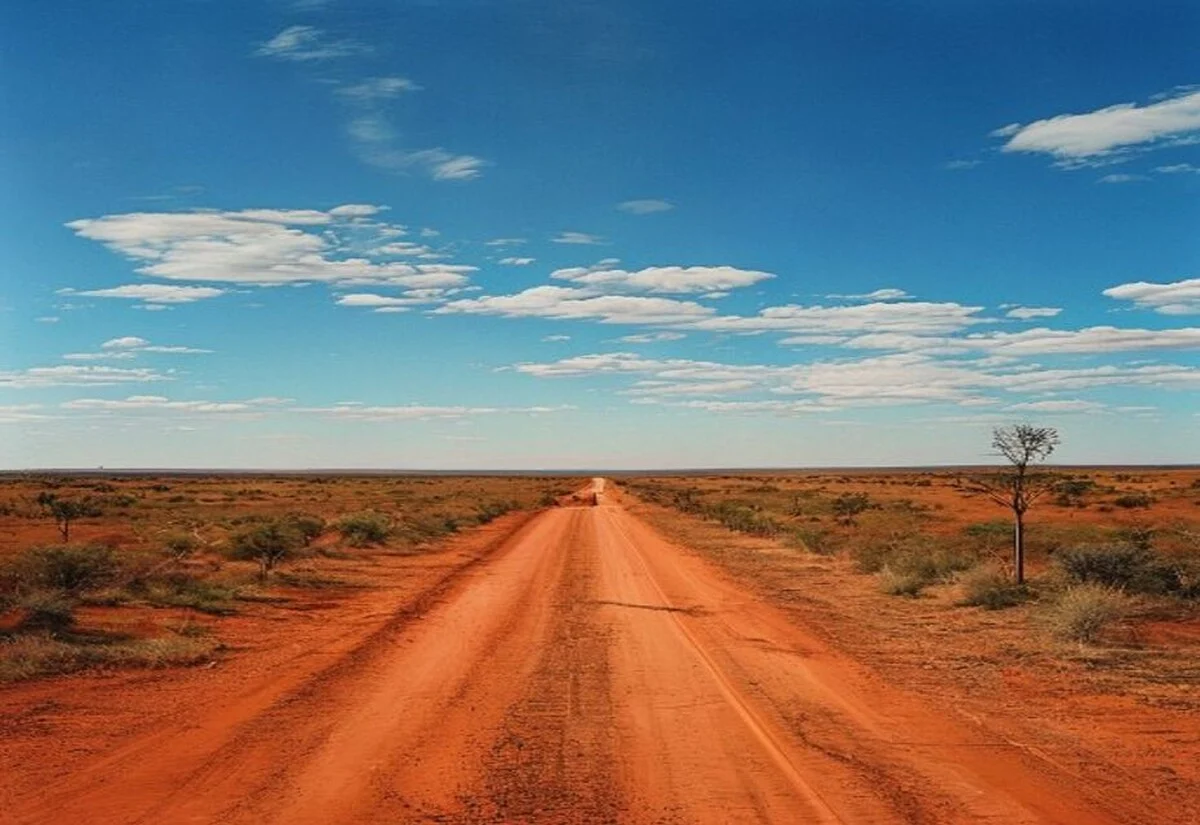
A small number of NSW public schools in the far west of the state — broadly, the region served by towns like Broken Hill — run on a separate calendar called the Western Division, sometimes referred to as “late start schools.” They get extra vacation days at the very start of each year, so Term 1 begins a week later than everywhere else in the state.
| Eastern Division | Western Division | |
|---|---|---|
| Term 1 starts | Monday 2 February | Monday 9 February |
| Term 1 school development days | Tue 27 – Fri 30 January | Tue 3 – Fri 6 February |
| Summer holidays 2025–26 end | Monday 26 January 2026 | Monday 2 February 2026 |
| Summer holidays 2026–27 end | Wednesday 27 January 2027 | Wednesday 3 February 2027 |
| Terms 2, 3 and 4 | Identical for both divisions | |
Everything else — Term 2 onward, every mid-year break, Term 4’s end date — is identical for both divisions. If you’re not sure which division your child’s school falls under, the Department’s guidance is straightforward: unless you’re enrolled at one of the specific far-west schools, you’re on the Eastern Division calendar used throughout the rest of this article. One more exception worth knowing about: a handful of schools right on the Victoria and Queensland borders run their own dates that differ from both divisions, “to reflect their local community,” so if you’re near Albury-Wodonga or the NSW/QLD border, check with the school directly rather than assuming either calendar applies.
The four holiday breaks, in detail
This is where most other calendars get muddled, because there are actually two different numbers for every break: the Department’s own “school holidays” label, and the full run of days your child is actually out of school once you count the public holidays and school development days sitting either side of it. Both are accurate; they’re just answering slightly different questions. We’ve given you both for every break below.
Autumn holidays (April)
The Department’s official “Autumn” school holidays run Tuesday 7 April to Friday 17 April — 11 days. But your child’s last day of Term 1 is Thursday 2 April, and Term 2 doesn’t start until Wednesday 22 April, so the actual run of non-school days is longer: 19 days, from Friday 3 April to Tuesday 21 April.
The gap is explained by two things stacking on either side of the official break. At the front: Good Friday falls on 3 April 2026, and Easter Monday on 6 April — both public holidays, not school holidays, so the Department doesn’t count them in the “school holidays” figure even though your child obviously isn’t at school on a public holiday either. At the back: two school development days, Monday 20 and Tuesday 21 April, are staff-only and sit right before students return on the Wednesday.
| Dates | What it is |
|---|---|
| Thu 2 April | Last day of Term 1 |
| Fri 3 April | Good Friday (public holiday) |
| Sat 4 – Sun 5 April | Weekend (Easter Sunday falls on the 5th) |
| Mon 6 April | Easter Monday (public holiday) |
| Tue 7 – Fri 17 April | Official “Autumn school holidays” |
| Sat 18 – Sun 19 April | Weekend |
| Mon 20 – Tue 21 April | School development days (staff only) |
| Wed 22 April | Term 2 begins |
Winter holidays (July)
Official “Winter school holidays”: Monday 6 July to Friday 17 July — 12 days. Term 2 finishes on Friday 3 July, and Term 3 starts on Tuesday 21 July, so the full run without school is 17 days: Saturday 4 July to Monday 20 July, with a single school development day on the Monday immediately before Term 3 begins.
This is the mid-winter break, and the shortest of the four — useful to know if you’re weighing it against Term 3’s spring break for a snow trip or an interstate visit, since Winter gives you less runway than Spring or Summer.
Spring holidays (September–October)
Official “Spring school holidays”: Monday 28 September to Friday 9 October — 12 days. Term 3 ends Friday 25 September and Term 4 starts Tuesday 13 October, so the full stretch is 17 days: Saturday 26 September to Monday 12 October, again with one school development day (Monday 12 October) right before term restarts.
Labour Day (5 October 2026, a Monday) falls inside this break, not on a school day, so it doesn’t add any extra time off — it’s already covered by the holiday period.
Summer holidays (December–January)
The big one. Term 4 finishes Thursday 17 December 2026, and the Department’s official “Summer school holidays” run Friday 18 December 2026 to Wednesday 27 January 2027 for Eastern Division — 41 days, covering Christmas, New Year, and the lead-up to Australia Day. Western Division schools get four extra days on the back end, through to Wednesday 3 February 2027, matching their later Term 1 start.
Unlike the other three breaks, the Department’s summer label and the actual last-day-of-school-to-first-day-of-school gap are close to the same thing here, because school development days for Term 1 2027 (see the FAQ below) run right up against when students return, rather than being tacked onto an already-published holiday block.
School development days: what they are, and why they're not "holidays"
Every term has at least one school development day (SDD) built in — sometimes called a pupil-free day or student-free day, though “school development day” is the Department’s own term. On these days, there are no timetabled lessons, so students do not attend, while staff take part in professional learning: analysing student data, mandatory compliance training, curriculum planning, and induction for teachers new to the school. The Department is explicit that the specific content of each SDD is decided locally, “by the principal in consultation with the school community.”
| Term | Dates |
|---|---|
| Term 1 | Eastern: Tue 27 – Fri 30 January · Western: Tue 3 – Fri 6 February |
| Term 2 | Mon 20 & Tue 21 April |
| Term 3 | Mon 20 July |
| Term 4 | Mon 12 October |
Why this matters for your calendar: SDDs are why “the day school gets back” and “the day the official holidays end” aren’t always the same date. They’re also why, if you’re relying on before-and-after-school care rather than the school itself, you still need cover on these days — most OSHC (Outside School Hours Care) providers run normal vacation-style care on SDDs, but it’s worth confirming with your provider rather than assuming.
One genuinely useful side detail: NSW school zone speed limits (40 km/h, 8–9:30am and 2:30–4pm) still apply on school development days, because they operate on all “notified school days” — which SDDs count as, even though no students are on site. If you drive past a school on an SDD assuming the zone is off because it’s “not a school day” for kids, that assumption is wrong and the fine still applies.
Catholic, independent and other non-government schools
Everything above applies to NSW public (government) schools. Catholic and independent schools are not bound by the Department of Education’s calendar — each diocese or independent school sets its own term dates, and while most stay close to the public school calendar, gaps of a week or more at either end of a term are common, particularly at Term 4 finishing dates and Term 1 starting dates. If your child is at a Catholic or independent school, the NSW Department’s calendar on this page is a reference point, not your school’s actual calendar.
We’ve written a full breakdown of how Catholic system dates typically compare, diocese by diocese, in our Catholic school holidays 2026 guide. If you’re in Newcastle specifically, our Newcastle school holidays guide folds in nearby Hunter-region council holiday programs too.
How NSW compares with other states
Every Australian state and territory sets its own school calendar independently — there is no national standard — so NSW’s term dates do not line up exactly with Victoria’s, Queensland’s, or anywhere else. The gap is usually one to two weeks at each term boundary, not a different structure altogether; every state still runs four terms with a long Term 4-to-Term 1 summer break. If you’re coordinating an interstate trip or have family split across state lines, check the specific state’s page rather than assuming NSW’s dates transfer: Victoria, Queensland, South Australia, Western Australia, Tasmania, and the ACT.
One practical NSW-specific wrinkle: families around Albury-Wodonga, split across the NSW/Victoria border, and schools near the NSW/Queensland border may follow a locally adjusted calendar rather than either state’s standard dates — the Department names this exception directly rather than leaving it to guesswork. If that’s your situation, the school’s own calendar overrides anything published at state level.
Public holidays around NSW school holidays in 2026
| Public holiday | 2026 date | Falls in |
|---|---|---|
| Good Friday | Friday 3 April | Just before the Autumn school holidays label starts |
| Easter Monday | Monday 6 April | Just before the Autumn school holidays label starts |
| Anzac Day | Saturday 25 April | Falls on a weekend during Term 2, week 1 — no day off school either way |
| King’s Birthday | Monday 8 June | Inside Term 2 (a rare public holiday that actually costs a school day) |
| Labour Day | Monday 5 October | Inside the Spring school holidays |
| Christmas Day / Boxing Day | Friday 25 / Saturday 26 December | Inside the Summer school holidays |
Worth flagging because it trips people up: Australia Day and Anzac Day are public holidays, not school holidays — they only reduce school time in years they land on a weekday during term. In 2026, Anzac Day falls on a Saturday, so it has no effect on the school calendar at all. King’s Birthday, on the other hand, lands on a Monday inside Term 2, so it genuinely is one instructional day fewer than the raw term dates would suggest.
Taking your child out of school during term time
This comes up constantly for migrant families with a trip home planned, or relatives visiting from overseas on a schedule that doesn’t bend around the NSW school calendar. NSW public schools have a formal process for this: the Application for Extended Leave – Travel, submitted to your child’s school.
- There is no minimum or maximum number of days set for how long you can apply for.
- The principal considers whether the travel is in the student’s best interests — educational, social and participation reasons should be specified on the application, along with the purpose of the trip.
- If approved, the school issues a Certificate of Extended Leave – Travel: you keep the original, and a copy goes on your child’s file.
- If the leave runs longer than one full school term, the Department requires the school to consider enrolling the student in Distance Education for the period away, so learning isn’t simply paused.
The practical takeaway: apply through the school before you book, don’t assume it’s automatic, and if the trip is genuinely long, ask about Distance Education options up front rather than after the fact. The full procedure sits in the Department’s student attendance policy.
Getting these dates into your phone or calendar app
Rather than re-typing dates from any website — including this one — the Department publishes a ready-made iCal file (.ics) and CSV file covering every term date, school development day and public holiday for 2026. Both import cleanly into Outlook, Google Calendar and Apple Calendar, and both are the same file the Department itself links from its own site — so if term dates ever get revised, re-downloading the file is the most reliable way to catch the change.
Planning around the breaks

A few things worth knowing before you book anything:
- Vacation care fills up. Most OSHC providers run dedicated vacation care programs across every break, including school development days, but places at popular centres go early — ask your regular before/after-school-care provider what they run over the break as soon as dates are confirmed, rather than the week before.
- The Child Care Subsidy applies to vacation care the same way it applies to regular OSHC, if your family is eligible — check your rate directly through Services Australia rather than trusting a flat daily figure quoted elsewhere, because it depends on your income and activity test.
- Term 4’s summer break is the one to book earliest for, simply because every other family in the state is trying to book the same window — the shorter Autumn, Winter and Spring breaks see less of a squeeze on accommodation and flights.
- Term 1’s Autumn break overlaps Easter, which is separately one of the busiest domestic travel weekends in the country regardless of school calendars — factor that in even though the school holiday label itself starts after Easter.
If you’re new to Australia and still finding your feet with school enrolment, OSHC and how the term system works day to day, our homepage indexes the rest of our settling-in guides.
A few practical picks for the school holidays
Whichever break you’re planning around, a few small purchases make family travel or a day trip easier.
As an Amazon Associate, newlifeinaus.com.au earns from qualifying purchases. Prices and availability change, so check the current price on Amazon before buying.
Kids Car Travel Activity Kit
Keeps younger kids entertained on the drive during any of NSW’s four term breaks.
Shop on Amazon AU →Kids Wireless Headphones
Handy for the Summer break road trip or a flight without a volume battle.
Shop on Amazon AU →Collapsible Cooler Bag
Packs flat the rest of the year, ready for a Sydney Harbour foreshore day out.
Shop on Amazon AU →Kids Sun Hat and UPF Rash Shirt Set
NSW’s Autumn and Spring breaks still bring strong sun, worth having on hand for any outdoor day.
Shop on Amazon AU →Portable Tablet Car Mount
Turns any car into a road-trip setup for the long Summer holiday stretch.
Shop on Amazon AU →Kids Travel Pillow and Blanket Set
Useful for the Summer break trip or an early school-development-day start.
Shop on Amazon AU →Frequently asked questions
You May Also Like

How to Become a Teacher in Victoria (2026): Full Guide to Qualifications, VIT Registration and Salary

The Four D’s: Dyslexia, Dysgraphia, Dyscalculia and Dyspraxia Explained (2026)