Healthy Breakfast Ideas (2026): 25 Fast, Cheap Australian Breakfasts

Breakfast is the meal where money leaks quietest. A coffee and something from a cafe five mornings a week is $150 to $200. The same five breakfasts made at home cost around $10 to $20. Nothing else in a weekly budget has that ratio.
This is twenty-five breakfasts sorted by how much time you actually have, from ninety seconds to make-ahead. All of them are cheap, all use ingredients from any Australian supermarket, and most need no cooking at all. There’s also an honest section on what the evidence does and doesn’t say about breakfast — because a lot of what you’ll read about it is overstated — and a plain explanation of the Australian breakfast things nobody tells new arrivals, starting with how much Vegemite to use.
The short version
- Home breakfast: $2 to $4 a person. Cafe breakfast with a coffee: $25 to $35. That’s the whole argument.
- Overnight oats are the highest-leverage habit here — three minutes on Sunday, five breakfasts done, about $1.05 each.
- Aim for protein. CSIRO suggests around 25g at breakfast. Two Weet-Bix with milk gives you 7–8g, so most people are well short.
- Don’t trust the Health Star Rating on cereal. It penalises total sugar, not added sugar — so a cereal that’s over 30% sugar can still carry four stars.
- The evidence on breakfast is weaker than you’ve been told. It clearly helps you hit nutrient targets. It does not reliably make adults lose weight.
- Vegemite is scraped, not spread. About a quarter teaspoon per slice, on buttered toast. This is the single most useful sentence in this article for a new arrival.
What breakfast actually does, honestly
Before the food, a short reality check — because breakfast is surrounded by claims that don’t survive contact with the research.
Well supported
Nutrient intake. People who eat breakfast are more likely to meet their daily fibre, folate, calcium, iron and B-vitamin targets. This is the strongest and least disputed benefit.Also solid: breakfast improves concentration and school performance in children, consistently across reviews.
Not supported
Breakfast for adult weight loss. A 2019 BMJ meta-analysis of randomised trials found the opposite of the popular claim — people assigned to eat breakfast ate more over the day, not less, and were very slightly heavier.The “breakfast eaters are slimmer” finding comes from observational studies, where breakfast eaters also tend to exercise more, smoke less and earn more.
So the honest position: eat breakfast because it makes it far easier to get the nutrition you need, and because it stops the 11am servo pie. If you genuinely aren’t hungry in the morning, the evidence does not say you must force it. Even Better Health Channel concedes that “good nutrition is not just about the number of meals you have each day”.
One more caution while we’re being careful with numbers. You’ll see it claimed that “almost half of Australians skip breakfast”. That figure comes from a survey commissioned by a hotel chain that was advertising its free breakfast. Treat it as marketing, not data.
The protein question
The one change that makes the biggest practical difference is getting some protein in. CSIRO recommends around 25g of protein at each main meal, and notes that the average Australian eats far less than that at breakfast. Protein’s short-term effect on fullness is well established — whether shifting protein to breakfast specifically produces long-term weight loss is a claim from a commercial diet program, so treat that part with more caution.
What 25g actually looks like, since the number is meaningless on its own:
- 3 eggs — about 19g, so add a slice of cheese or some yoghurt
- 200g Greek yoghurt plus 30g nuts — gets you there comfortably
- 2 Weet-Bix, milk, a boiled egg and a spoon of yoghurt — the cheapest route
- 2 Weet-Bix with milk alone — only 7–8g. Fine, but it won’t hold you to lunch
You don’t need to hit 25g every day. But if you’re hungry again at ten every morning, protein is almost always the missing piece — not willpower.
Breakfast in 2 minutes
No cooking, barely any assembly. For mornings when you’re already late.
| What | Cost | Notes |
|---|---|---|
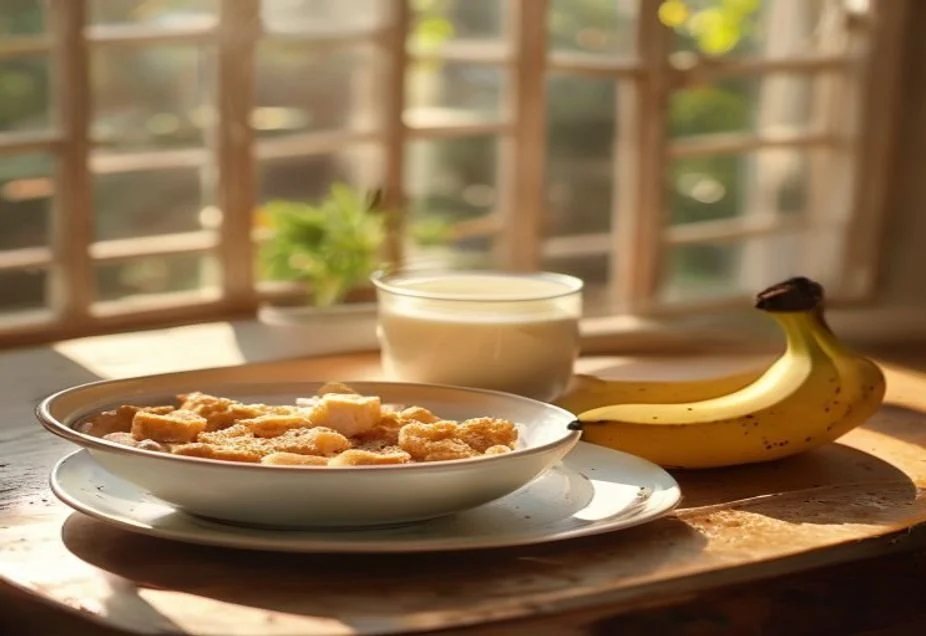
| Weet-Bix, milk, banana | $0.90 | Add the milk last — they turn to mush in about forty seconds |
| Greek yoghurt, oats, honey | $1.30 | Raw oats stirred into yoghurt is a real breakfast, not a compromise |
| Peanut butter on wholemeal toast | $0.70 | Two slices gets you about 12g of protein |
| Banana and a handful of nuts | $1.20 | The one you can eat walking to the bus |
| Cheese and Vegemite toast | $0.85 | Grill it. A genuine Australian institution |
| Overnight oats from the fridge | $1.05 | Made on Sunday. The best of all of these — see below |
Overnight oats: the one worth building a habit around
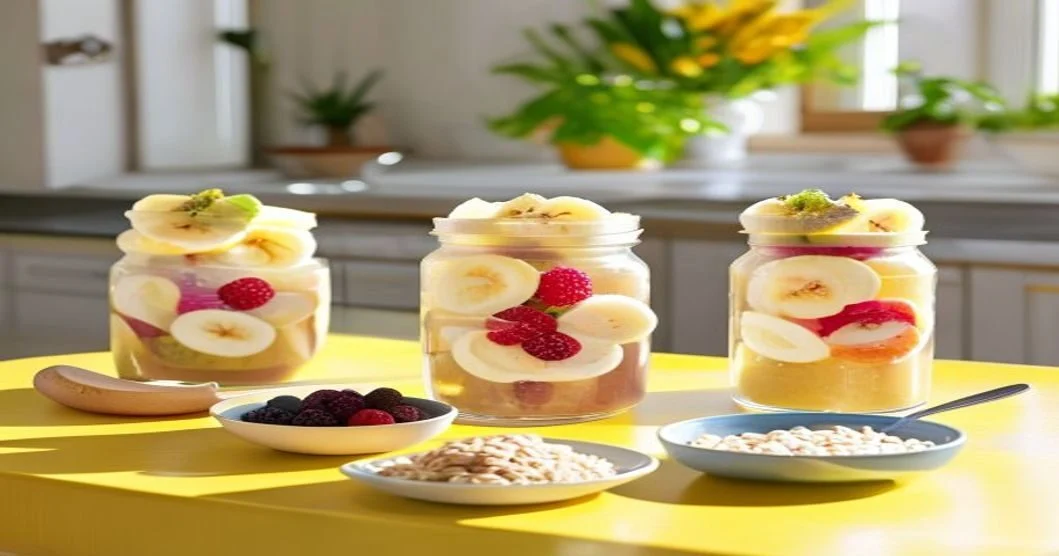
If you make one change after reading this, make it this one. Five jars on a Sunday night takes about ten minutes total and removes the breakfast decision from your entire week. They keep four to five days in the fridge, cost around a dollar each, and you eat them cold straight from the container.
The base, per serve: ½ cup (60g) rolled oats, ¾ cup milk or 150g yoghurt (or half each), a pinch of salt. Stir, lid on, fridge overnight. That’s it — there is no cooking and no soaking time to get right.
Peanut Butter & Banana
Add to the base
- 1 tbsp peanut butter
- ½ banana, sliced in at night
- Cinnamon
- The other ½ banana in the morning
Berry & Yoghurt
Add to the base
- Use 150g Greek yoghurt instead of milk
- ½ cup frozen mixed berries
- 1 tsp honey
Apple & Cinnamon
Add to the base
- ½ apple, grated
- 1 tsp cinnamon · pinch nutmeg
- 1 tbsp sultanas
Mango & Coconut
Add to the base
- ½ cup frozen mango pieces
- 2 tbsp coconut milk, rest milk
- 1 tbsp desiccated coconut
Chocolate & Date
Add to the base
- 1 tbsp cocoa powder
- 2 dates, chopped small
- 1 tsp peanut butter
The High-Protein One
Add to the base
- 150g Greek yoghurt and ¼ cup milk
- 1 tbsp chia seeds
- 1 tbsp peanut butter
- Fruit of choice
Breakfast in 5 to 10 minutes
Proper Porridge
Ingredients
- ½ cup (60g) rolled oats
- 1 cup milk or water
- Pinch of salt
- Banana, cinnamon, honey
Method
- Oats, liquid and salt in a deep bowl. The salt is not optional — unsalted porridge tastes like wet cardboard.
- Microwave 2 minutes, stir, then 30–60 seconds more. Use a bowl twice the size you think you need.
- Stir hard at the end — that’s what makes it creamy.
Scrambled Eggs on Toast
Ingredients
- 2 eggs · splash of milk
- 2 slices toast · butter
- Salt, pepper
Method
- Beat the eggs with a splash of milk and a pinch of salt.
- Low heat. Butter in the pan, eggs in, and stir slowly and constantly.
- Take them off while they still look slightly underdone — they keep cooking in the pan.
Avo Toast, Done Right
Ingredients
- ½ avocado
- 2 slices sourdough or wholemeal
- Lemon juice, salt, pepper, chilli flakes
- Optional: feta, a poached egg
Method
- Toast the bread properly — dark enough to stay crisp under the avocado.
- Mash the avocado with lemon juice and a real pinch of salt. That’s the difference between cafe avo toast and sad avo toast.
- Pile it on, crack pepper and chilli over.
Baked Beans on Toast
Ingredients
- ½ can baked beans
- 2 slices toast
- Grated cheese
- Chilli flakes or Worcestershire
Method
- Heat the beans in a pan or microwave.
- Toast, butter, beans on top, cheese over while hot.
Savoury Yoghurt Bowl
Ingredients
- 200g Greek yoghurt
- Cucumber, tomato, diced
- Olive oil, salt, dried mint or za’atar
- Toast or flatbread to dip
Method
- Yoghurt in a bowl, dressed with olive oil and salt.
- Chopped vegetables over the top, herbs scattered.
Freezer Breakfast Burritos
Ingredients (makes 8)
- 8 tortillas · 10 eggs, scrambled
- 1 can black or kidney beans
- 1 capsicum, 1 onion, cooked down
- 2 cups grated cheese
Method
- Scramble the eggs, cook the vegetables, drain the beans.
- Fill, roll tightly, wrap each in foil or baking paper, freeze.
- Microwave from frozen 90–120 seconds, or air fryer 8 minutes for a crisp one.
Australian breakfast, decoded
A few things here need explaining if you didn’t grow up with them.

Vegemite: scrape it, don’t spread it
This is the mistake almost every new arrival makes, and it’s why Vegemite has the reputation it has overseas. People treat it like Nutella or jam, put a thick layer on dry toast, and understandably hate it.
Vegemite is a concentrated yeast extract. Think stock cube, not chocolate spread. How to actually eat it:
- Hot toast. It needs the heat.
- Butter first, generously. This is not optional — the butter is the buffer between your tongue and the salt.
- About a quarter teaspoon per slice. Scraped so thin the butter underneath just goes light brown. If you can see a solid black layer, it’s several times too much.
Once you’re used to it, add sliced avocado, or melt cheese over it — a Vegemite and cheese toastie is a national institution. Nutritionally it’s a genuinely good source of B vitamins including folate, and a serve is only 5g. It is also very high in salt, which is the whole reason the quantity matters.
- Weet-Bix is Australia’s biggest-selling breakfast cereal, made here since 1928 and 97% wholegrain. Two biscuits is a standard serve. Add the milk immediately before eating — they collapse into paste within a minute, which locals will tell you is either the point or the problem depending on who you ask.
- The bacon and egg roll is the standard Australian takeaway breakfast, $12–$18 at a cafe and $8–$10 from a bakery or service station.
- “Smashed avo” is the cafe breakfast Australia became internationally known for. It’s $17–$26 in a capital city and about $2 at home.
- The “big breakfast” — eggs, bacon, sausage, mushrooms, tomato, toast — runs $24–$32 and is a weekend social ritual more than a meal.
- Coffee culture is serious here. A flat white is espresso with steamed milk; a long black is espresso with hot water. Ordering “a coffee” without specifying will get you a puzzled look.
The cereal aisle problem
Breakfast cereal is where the Health Star Rating is least reliable, and it’s worth knowing why before you shop by the stars.
The rating algorithm penalises total sugars rather than added sugars. CHOICE applied a strengthened algorithm proposed by The George Institute and found that Kellogg’s Nutri-Grain and Nestlé Milo Cereal, both currently rated 4 stars, would each lose 2.5 stars if added sugar were penalised properly. Nutri-Grain is more than 30% sugar and carries a four-star rating.
The system remains voluntary — uptake reached only 39% in Australia against a 70% target — and in February 2026 Food Ministers asked FSANZ to begin work on making it mandatory.
How to read a cereal box in ten seconds
- Ignore the stars. Read the “per 100g” column on the nutrition panel — not “per serve”, because manufacturers choose the serve size.
- Sugars under about 15g/100g is reasonable. Over 25g/100g is dessert.
- Fibre above 7g/100g is good.
- Sodium under about 400mg/100g.
- Check the first ingredient. Ingredients are listed by weight, so if sugar is second or third, that tells you most of what you need.
- Plain rolled oats, Weet-Bix and untoasted muesli all sit comfortably under those thresholds and are the cheapest options on the shelf anyway.
The coffee maths
This deserves its own section because it’s the single biggest number in the whole breakfast budget.
Commonwealth Bank reported in January 2026 that the average flat white has risen 30% since Covid, and now costs about $6.50 in Sydney and Perth and roughly fifty cents less in the other capitals. Oat milk, a large, or an extra shot adds $0.50 to $1.00 each.
| How | Per cup | Per week | Per year |
|---|---|---|---|
| Cafe flat white (Sydney or Perth) | $6.50 | ~$45 | ~$2,370 |
| Cafe flat white (other capitals) | $6.00 | ~$42 | ~$2,190 |
| Pod machine at home | ~$1.00 | ~$7 | ~$365 |
| Instant, or plunger with supermarket beans | ~$0.60 | ~$4 | ~$220 |
Finder’s analysis puts the saving from switching a daily takeaway coffee to a pod machine at about $914 a year, and to instant at about $1,105 a year.
The point is not that you should never buy coffee. Cafes are how a lot of people meet other people, which matters a great deal when you’re new to a country. The move is to make coffee a social thing two or three times a week rather than a caffeine delivery system five mornings a week. That single change is worth $1,500 a year and costs you nothing you actually valued.
For what it’s worth on the industry side: Australians spend around $8 billion a year on coffee across more than 27,000 cafes, and cafe profit margins have fallen from about 3.5% to 2.5%. Prices are unlikely to come back down.
Building the habit
- Decide the night before, not the morning of. Every good breakfast habit is really an evening habit — jars in the fridge, oats in the cupboard, bread in the freezer.
- Freeze the bread. A loaf lasts four days on the bench and two months in the freezer. Toast goes straight from frozen.
- Buy the biggest oats bag. 1.5kg is about $3 and covers 25 breakfasts. It does not go off.
- Boil six eggs on Sunday. They keep a week in the fridge in their shells and turn any breakfast into a protein one.
- Frozen fruit over fresh for breakfast specifically. It’s cheaper, it never goes off in the back of the fridge, and it thaws overnight in a jar.
- Keep one emergency breakfast — a tin of beans, a packet of oats — so that a bad week doesn’t turn into buying breakfast out for a fortnight.
- Don’t aim for seven out of seven. Five home breakfasts and two bought ones is a win worth about $1,500 a year against buying every day.
Breakfast is one line of a much bigger picture. Our guide to cheap healthy meals in Australia covers the cooking side properly — kit, staples, ten costed dinners and the food safety rules for batch cooking — and the full student budget breakdown shows where food sits against rent, transport and everything else.
If you only take one thing: make five jars of overnight oats this Sunday. Ten minutes, about five dollars, and breakfast is solved until Friday.
Frequently asked questions
You May Also Like

Moving to Australia: The Complete Checklist and Guide (2026)

NT Public Holidays 2026: Full Calendar, Dates and How Darwin and Alice Springs Celebrate