Cost of Living in Regional Cities vs Capital Cities for International Students


“Regional Australia is cheaper” is true, but it hides two different questions that get answered very differently depending on which one you’re actually asking. If you mean “will my rent be lower in Toowoomba than in Sydney,” the answer is yes, dramatically. If you mean “does my course count as regional for visa and migration purposes,” the answer follows a completely different, legally defined list that includes cities most people would never call regional — Perth, Adelaide, Newcastle and the Gold Coast among them. This guide separates the two questions properly, with real weekly numbers across specific cities rather than a vague “regional is cheaper” gesture, so you can work out what studying regionally actually means for your budget and your visa pathway.
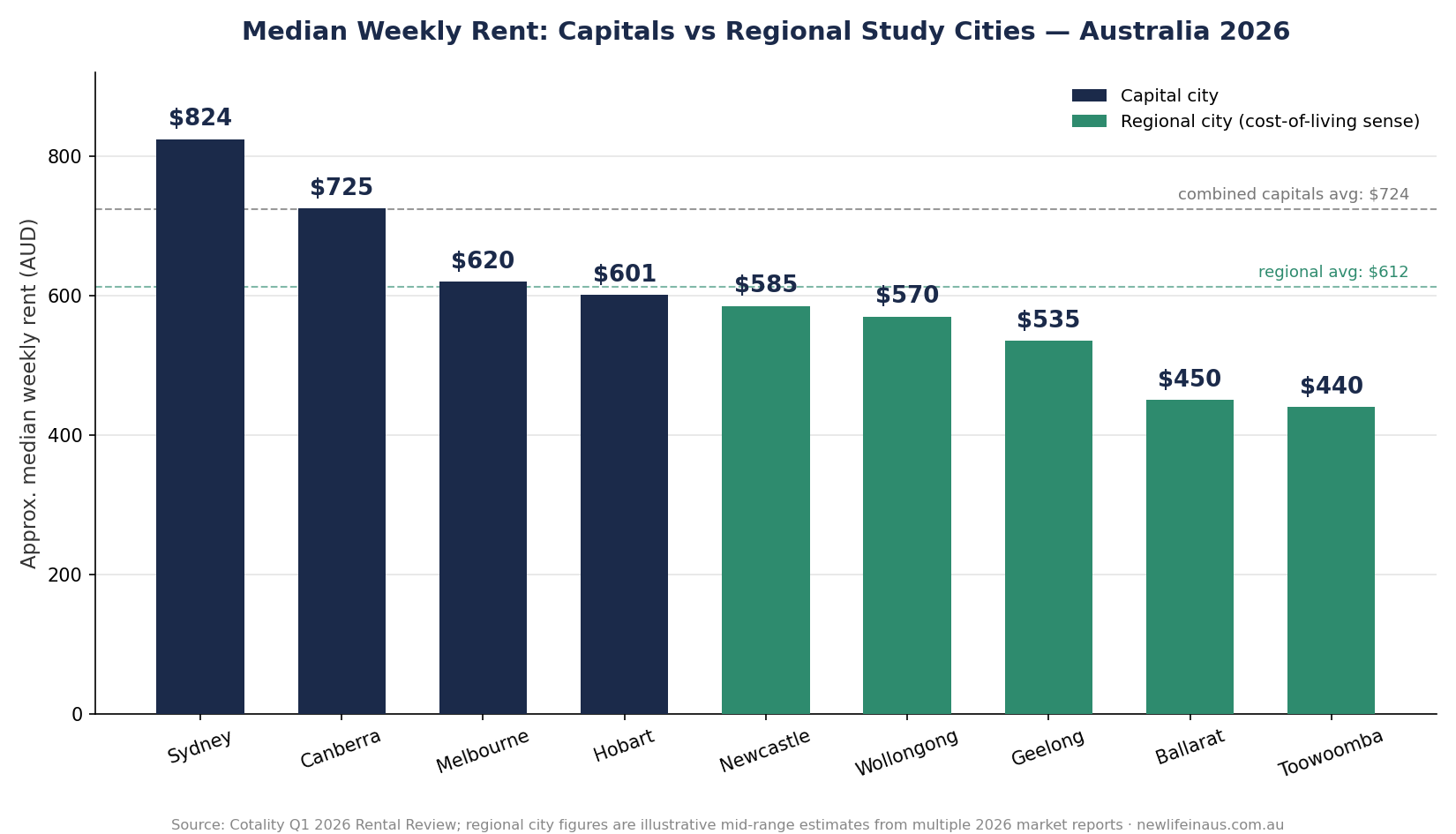
Quick facts: The combined capital cities’ median dwelling rent reached $724 per week as of Q1 2026, against a regional average of $612 per week — roughly 15% lower. But “regional” for migration and visa-extension purposes is a separate, legislated list that includes Perth, Adelaide, Hobart, Canberra, the Gold Coast, Newcastle and Wollongong, none of which are cheap or small. Source: Cotality Q1 2026 Rental Review; Department of Home Affairs designated regional area list. Checked August 2026.
Two different meanings of "regional" — and why mixing them up costs you money or a visa mistake

This is the single most common confusion in this whole topic, and it’s worth resolving before any numbers matter. There are two entirely separate definitions of “regional” in play, and guides that blend them together give genuinely misleading advice.
| Definition | What it actually means | Includes | Excludes |
|---|---|---|---|
| Everyday / cost-of-living “regional” | Smaller cities and towns with genuinely lower rent, smaller population, fewer big-city amenities | Newcastle, Wollongong, Geelong, Ballarat, Bendigo, Toowoomba, Cairns, Townsville, Launceston, and similar | All state and territory capitals |
| Migration / visa “Designated Regional Area” | A legislated list used for visa work-hour, points and post-study work purposes, defined by postcode | Everywhere in Australia except Sydney, Melbourne and Brisbane — which means Perth, Adelaide, Hobart, Canberra, Darwin, the Gold Coast, Newcastle and Wollongong all count as “regional” here | Only the Sydney, Melbourne and Brisbane metro areas |
In practice this means Perth and Adelaide — both large, well-resourced capital cities with international airports, major hospitals and full university campuses — are “regional” for visa purposes but not remotely regional in the everyday cost-of-living sense you’re probably picturing. The exact qualifying postcodes are set by legislative instrument and can change, and eligibility is genuinely postcode-specific rather than just city-wide — always verify your specific campus address against the current Department of Home Affairs designated regional area list rather than assuming based on the city name alone.
Rent: the real weekly numbers, city by city
Rent is the single biggest line item in almost every student’s budget, and it’s also where the regional-vs-capital gap is most dramatic. These figures are current median asking rents from Cotality’s Q1 2026 Rental Review and related 2026 market data — actual student sharehouse rooms are typically cheaper than a whole-dwelling median, but the relative gap between cities holds.
| City | Category | Approx. median weekly rent |
|---|---|---|
| Sydney | Capital | $824 |
| Canberra | Capital (regional for visa purposes) | $725 |
| Combined capitals average | — | $724 |
| Melbourne | Capital | ~$595–650 |
| Hobart | Capital (regional for visa purposes) — lowest of all capitals | $601 |
| Regional Australia average | — | $612 |
| Newcastle, NSW | Regional (cost-of-living sense) | ~$550–620 |
| Wollongong, NSW | Regional (cost-of-living sense) | ~$540–600 |
| Geelong, VIC | Regional (cost-of-living sense) | ~$500–570 |
| Toowoomba, QLD | Regional (cost-of-living sense) | ~$400–480 |
| Ballarat, VIC | Regional (cost-of-living sense) | ~$450 |
The pattern worth noticing: Newcastle and Wollongong, despite legally counting as “regional” for visa purposes, sit much closer to capital-city rent levels than a genuinely smaller centre like Toowoomba or Ballarat. If your priority is minimising rent specifically, chasing the visa-regional label alone can be misleading — you need the city-specific number, not just the regional classification. Independent estimates put Newcastle at roughly 30–40% cheaper than Sydney and Geelong at roughly 30–40% cheaper than Melbourne overall, but Wollongong and Newcastle rent levels are noticeably higher than smaller inland regional centres like Toowoomba or Ballarat specifically because of their coastal location and proximity to Sydney/Melbourne commuter demand.
Groceries, transport and everyday costs: a smaller gap than most people expect
This is where the “regional is cheaper” narrative gets more nuanced, and it’s worth being precise rather than repeating the general assumption. For groceries specifically, the gap between major cities is typically only 5–15%, and regional areas are only slightly cheaper on average — the savings rarely exceed $20 to $30 per week compared to a capital city. That’s real money over a year, but it’s a much smaller effect than the rent difference. Genuinely remote and very isolated areas are actually the exception in the other direction: distance and supply chain costs can push grocery prices 21% to 62% higher than in a capital, so “regional” does not uniformly mean “cheaper” once you’re talking about small remote towns rather than a mid-sized regional city.
| Cost category | Capital city | Regional city (Newcastle/Geelong-type) | Notes |
|---|---|---|---|
| Weekly groceries (single person) | ~$110–140 | ~$95–125 | 5–15% lower on average, not dramatically different |
| Public transport weekly pass | ~$50–65 (Opal/Myki-style capped weekly) | Often cheaper flat-fare systems, but far less frequent service | Regional centres commonly have longer wait times and fewer late-night services |
| OSHC (mandatory health cover) | Same national pricing | Same national pricing | OSHC costs roughly $623–$806/year for a single student regardless of where in Australia you live — location does not change this cost |
| Mobile/internet plans | National pricing, no city premium | National pricing, but regional mobile coverage can be patchier outside town centres | Check coverage maps for your specific campus, not just the city name |
Part-time job availability and pay: the trade-off that offsets some of the rent savings
This is the part of the comparison that pure cost-of-living calculators tend to miss, and it matters just as much as rent for most students who rely on part-time income. Major cities consistently offer more part-time job opportunities than regional areas — a larger hospitality, retail and logistics sector simply means more open shifts, more employers to apply to, and more flexibility to find hours that fit your class timetable. Award minimum pay rates themselves are set nationally and don’t vary by city (the same Fast Food or Retail Award minimums apply whether you’re in Sydney or Toowoomba), so the gap isn’t about the hourly rate — it’s about how many hours you can realistically get rostered, and how quickly you can find a second job if your first one falls through.
Practically, this means a regional cost-of-living saving on rent can be partly or fully offset if you can’t secure enough part-time hours to cover the rest of your budget. Before committing to a regional campus specifically to save money, it’s worth researching the actual local job market — vacancy rates on major job boards filtered to that specific city, and if possible, asking current international students at that campus (via the university’s international student association) how realistic part-time work actually is there, rather than assuming lower rent automatically means a better financial position overall.
The migration and visa incentives of studying in a designated regional area

This is where the visa-specific definition of “regional” becomes genuinely valuable, separate from any cost-of-living argument. Graduating from a designated regional area campus can unlock real, tangible advantages in the points-tested permanent residency system:
- Extra Temporary Graduate (subclass 485) visa duration. The base 485 visa grants 2 years for a bachelor’s or master’s-by-coursework degree, 3 years for a master’s-by-research, and 4 years for a doctorate — but studying in a designated regional area can add 1 to 2 extra years through the Second Post-Higher Education Work stream, subject to eligibility rules.
- Bonus points in the skilled migration points test. Regional study and regional work can add 5 to 15 additional points, which matters directly in a competitive points-tested system where a handful of points is often the difference between an invitation and a miss.
- Access to the Subclass 491 regional visa pathway. This points-tested visa, nominated by a state/territory or a family sponsor, lets skilled workers live and work in a designated regional area for up to 5 years, with a defined pathway to permanent residency via the Subclass 191 visa after meeting residence and income requirements.
Remember: because Perth, Adelaide, Hobart, Canberra, the Gold Coast, Newcastle and Wollongong all count as “designated regional” for this purpose, you can access these migration advantages while still studying in a genuinely large city with full amenities, established international student communities, and — in Perth and Adelaide’s case — a significantly lower cost of living than Sydney or Melbourne even though they’re major capitals. This is arguably the strongest practical argument for choosing one of these cities specifically: capital-city infrastructure and job markets, combined with regional migration benefits.
A full worked comparison: two realistic student budgets

Numbers mean more side by side. Here’s an illustrative weekly budget comparison for a single international student sharing accommodation, working close to the 48-hour fortnightly cap, in Sydney versus Newcastle — chosen because Newcastle is close enough to Sydney to make the comparison realistic (same state, similar climate, well-connected by train) while being genuinely cheaper across nearly every category.
| Weekly cost category | Sydney (capital) | Newcastle (regional) |
|---|---|---|
| Shared rent (single room) | ~$320–420 | ~$220–280 |
| Groceries | ~$120 | ~$105 |
| Public transport | ~$50 (Opal weekly cap) | ~$40 |
| Phone/internet | ~$25 | ~$25 |
| OSHC (weekly equivalent) | ~$13–15 | ~$13–15 |
| Miscellaneous/social | ~$60 | ~$45 |
| Approx. weekly total | ~$588–690 | ~$448–510 |
That’s a difference of roughly $140 to $180 per week — well over $500 per month — purely from the city choice, before even accounting for the part-time job availability trade-off discussed above. Over a full academic year, that gap is substantial enough to change what’s financially realistic for a lot of students, which is exactly why this decision deserves real numbers rather than a general impression.
Snapshot profiles of the most common regional study cities

Rather than treating “regional” as one homogeneous option, here’s a closer look at the specific cities international students most commonly consider, since they differ meaningfully from each other.
Newcastle and Wollongong, NSW
Both are coastal cities roughly 1.5 to 2 hours from Sydney by train, home to major University of Newcastle and University of Wollongong campuses respectively. They offer the closest thing to “capital city amenities at a discount” — real nightlife, beaches, established retail precincts and reasonably frequent train links back to Sydney — while still costing meaningfully less than Sydney itself. Both count as designated regional for visa purposes despite being substantial cities in their own right.
Geelong and Ballarat, Victoria
Geelong, about an hour from Melbourne, hosts a Deakin University campus and has grown rapidly as a genuinely liveable mid-sized city with its own waterfront and retail centre. Ballarat, further inland, is smaller and noticeably cheaper again — among the most affordable rental markets of the commonly chosen regional Victorian cities — home to Federation University, with a distinct heritage-town character rather than Geelong’s coastal-city feel.
Toowoomba, Cairns and Townsville, Queensland
Toowoomba, about 90 minutes inland from Brisbane, offers some of the lowest rent of any commonly chosen study city in this guide, home to the University of Southern Queensland. Cairns and Townsville, both in tropical North Queensland with James Cook University campuses, offer a genuinely different climate and lifestyle — hot, humid, close to the Great Barrier Reef — at the trade-off of being considerably further from the Sydney-Melbourne-Brisbane population centre and, in Cairns’ case specifically, a smaller overall job market.
Perth and Adelaide — the "large city, regional visa status" option
Worth repeating because it’s the most commonly missed opportunity in this whole comparison: Perth and Adelaide are both major capital cities with full international airports, large hospitals, multiple universities and established multicultural communities — and both count as designated regional for visa and migration purposes. Adelaide in particular consistently ranks as one of the more affordable Australian capitals for food and overall living costs. For students who want real regional migration advantages without the trade-offs of an actually small town, these two cities are the strongest combination on the table.
Healthcare access: a genuine trade-off worth planning for
Capital cities host Australia’s largest tertiary hospitals and the widest range of specialist medical services, generally with shorter travel distances to reach them. Regional centres typically have solid general hospital and GP access for everyday healthcare needs, but for specialist treatment, some regional patients are referred to a capital-city hospital, which can mean travel time and cost on top of any medical cost itself. This is a manageable trade-off for the overwhelming majority of healthy students most of the time, but it’s genuinely worth factoring in if you have an ongoing health condition that requires specialist or regular monitoring — check what’s actually available locally at your specific regional city before assuming equivalent access to a capital city.
The hidden costs of the regional choice that budgets often miss
- Travel costs back to a capital city for flights home. If you fly internationally, you’ll likely still need to reach a major airport — factor in the domestic leg or coach/train cost from a regional city to Sydney, Melbourne, Brisbane or Perth for international connections.
- Fewer competing retailers can mean less price competition on some goods and services in smaller regional centres, partially offsetting the rent savings on non-grocery spending.
- Relocation cost if you change your mind. Moving cities mid-course is disruptive and costly — bond, removalist or freight costs, and potentially lost sharehouse bond — so treat the initial choice as a meaningfully sticky one rather than easily reversible.
- Car dependency in some regional centres. A few regional cities have genuinely limited public transport outside peak hours, which can push students toward buying a car — with registration, insurance and fuel costs that a well-connected capital-city student on public transport avoids entirely.
University and course availability
Capital cities host the largest number of universities and the widest breadth of course offerings, including highly specialised postgraduate and research programs that may only be offered at one or two institutions nationally, most of them in Sydney, Melbourne or Brisbane. Regional and outer-metro campuses (including regional campuses of major universities, which are increasingly common) tend to offer a narrower but often more focused course range, sometimes with smaller class sizes and more direct access to teaching staff as a genuine trade-off benefit rather than just a compromise. If your specific course, specialisation or research supervisor is only available at one institution, that constraint should generally take priority over the cost comparison — a cheaper city doesn’t help if it doesn’t offer the degree you actually need.
Community, culture and everyday support networks
This is a genuinely practical consideration, not just a lifestyle preference. Capital cities have larger, more established international and multicultural communities, which in practice means easier access to home-country groceries and restaurants, larger and more numerous religious facilities, and bigger cultural and diaspora community networks. For Muslim students specifically, halal food and mosque access is significantly more established and geographically spread across Sydney, Melbourne, Brisbane, Perth and Adelaide than in most smaller regional centres — see our full guide to halal food across Australia for a city-by-city breakdown of what’s actually available. Smaller regional cities can and do have real communities too, but they’re typically smaller, more geographically concentrated, and slower to expand — worth researching specifically for your city rather than assuming, since this genuinely affects day-to-day quality of life beyond the raw cost numbers.
Regional scholarships: what's actually still available
You may see the federal Destination Australia scholarship — previously worth up to $15,000 a year toward tuition and living costs at a regional campus — referenced on university and third-party websites. Be aware this program is no longer accepting new applicants: as part of the 2024–2025 Federal Budget, the Australian Government confirmed there would be no further funding rounds from 1 July 2024, though students who were already receiving it continue to be supported for the remainder of their course. If you see a website advertising it as currently open, that’s outdated information rather than a live opportunity. What’s still genuinely available is university-specific regional scholarships and bursaries — several universities, including Western Sydney University and various Western Australian institutions, offer their own regional achievement awards and partial tuition-fee scholarships worth anywhere from $3,000 to $15,000 or more, funded directly by the institution rather than the discontinued federal program. Check the specific scholarships page of any regional campus you’re considering directly, since these change yearly and vary significantly by university.
Which choice actually fits your situation
There’s no single right answer, but a few honest questions narrow it down quickly:
- Is your specific course or specialisation only offered at a particular institution? If yes, that generally overrides the cost comparison.
- Do you need to work substantial part-time hours to fund your studies? If yes, weigh the local job market seriously, not just the rent — a genuinely large regional-for-visa-purposes city like Perth or Adelaide may offer the best of both: lower cost than Sydney/Melbourne, and a genuinely large job market.
- Is post-study migration a firm part of your plan? If yes, the extra 485 duration and points from a designated regional area are worth real money and time — factor this in even if the city itself (like Perth or Adelaide) isn’t dramatically cheaper.
- How important is an established cultural or religious community day to day? If very important, weight this alongside the raw numbers rather than treating cost as the only variable.
- Are you comfortable with less frequent public transport and fewer late-night services? Genuinely smaller regional centres save money but usually require more planning around transport, particularly at night.
For a broader pros-and-cons discussion of the regional study decision beyond just the cost numbers, see our companion guide, studying in regional Australia to save money: pros and cons. If you’ve already chosen a specific city, our dedicated guides to living in Perth, the cost of living in Perth, and living in Wollongong near UOW go deeper on those specific cities.
Bottom line
Rent is where the real regional savings live — a genuine 15 to 40% gap depending on which city you’re comparing, worth $500 or more a month in some comparisons. Groceries and everyday costs move much less than people assume, only 5 to 15% in most cases. And the “regional” label for visa and migration purposes is a completely different, legislated list that includes major capitals like Perth and Adelaide — meaning you can potentially access real post-study visa and points advantages without moving to a small town at all. Work out which definition of “regional” actually matters for your situation before deciding, and use the specific city numbers above rather than the general assumption.
You May Also Like

How to Become a Hairdresser in Australia (2026): Certificate III, TAFE Costs and Visa Pathway for International Students

Studying Accounting in Australia: Courses, Costs and Career Path