International Groceries and Restaurants in Brisbane: Where to Find Them

“Certain suburbs with international communities” is not an answer – it is a placeholder for one. Brisbane has specific, named precincts for this, and knowing them saves you a lot of wandering around guessing. This guide names the actual shopping centres, grocers, butchers and restaurants, tells you which suburb to go to for which cuisine, what it costs relative to Coles and Woolworths, and how to get there without a car.
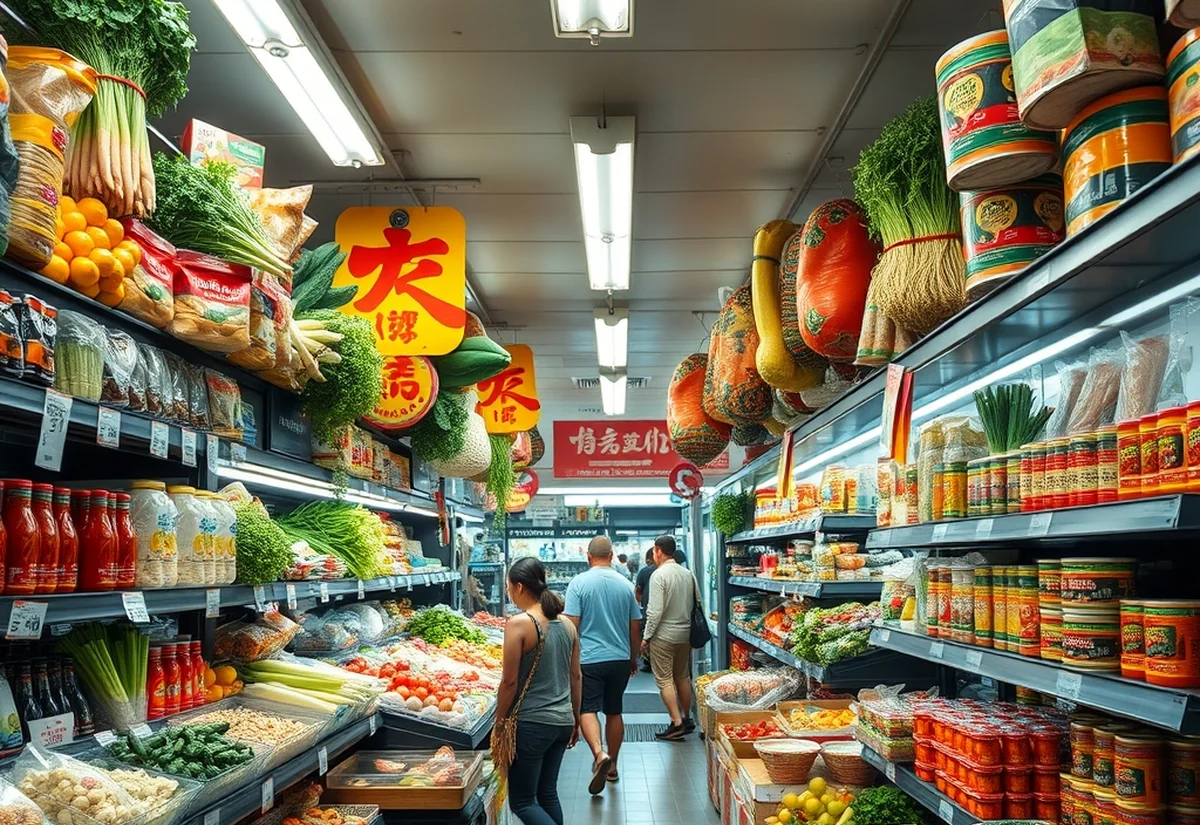
Brisbane’s international food geography is not evenly spread across the city. It clusters hard around a handful of suburbs, mostly south and southwest of the CBD, each shaped by a specific migration history. Sunnybank became Brisbane’s “Little Asia” through Taiwanese, Hong Kong and mainland Chinese settlement from the 1980s onward. Inala and Darra carry one of Australia’s oldest Vietnamese communities, dating to resettlement after 1975. Woolloongabba, Greenslopes and Logan Road corridor carry a dense strip of Indian and Sri Lankan grocers. Zillmere, in the north, has its own smaller Indian and African precincts. Knowing which cluster to target for which cuisine is the single biggest time-saver in this guide.
Sunnybank and Sunnybank Hills: Brisbane's biggest Asian food precinct
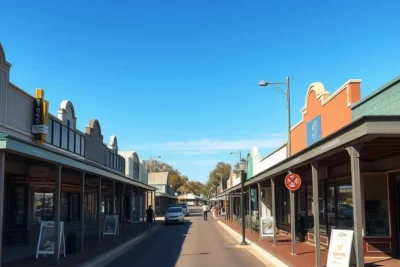
Sunnybank, about 13km south of the CBD on the Beenleigh rail line, is the precinct most people mean when they say “go to Sunnybank for Asian food.” Three shopping centres converge on the corners of Mains Road and McCullough Street: Sunnybank Plaza, Market Square and Sunny Park. Between them and the surrounding strip malls, this is the densest concentration of East and Southeast Asian grocers and restaurants in Queensland.
Grocers to know in Sunnybank
- Formosa Supermarket – a modern, well-lit Asian grocer stocking hard-to-find greens, pastes, sauces, noodles and frozen goods across Chinese, Taiwanese, Japanese and Korean categories.
- Yuen’s Market – a larger, denser store known for a huge range at competitive prices, including fresh seafood and butchered meat cuts not found in mainstream supermarkets.
- Multiple smaller grocers and bakeries scattered through Sunnybank Plaza and Market Square, each specialising in a narrower category (Taiwanese snacks, Japanese goods, Korean banchan and instant foods).
Restaurants to know in Sunnybank
The Sunnybank Market Square dining strip in particular has become known for genuinely regional Chinese cooking rather than the generalised “Chinese restaurant” menu found elsewhere. Names worth knowing:
| Restaurant | Cuisine focus | What it’s known for |
|---|---|---|
| Chengdu Taste | Sichuan | Authentic Sichuan heat and numbing spice, a genuine newcomer standout in the Market Square strip |
| Golden Lane | Cantonese / Hong Kong | Long-running mainstay of Brisbane’s Chinese dining scene, classic Hong Kong-style dishes |
| Ya Hoo Malaysian | Malaysian | Laksa, char kway teow and other hawker-style Malaysian staples |
| Lily’s Kitchen | Chinese | Consistently well-reviewed for food quality and fast, reliable delivery |
| Chinese Garden Restaurant | Cantonese | Established local favourite, broad menu |
| Parkland Restaurant | Chinese / yum cha | A go-to for yum cha and banquet-style dining |
If you’re new to the area, the honest advice is to walk the Market Square strip at dinner time and follow the queues – Sunnybank locals are not shy about walking past a mediocre restaurant for a genuinely good one two doors down.
Inala and Darra: Brisbane's Vietnamese heartland
Inala, roughly 16km southwest of the CBD, and neighbouring Darra hold one of Australia’s longest-established Vietnamese communities, tracing back to resettlement after 1975. This is not a curated, Instagram-friendly precinct – it’s a genuinely lived-in one, and the food reflects that: cheaper, more traditional, and less adapted for non-Vietnamese palates than what you’ll find in inner-city Vietnamese restaurants.
Grocers in Inala and Darra
- Inala Plaza Shopping Centre (Inala Avenue) – a shopping centre built around Vietnamese and broader Southeast Asian grocers, offering produce and packaged goods not stocked in standard supermarkets.
- Railway Parade, Darra – a smaller strip with several Vietnamese-run grocers, good for fresh herbs, rice paper, and Vietnamese sauces and condiments.
Restaurants in Inala and Darra
| Restaurant | Suburb | What it’s known for |
|---|---|---|
| Tan Thanh | Inala | Widely rated among Brisbane’s best pho; open from 8am for a real Vietnamese breakfast; also known for banh mi |
| Pho An Skylark | Inala | Traditional noodle shop known for house-made iced coffee and herbal drinks alongside pho |
| Van Vietnamese Restaurant | Darra | Generous, reasonably priced portions – pho, crispy chicken with rice, grilled pork, pad thai |
If you can only make one trip to this part of Brisbane, breakfast pho at Tan Thanh followed by a walk through Inala Plaza for grocery shopping is the efficient version of the full experience.
Woolloongabba, Greenslopes and the Logan Road corridor: Indian, Sri Lankan and Middle Eastern
Unlike Sunnybank and Inala, this precinct is close to the CBD – Woolloongabba is about 2km out, right next to the Gabba stadium, and well served by the South East Busway. Logan Road running south through Greenslopes, Upper Mount Gravatt and on to Underwood carries a long, informal strip of Indian, Sri Lankan and Middle Eastern grocers and eateries.
Indian and Sri Lankan grocers
- Mirchh Masala Impex – 3/110 Logan Road, corner of Lotus Street, Woolloongabba. Open every day of the year, 9:30am–9:00pm. Known for fresh Indian vegetables including mooli, turiya, methi, coriander and loki, with fresh stock arriving Sundays.
- All India Food – 31 Balaclava Street, Woolloongabba.
- Kairali Stores – Shop 10, 357 Logan Road, Greenslopes – a good stop for South Indian and Kerala-specific groceries.
- Asia Mart and Afshar Market – both in the Woolloongabba grocery strip, covering broader South Asian and Persian/Middle Eastern staples respectively.
Middle Eastern and halal groceries further along Logan Road
- Mabrouk & Sons Halal Meat – Underwood Marketplace, 3215 Logan Road, Underwood. Family-owned for over 20 years, sells quality halal cuts alongside Middle Eastern grocery staples.
- Watany Manoushi Lebanese Foods – Palmdale Shopping Centre, Logan Road, Upper Mount Gravatt (opposite Westfield Mt Gravatt). A halal Lebanese bakery, cafe and grocery store with dine-in and takeaway.
- Continental Halal Meats – a dedicated halal butcher and wholesale meat supplier serving the wider Brisbane area.
This corridor is worth understanding as a single continuous strip rather than isolated shops: if you’re travelling down Logan Road from Woolloongabba toward Underwood, you pass through Indian, Sri Lankan, Persian and Lebanese grocers within about a 20-minute drive, with the mix shifting gradually as you go south.
Zillmere: the north side's smaller international precinct
Most of Brisbane’s international food precincts sit south of the river, which is inconvenient if you live or study on the north side. Zillmere, about 13km north of the CBD on the Shorncliffe line, is the exception worth knowing about.
- Zillmere Indian Grocery Fruit & Veg – 2/413 Zillmere Road, Zillmere – the main Indian grocery anchor for the north side.
- Several African grocers serve the broader Brisbane area with delivery, including Afromart (described as one of Australia’s largest African grocery retailers, in-store and online) and The Jerky Hut, which specialises in South African products including biltong and droëwors.
If you live north of the river and the Sunnybank or Woolloongabba trip is impractical for a weekly shop, Zillmere plus the delivery-capable African grocers cover a reasonable baseline – though the range will not match the south-side precincts for depth.
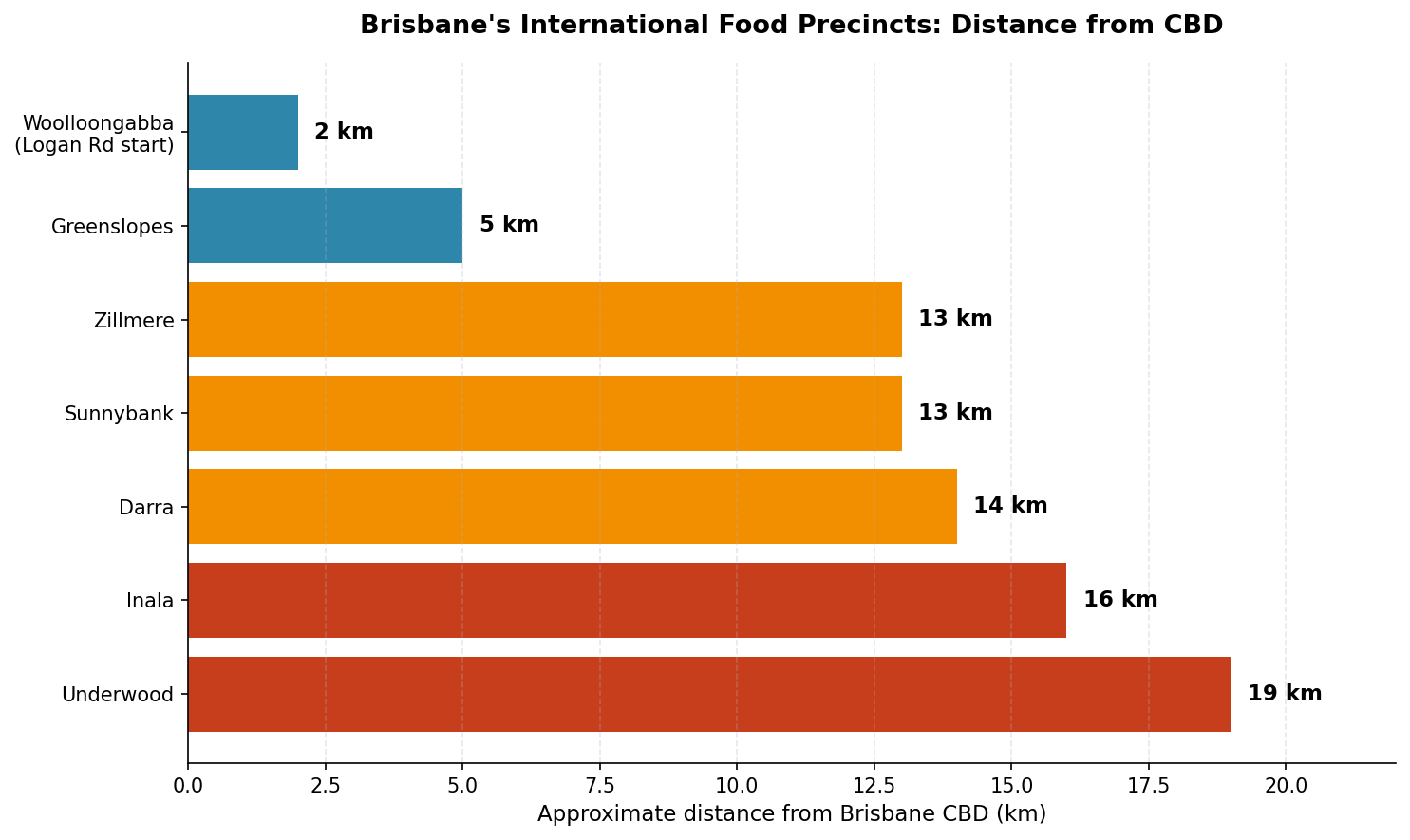
How far is each precinct from the CBD?
Distance shapes how realistic a regular grocery run actually is, especially without a car. Here’s how the main precincts stack up against the CBD, roughly ordered by proximity.
Getting there without a car
All four precincts are reachable by public transport, though with very different levels of convenience.
| Precinct | Nearest train station | Notes |
|---|---|---|
| Sunnybank / Sunnybank Hills | Sunnybank station (Beenleigh line) | Ground-level station on Dixon Street with an island platform, over 200 car parking bays, and a footbridge with lifts – a short, flat walk from the station to Sunnybank Plaza and Market Square. |
| Inala / Darra | Darra station (Ipswich/Rosewood line) | Darra station serves the Railway Parade grocery strip directly; getting from there to Inala Plaza requires a short bus or rideshare leg, as Inala itself is not on the rail network. |
| Woolloongabba / Logan Road corridor | Buranda station or South East Busway (Woolloongabba busway station) | Closest precinct to the CBD by far; the South East Busway runs frequent services and puts the Woolloongabba grocery strip within a short ride of the city. |
| Zillmere | Zillmere station (Shorncliffe line) | Station sits close to the Zillmere Road shopping strip, a short walk from the platform. |
The Sunnybank and Zillmere precincts are the most transit-friendly, since the shops sit close to the station. Inala requires an extra bus or rideshare leg because it isn’t directly on a rail line, which is worth factoring in if you’re planning a big grocery haul and don’t want to carry it far.
Are ethnic grocers actually cheaper than Coles and Woolworths?
For the specific categories they specialise in, generally yes – and often by a wide margin, because these stores buy in bulk from wholesale importers and don’t carry the overhead of a mainstream supermarket’s broader product range. The pattern that holds consistently across Sunnybank, Inala and the Woolloongabba corridor:
| Category | Typical pattern at ethnic grocers | Typical pattern at Coles/Woolworths |
|---|---|---|
| Rice (bulk bags, 10–25kg) | Meaningfully cheaper per kilogram; far wider range of Asian, Indian and Middle Eastern rice varieties | Smaller pack sizes, higher per-kilogram cost, limited variety |
| Fresh Asian and South Asian vegetables (bok choy, gai lan, methi, mooli, curry leaves) | Cheaper and fresher, often restocked multiple times a week; varieties simply not stocked at all in mainstream supermarkets | Limited selection, often wilted by the time it reaches shelves, higher price for what is available |
| Spices and dried goods (bulk, unbranded or house-brand) | Substantially cheaper than small branded jars, especially buying in bulk | Small jars carry a large per-gram premium |
| Halal and specialty cuts of meat | Butcher-direct pricing and cuts not available pre-packaged elsewhere | Limited halal-certified range, standard cuts only |
| Packaged staple goods (noodles, sauces, snacks) | Cheaper on imported staples due to direct wholesale relationships | Convenient but carries retail markup on imported lines |
| Everyday Western staples (dairy, bread, cleaning products) | Not usually the point of these stores – range is thin | Cheaper and more convenient for these categories, especially with loyalty pricing |
The practical strategy most international students and long-term residents settle on is a hybrid one: a weekly or fortnightly trip to Sunnybank, Woolloongabba or Inala for rice, produce, spices and specialty items, combined with a regular Coles or Woolworths run (or Aldi, which tends to undercut both on packaged basics) for everyday Western staples. Trying to do a full weekly shop exclusively at either type of store usually ends up either more expensive or missing key items.
A practical route if you're new to Brisbane
If you’re setting up your pantry for the first time and don’t yet know the city, this order works well:
- Start with whichever precinct is closest to where you live or study – check the transport table above before committing to a suburb.
- On your first trip, buy staples in bulk (rice, dried spices, sauces) since these keep for months and the price gap versus mainstream supermarkets is largest here.
- Buy fresh produce and meat in smaller, more frequent trips – weekly if the precinct is accessible, fortnightly if it’s a longer trip.
- Keep a running Coles/Woolworths/Aldi order for Western staples so you’re not making a 30–40 minute trip across the city for a loaf of bread.
- If you’re specifically after halal-certified meat, go directly to a dedicated halal butcher (Mabrouk & Sons or Continental Halal Meats) rather than assuming supermarket halal sections cover what you need – range and certification standards vary.
For a full breakdown of what everyday shopping and living actually costs once you’ve settled in, see our guide to living in Brisbane as an international student, which covers rent, utilities, transport and weekly budgets in detail.
Frequently asked questions
You May Also Like

How to Become a Hairdresser in Australia (2026): Certificate III, TAFE Costs and Visa Pathway for International Students

Studying Accounting in Australia: Courses, Costs and Career Path