How to Read Australian Bus and Train Timetables (With Real Examples)


Australian timetables follow one rule that explains almost everything: each row is one vehicle, and you read across it. The columns are the stops or stations in order, so a single row shows you one bus or train travelling the whole route. The symbol that confuses people most is the humble dash (–), which means this service does not stop there — that’s why the train on the platform sometimes sails straight past your station. This guide walks through two real Australian timetables — an Adelaide Metro train timetable and a Transperth bus timetable — line by line, so you can read any of them.
We’ve used genuine published timetables rather than made-up examples, because the real ones contain the quirks that trip people up. The specific times below are from the versions current when we wrote this — always use the live app or website for the times you’ll actually travel on. Every timetable carries a “correct at time of publication” disclaimer for good reason.
The five things every Australian timetable has
Before the examples, here’s the anatomy. Almost every printed or PDF timetable in Australia has these five parts:
- A direction. Each direction gets its own separate table — for example “Gawler Central to city” and “City to Gawler Central”. Reading the wrong one is the single most common mistake. On a printed timetable the other direction is usually on the back.
- Day-type blocks. Services differ by day, so you’ll see separate blocks such as Monday to Friday, Saturday, and Sunday and public holidays. Public holidays almost always run the Sunday timetable — catching people out on long weekends.
- Stops or stations across the top, listed in the order the vehicle travels.
- Rows of times — one row per service.
- A legend explaining letters, symbols and footnotes, usually in a corner and usually ignored. Read it: it’s where “school days only” hides.
You’ll also find an effective date (“Effective 13 October 2025”) and often a version number. If the date is old, find the current version — timetables are revised regularly.
Example 1: reading a real train timetable
Let’s use the Adelaide Metro Gawler line timetable (Gawler Central to the city). The stations run across the top in order, and each row is one train. Here are three genuine rows from the Monday to Friday table, simplified to a handful of stations so it fits on screen:
| Gawler Central | Evanston | Kudla | Smithfield | Elizabeth | Salisbury | Mawson | Ovingham | Adelaide |
|---|---|---|---|---|---|---|---|---|
| 6:35 | 6:42 | 6:47 | 6:52 | 6:59 | 7:06 | 7:15 | 7:29 | 7:35 |
| 6:50 | 6:58 | – | 7:06 | 7:13 | 7:20 | 7:28 | – | 7:45 |
| 7:15 | – | – | 7:27 | 7:33 | 7:39 | 7:44 | – | 8:01 |
Now read it properly:
- Row 1 is an all-stops train. It leaves Gawler Central at 6:35 and reaches Adelaide at 7:35 — 60 minutes, stopping everywhere.
- Row 3 is an express. It leaves at 7:15 and arrives at 8:01 — 46 minutes — because of all those dashes. It skips Evanston, Kudla, Ovingham and many others.
- So the 7:15 gets you there 14 minutes faster, but only if your station isn’t one of the dashes. If you live at Evanston, the 7:15 is useless to you — it won’t stop.
That’s the whole trick. Find your station’s column first, then run your finger down it and ignore every row with a dash. What’s left is your actual list of trains. Then read across that row to your destination column to get your arrival time.
The details on that page most people skip
Real timetables carry a surprising amount of genuinely useful information in the margins. That same Adelaide Metro timetable tells you:
- High Frequency Stations — stations where trains run roughly every 15 minutes from 7:30am to 6:30pm, Monday to Friday. If your station is one of these, you can turn up without checking the timetable at all.
- Bikes travel free — but only Monday to Friday 9:01am–3pm and from 6pm until the last service, and all day Saturday, Sunday and public holidays. Outside those windows you need a separate concession ticket for the bike.
- Ticket machines are in every carriage, and take coins or EFTPOS/credit with a PIN — but not notes and not 5c pieces.
- Keep your ticket until you leave the station. Ticket checks happen every day at Adelaide Railway Station and randomly elsewhere — and you need your ticket or metroCARD to exit Adelaide Railway Station.
- An InfoLine number (1300 311 108, 7am–8pm daily) for when something goes wrong.
None of that is in a journey planner app. It’s worth two minutes with the PDF for your own line, once.
Example 2: reading a real bus timetable
Bus timetables add one big complication. Let’s use Transperth Route 514 in Perth (Murdoch Station to Cockburn Central, via Bibra Lake). Here are real rows from the Monday to Friday table:
| Route | Note | Murdoch Stn Stop 23707 / Stand 1 | Parkway Rd / Marchant Dr Stop 20379 | Cockburn Central Stn Stop 23635 / Stand 11 |
|---|---|---|---|---|
| 514 | 2:39 | 2:48 | 3:05 | |
| 514 | H | 3:04 | 3:14 | 3:33 |
| 514 | A | 3:09 | 3:35 | 3:54 |
| 514 | 3:44 | 3:55 | 4:13 | |
| 514 | B | 3:53 | 4:04 | 4:22 |
The letters in the Note column are the ones almost everyone ignores, and this timetable’s legend spells them out:
- A — “Operates on school days only. Departs Leeming Senior High School at 2.58pm and travels express to Murdoch Stn. Trip also deviates via Kennedy Baptist College.”
- B — “Operates on school days only.”
- H — “Operates on school holidays only.”
- S — “Operates on school days only and deviates via Kennedy Baptist College and Lakeland Senior High School.”
Look at what those footnotes actually do to your day:
- The 3:04 (H) bus only runs during school holidays. Wait for it in week 3 of term and nothing will come.
- The 3:53 (B) bus only runs on school days. Rely on it in January and you’ll be stranded.
- The 3:09 (A) bus takes 26 minutes to reach Parkway Rd, while the ordinary 3:44 bus does the same leg in 11 minutes. Why? Because A deviates via a school. Same route number, same stops listed — more than double the travel time.
This is why the legend matters more on buses than anywhere else. A footnote letter can mean the bus doesn’t exist today, or that it takes twice as long.
The big one: "timed stops" are not all the stops
Notice that the Route 514 timetable lists only three locations, headed “Timed Stops”. The bus does not magically teleport between them — it stops at dozens of ordinary stops along the way that simply aren’t printed.
This confuses newcomers constantly: you look for your stop on the timetable, can’t find it, and assume the bus doesn’t go there. It probably does. To work out your own stop’s time:
- Find the timed stop just before yours and estimate a few minutes on, or
- Use the journey planner or app with your exact stop number — which is the reliable method.
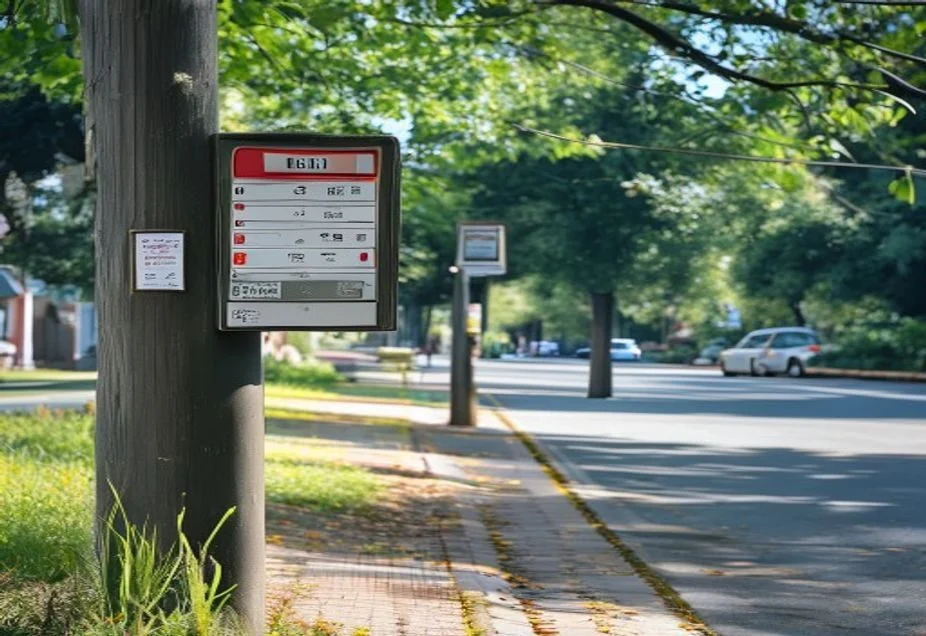
Which brings us to the numbers under each stop name. Every bus stop in Australia has a stop number — here, 23707, 20379 and 23635. It’s printed on the physical stop sign. Type that number into the journey planner or app and you get departures for that exact stop, with no ambiguity about which side of the road you’re standing on. It’s the single most useful habit to build.
You’ll also see “Stand 1” and “Stand 11”. At big interchanges the stops are grouped into numbered stands or bays — so at Murdoch Station you want Stand 1 specifically, not just “somewhere at Murdoch Station”. Check the stand number before you settle in to wait.
Symbols and terms you'll meet
Exact notation varies between states, but these are near-universal. When in doubt, the legend on that timetable is the authority.
| What you see | What it means |
|---|---|
| – (dash) | This service does not stop here. Not “unknown time” — it simply doesn’t stop. |
| A, B, H, S (letters) | A footnote. Check the legend — usually school days only, school holidays only, or a route deviation. |
| am / pm down the side | Australian timetables often use 12-hour time in bands. 1:08 in the pm band is 13:08. |
| Timed stops | Only the main stops are listed. The vehicle stops at many more in between. |
| Stand / Bay number | Which platform-like bay at an interchange your bus leaves from. |
| Stop number | The unique ID for that exact stop, printed on the sign. Use it in the app. |
| Express / limited stops | Skips stations to go faster. Great unless you’re one of the skipped ones. |
| a after a time | On some networks: arrives only (you can get off but not on). Check the legend. |
| High frequency | So frequent you don’t need the timetable — just turn up. |
| Effective / version date | When this timetable started. If it’s old, find the current one. |
How to actually plan a trip in 2026
Honestly? Most of the time you shouldn’t be reading a printed timetable at all. Use the official journey planner, which knows about delays, roadworks and cancellations that no PDF can:
- NSW — Transport NSW trip planner (transportnsw.info)
- Victoria — PTV journey planner (ptv.vic.gov.au)
- Queensland — Translink (translink.com.au)
- WA — Transperth JourneyPlanner (transperth.wa.gov.au)
- SA — Adelaide Metro (adelaidemetro.com.au)
- Google Maps works well nationally, and apps like Transit and Moovit are popular locally.
The printed timetable still earns its place in three situations: when you have no phone signal or battery, when you want to see the whole day at once to plan a shift or class schedule, and when you need to know what runs during school holidays — the thing apps often show poorly if you’re planning weeks ahead.
Mistakes that make people miss the bus
- Reading the wrong direction’s table. Check the heading says the destination you want. On paper, the return journey is usually on the reverse side.
- Reading the wrong day block. Saturday and Sunday timetables are much thinner, and public holidays run the Sunday timetable — a classic long-weekend trap.
- Ignoring a footnote letter, then waiting for a bus that only runs in school holidays.
- Standing on the wrong side of the road. The stop opposite goes the other way. The stop number on the sign tells you which is which.
- Not allowing transfer time. If your trip involves a change, the timetable shows the scheduled connection — a five-minute delay can cost you 30 minutes.
- Turning up exactly on time. Be at the stop five minutes early. Buses can leave slightly early from timed stops if running ahead, and drivers won’t always see you sprinting.
- Assuming the last service is late. Many suburban routes finish surprisingly early, and Sunday services can stop by mid-evening. Check the last departure before you go out — our Australia at night guide covers which cities run overnight transport.
Getting the bus to actually stop
One last thing that no timetable tells you, and that catches out almost every new arrival: in Australia you must signal the bus. Buses do not automatically stop at every stop.

- To board: stand where the driver can see you and put your arm out as the bus approaches. If you’re sitting on a bench looking at your phone, expect it to drive past.
- To get off: press the stop button (usually a red button on a pole or a strip) well before your stop — roughly as the bus leaves the previous one.
- Tap on and tap off with your card. Forgetting to tap off usually charges you the maximum default fare.
- At night, some networks let you ask the driver to let you off between stops closer to home — ask politely, it’s a common courtesy on late services.
More on cards, caps and concessions in our state-by-state student concession guide, plus city guides for Sydney, Melbourne, Brisbane and Perth.
The bottom line
Find the right direction and the right day block, locate your stop’s column, and read across the row — that’s a timetable. A dash means the service skips your stop, a letter means check the legend (usually school days or school holidays only), and on buses the printed stops are just the timed stops, with many more in between. Learn your stop number, use the official journey planner for live times, be at the stop five minutes early, and put your arm out to signal the bus. Do that and you’ll never be left standing at an empty stop wondering what went wrong.
Most of the time an app is faster than a printed timetable — see our comparison of the best public transport apps in Australia, with real ratings and prices.
You May Also Like

Moving to Australia: The Complete Checklist and Guide (2026)

NT Public Holidays 2026: Full Calendar, Dates and How Darwin and Alice Springs Celebrate