City & State Guides

QLD School Holidays 2026: Complete Calendar & Dates

· · 18 min read
QLD School Holidays 2026: Complete Calendar & Dates

QLD School Holidays 2026 are scheduled across four main holiday periods throughout the academic year, with specific dates varying between state, Catholic, and independent schools. Queensland families need to plan ahead as these school breaks align with Easter, winter, spring, and the extended summer holiday period.

The 2026 school calendar follows Queensland’s traditional four-term system. However, exact dates differ between Education Queensland state schools, Catholic Education Queensland, and Independent Schools Queensland.

Additionally, families must consider pupil-free days and professional development days when planning childcare and family activities. These scheduled breaks provide opportunities for vacation planning and accessing school holiday programs across Queensland.

TL;DR

  • Four main holiday periods: Easter break, winter holidays, spring break, and extended summer holidays
  • School type variations: State, Catholic, and independent schools have different calendar dates
  • Extra planning needed: Pupil-free days and professional development days affect childcare arrangements
  • Early booking recommended: Popular holiday destinations and programs fill up quickly during school breaks

QLD School Holiday Overview 2026

Queensland schools operate on a four-term academic calendar with scheduled breaks between each term. These holiday periods include the Easter break in Term 1, winter holidays between Terms 2 and 3, spring break between Terms 3 and 4, and the extended summer holidays from December through January.

Furthermore, each term typically runs for approximately 10-11 weeks, creating consistent learning blocks throughout the year. The Queensland education system structures these breaks to align with seasonal weather patterns and national public holidays.

School Calendar Variations by Sector

Education Queensland state schools follow the official government calendar set by the Department of Education. Meanwhile, Catholic Education Queensland schools may vary their dates by up to one week from the state calendar.

Additionally, Independent Schools Queensland members have the greatest flexibility in setting their holiday dates. These independent institutions often start holidays earlier or extend breaks longer than state schools, particularly during the summer period.

School SectorCalendar AuthorityFlexibility Level
State SchoolsEducation QueenslandFixed dates
Catholic SchoolsCatholic Education QueenslandMinor variations (±1 week)
Independent SchoolsIndividual school boardsHigh flexibility

Key Holiday Dates Summary

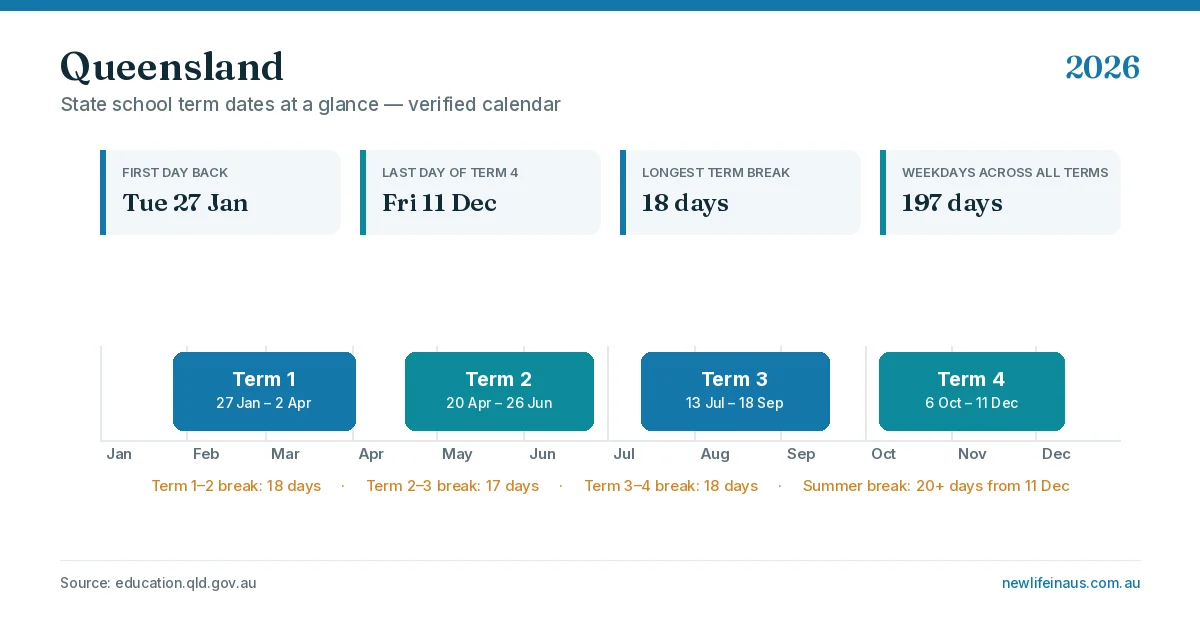
The 2026 school year begins in late January for most Queensland schools. Term 1 concludes with the Easter break in early April, followed by a two-week winter holiday in July.

Subsequently, the spring break occurs in late September or early October. The academic year concludes in mid-December, launching the six-week summer holidays that extend into the following year.

  • Term 1 Break: Easter holidays (2 weeks)
  • Term 2 Break: Winter holidays (2 weeks)
  • Term 3 Break: Spring holidays (2 weeks)
  • Term 4 Break: Summer holidays (6 weeks)

Interstate Holiday Alignment

Queensland school holidays generally align with New South Wales and Victoria during the winter and spring breaks. However, significant variations occur during the Easter and summer holiday periods across different states.

Consequently, families planning interstate travel should verify holiday dates for their destination state. Western Australia and South Australia often have different holiday timing, particularly during the autumn break period.

Moreover, this alignment affects accommodation pricing and availability during peak travel periods. Popular family destinations like the Gold Coast and Sunshine Coast experience higher demand when multiple states share concurrent holiday periods.

Term 1 Holidays 2026 (Easter Break)

Queensland schools observe their Term 1 holidays from Friday, April 3 to Sunday, April 19, 2026. This Easter break spans 17 consecutive days, providing students and families with an extended autumn holiday period.

The holiday period commences immediately after classes conclude on Thursday, April 2, 2026. Students return to classrooms on Monday, April 20, 2026 to begin Term 2 across all Queensland state schools.

Easter Weekend Integration

Easter Sunday falls on April 12, 2026, positioning the religious holiday perfectly within the school break. Good Friday occurs on April 10, while Easter Monday lands on April 13, creating a four-day public holiday weekend.

Consequently, families can plan extended Easter celebrations without conflicting with school attendance requirements. The timing allows for interstate travel during the Anzac Day long weekend, which follows closely on April 25.

Public HolidayDate 2026Day of Week
Good FridayApril 10Friday
Easter SaturdayApril 11Saturday
Easter SundayApril 12Sunday
Easter MondayApril 13Monday
Anzac DayApril 25Saturday

Holiday Duration and Planning

The 17-day break includes two full weekends plus 13 weekdays free from school obligations. This duration matches the standard two-week Easter holiday format across most Australian education systems.

Moreover, the extended break provides sufficient time for family vacations, educational camps, and recreational activities. Popular destinations like the Gold Coast theme parks and Sunshine Coast beaches experience peak demand during this period.

Additionally, many families coordinate interstate visits during these holidays, particularly to New South Wales and Victoria where similar holiday periods occur. The alignment facilitates extended family gatherings and reduces accommodation costs through shared timing.

Term 2 Commencement

Classes resume on Monday, April 20, 2026 across all Queensland state schools. This return date applies to primary schools, secondary schools, and special education facilities throughout the state.

Furthermore, Term 2 continues until the winter holidays commence in early July. The second term typically spans 10 weeks and includes important assessment periods for senior students preparing for mid-year examinations.

Term 2 Holidays 2026 (Winter Break)

Queensland’s winter holidays commence on Friday, July 3, 2026 and conclude on Sunday, July 19, 2026. This mid-year break provides students across all Queensland state schools with a consistent 17-day holiday period during the coldest months of the year.

The winter break duration spans two weeks and three days, including two full weekends plus 13 weekdays. Additionally, this timing aligns with similar winter holiday periods in New South Wales and Victoria, facilitating interstate family visits and coordinated vacation planning.

Holiday PeriodStart DateEnd DateDuration
Winter Break 2026Friday, July 3Sunday, July 1917 days

Mid-Year Break Activities and Planning

The winter holidays offer optimal timing for indoor activities and cultural experiences throughout Queensland. Museums, galleries, and entertainment venues typically extend their operating hours during this period to accommodate increased family visitation.

Furthermore, many Queensland families utilize the winter break for travel to warmer destinations, particularly northern Queensland regions like Cairns and the Whitsundays. The school holiday period coincides with peak tourism season in tropical areas where winter temperatures remain comfortable.

Educational camps and skill development programs also concentrate during these holidays. Sports academies, music workshops, and academic enrichment courses schedule intensive programs to maximize student participation during the extended break period.

Term 3 Commencement

Term 3 begins on Monday, July 20, 2026 across all Queensland state educational institutions. This return date applies uniformly to primary schools, secondary schools, special education facilities, and distance education programs throughout the state.

The third term represents the longest academic period of the year, typically spanning 11 weeks until the September holidays. Consequently, this term includes crucial assessment periods for senior students and preparation phases for end-of-year examinations.

Moreover, Term 3 encompasses significant academic milestones including mid-year report distributions and parent-teacher conferences. The extended term duration allows for comprehensive curriculum delivery before the final term’s examination and graduation activities commence.

Term 3 Holidays 2026 (Spring Break)

Queensland schools observe their Term 3 holidays from September 21 to October 5, 2026, providing students and families with a refreshing two-week spring break. This mid-semester pause arrives after the longest academic term, offering essential respite before the final quarter of the school year commences.

The 15-day holiday duration encompasses two complete weekends plus 11 weekdays, creating an extended period for family activities and travel. Additionally, this timing coincides with Queensland’s most pleasant weather conditions as spring temperatures moderate and rainfall patterns stabilize across the state.

Spring break activities typically focus on outdoor pursuits and regional exploration. Many Queensland families schedule camping trips to national parks, beach holidays along the coast, or visits to theme parks on the Gold Coast during this period. Furthermore, the moderate spring climate makes this holiday period ideal for sporting events and outdoor festivals throughout the state.

Educational institutions utilize this break for final term preparation activities including facility maintenance, curriculum planning, and assessment material development. Teachers complete mid-year evaluations, finalize Term 4 lesson plans, and prepare examination schedules during this period. Meanwhile, senior students often engage in study programs and university preparation activities.

The holiday period also serves as a crucial preparation phase for Year 12 students approaching their final examinations. Many schools organize voluntary study sessions, mock examinations, and university application workshops during the spring break. Consequently, libraries and study centers experience increased usage as students intensify their academic preparation.

Term 4 commences on Monday, October 6, 2026 across all Queensland educational institutions. This final term spans approximately 9 weeks, concluding the academic year in early December. The fourth term encompasses crucial activities including final examinations, graduation ceremonies, and end-of-year celebrations for students completing their educational journey.

Moreover, Term 4 represents the culmination of the academic year with significant assessment periods for all year levels. Primary students complete annual evaluations, while secondary students undertake semester examinations and senior students face their final Queensland Certificate of Education assessments.

Term 4 Holidays 2026 (Summer Break)

Queensland schools conclude their academic year on Friday, December 11, 2026, marking the commencement of the extended summer holiday period. This final day represents the culmination of Term 4 activities including graduation ceremonies, final assessments, and end-of-year celebrations across all educational institutions statewide.

The summer break extends for approximately 7 weeks and 4 days, providing families with an extended period for holiday planning and recreational activities. Subsequently, students enjoy Queensland’s longest school holiday break, traditionally spanning from mid-December through early February of the following year.

Christmas and New Year Holiday Period

Christmas Day falls on Friday, December 25, 2026, followed by Boxing Day on Saturday, December 26, creating an extended weekend celebration period. Families typically utilize this timing for interstate travel, beach holidays, and traditional summer festivities throughout Queensland’s coastal regions.

New Year’s Day occurs on Thursday, January 1, 2027, positioned strategically within the summer break period. Therefore, students experience uninterrupted holiday enjoyment without academic commitments during Australia’s most significant celebration periods.

Extended Summer Break Duration

The 2026-2027 summer holidays provide 52 days of continuous break time for Queensland students and families. This extended duration allows for comprehensive holiday planning, international travel, summer camp participation, and family bonding activities across the state’s diverse recreational offerings.

Educational facilities utilize this extended period for major maintenance projects, infrastructure upgrades, and curriculum preparation activities. Meanwhile, teaching staff engage in professional development programs, lesson planning, and assessment preparation for the upcoming academic year.

2027 School Year Commencement Preparation

Queensland schools reopen for Term 1, 2027 on Tuesday, February 2, 2027, following Australia Day celebrations and final holiday activities. This commencement date provides adequate preparation time for students, families, and educational institutions to transition from holiday mode to academic focus.

Preparation activities intensify during late January as families organize school supplies, uniform fittings, and enrollment procedures for new students. Additionally, schools conduct orientation programs, staff meetings, and facility preparations to ensure smooth academic year commencement across all Queensland educational institutions.

State vs Private School Holiday Differences

Queensland’s educational landscape operates under three distinct school systems, each maintaining unique holiday schedules and calendar variations. Understanding these differences helps families plan effectively across state, Catholic, and independent educational sectors throughout 2026.

Queensland State School Official Calendar

Education Queensland establishes the official state school calendar, which serves approximately 70% of Queensland students. State schools follow standardized term dates across all government educational institutions, ensuring consistency for families with multiple children in the system.

Government schools commence Term 1 on Tuesday, January 28, 2026, maintaining alignment with Australia Day celebrations. Subsequently, term breaks occur simultaneously across all state institutions, facilitating coordinated family holidays and educational planning activities.

State school holidays provide fixed durations: two weeks for autumn and spring breaks, three weeks for winter holidays, and approximately seven weeks for summer vacation. This standardization enables predictable planning for working parents and educational support services throughout Queensland.

Catholic Education Queensland Variations

Catholic Education Queensland operates semi-independently, often aligning closely with state school calendars while maintaining flexibility for religious observances. Catholic schools typically commence their academic year within one to two days of state school start dates, ensuring minimal disruption for families with children across different systems.

Religious feast days and Catholic liturgical calendar considerations occasionally influence Catholic school holiday timing. However, major term breaks generally coincide with state school holidays to maintain community coherence and family planning consistency across Queensland’s educational sectors.

Catholic schools demonstrate greater autonomy in pupil-free days and professional development scheduling. Consequently, individual Catholic institutions may extend or modify minor breaks while adhering to core term structure established by Education Queensland guidelines.

Independent Schools Queensland Differences

Independent Schools Queensland maintains the most flexible approach to holiday scheduling, with individual institutions setting their own academic calendars. Private schools often commence terms earlier or later than state counterparts, creating unique planning challenges for families transitioning between systems.

Elite independent schools frequently extend summer holiday periods beyond state school durations, sometimes providing up to nine weeks of vacation time. Additionally, private institutions may incorporate mid-term breaks, study weeks, or extended weekend periods not found in government school calendars.

Boarding schools within the independent sector often align their holidays with interstate student travel requirements. Therefore, these institutions may commence holidays earlier to accommodate students traveling significant distances to family homes across Australia and internationally.

Regional Variations and Considerations

Remote and rural Queensland schools occasionally modify holiday schedules to accommodate local agricultural cycles, weather patterns, and community events. Far North Queensland institutions may adjust timing to align with wet season considerations and tropical climate factors affecting student attendance and transportation.

Mining communities and resource-dependent regions sometimes coordinate school holidays with fly-in-fly-out worker schedules. This coordination ensures family time optimization when parents working in remote locations return home during designated break periods throughout the academic year.

Indigenous communities may incorporate cultural calendar considerations into local school holiday planning. Moreover, schools serving significant Aboriginal and Torres Strait Islander populations often acknowledge traditional seasonal activities and ceremonial obligations within their academic scheduling frameworks.

Pupil-Free Days and Professional Development

Queensland schools designate specific pupil-free days throughout 2026 for essential staff training and curriculum planning activities. These student-free periods occur strategically across the academic year, allowing educators to engage in professional development without disrupting regular classroom instruction.

Government schools typically schedule five pupil-free days annually, distributed across different terms to maximize educational planning effectiveness. Furthermore, these days often coincide with the beginning or end of term periods, extending holiday durations for families while providing concentrated professional development opportunities for teaching staff.

Scheduled Professional Development Dates

Education Queensland mandates specific professional development sessions focusing on curriculum implementation, assessment strategies, and student wellbeing initiatives. Additionally, schools utilize these days for collaborative planning, resource development, and cross-curricular alignment activities that enhance overall educational delivery.

TermTypical Pupil-Free PeriodsPrimary Focus Areas
Term 1Late January preparation daysYear planning, new curriculum training
Term 2Mid-term professional developmentAssessment moderation, student data analysis
Term 3August development weekSemester review, reporting preparation
Term 4End-year planning sessionsAnnual reviews, next year preparation

Catholic and independent schools maintain flexibility in scheduling their professional development days, often aligning with system-wide requirements while addressing institution-specific needs. Consequently, these schools may distribute pupil-free days differently throughout the academic calendar.

Impact on Family Planning and Childcare

Pupil-free days create significant childcare challenges for working parents who must arrange alternative supervision during these unscheduled school closures. Moreover, these days often occur with minimal advance notice, complicating family scheduling and increasing childcare costs for many Queensland households.

Parents should anticipate approximately five additional days of childcare arrangements beyond standard school holidays throughout 2026. Early planning becomes essential as these professional development days may not align with public holidays or traditional vacation periods.

Many childcare centers and vacation care programs extend their services during pupil-free days, recognizing the increased demand from working families. However, these services often require advance booking and may charge premium rates during high-demand periods.

Professional development days can add up to one additional week of childcare costs annually for Queensland families

Regional areas face particular challenges during pupil-free days due to limited alternative childcare options and extended family support networks. Therefore, rural communities often coordinate informal childcare arrangements among parents to address these scheduling gaps effectively.

Planning Your Family Activities

Strategic planning transforms Queensland school holidays from stressful scrambles into memorable family experiences. Furthermore, early booking secures better rates and availability for accommodation, activities, and childcare services throughout 2026.

Best Times to Book Family Holidays

Queensland families should book holiday accommodation 6-8 months in advance for peak periods like Christmas and Easter breaks. Additionally, booking during off-peak periods reduces costs by up to 40% while providing greater flexibility for family scheduling.

Mid-year holidays offer exceptional value for Queensland families seeking affordable getaways. Similarly, the September-October break provides ideal weather conditions for outdoor activities without the premium pricing of summer holidays.

Holiday PeriodBooking TimelineCost Savings
Christmas/Summer6-8 months aheadStandard rates
Easter Break4-6 months ahead15-25% savings
Mid-year Holidays3-4 months ahead30-40% savings
September Break2-3 months ahead25-35% savings

School Holiday Program Availability

Queensland councils operate extensive vacation care programs during all school holiday periods, typically opening registration 4-6 weeks before each break. However, popular programs fill quickly, particularly during longer holiday periods when demand peaks significantly.

Most vacation care services provide full-day supervision from 6:30 AM to 6:00 PM, accommodating working parents’ schedules effectively. Moreover, these programs offer structured activities including excursions, sports, arts and crafts, and educational workshops for children aged 5-12 years.

  • Council-run programs: $45-65 per day
  • Private providers: $55-85 per day
  • YMCA/PCYC programs: $50-70 per day
  • School-based care: $40-60 per day

Childcare and Vacation Care Options

Working parents require reliable childcare solutions during Queensland’s 13 weeks of annual school holidays plus additional pupil-free days. Consequently, families spend an average of $2,800-4,200 annually on vacation care services across all holiday periods.

Before and after school care providers typically extend their services during holidays, offering familiar environments for children. Meanwhile, family day care educators provide flexible, home-based alternatives that accommodate varying schedules and individual family needs.

Queensland families spend up to $4,200 annually on vacation care during school holidays

Grandparent care remains the most popular childcare solution for 68% of Queensland families during school holidays. Nevertheless, professional vacation care provides structured activities and social interaction when extended family support isn’t available or sufficient.

The Gold Coast attracts over 2.5 million Queensland families annually during school holidays, making it the state’s premier family destination. Similarly, the Sunshine Coast offers excellent value with shorter travel times for Brisbane families and abundant child-friendly attractions.

Theme parks experience peak attendance during Queensland school holidays, with Dreamworld and Sea World reporting 40-60% higher visitor numbers. Therefore, families should purchase tickets in advance and arrive early to minimize wait times during these busy periods.

  • Gold Coast: Theme parks, beaches, family resorts
  • Sunshine Coast: Australia Zoo, Eumundi Markets, beach activities
  • Cairns: Great Barrier Reef tours, rainforest adventures
  • Whitsundays: Island hopping, snorkeling, sailing
  • Brisbane: South Bank, museums, river activities

Regional Queensland destinations like Airlie Beach and Port Douglas offer exceptional experiences for families seeking adventure beyond traditional beach holidays. Additionally, these locations provide educational opportunities about marine life, indigenous culture, and tropical ecosystems that enhance children’s learning experiences.

Camping and caravan parks across Queensland report 95% occupancy rates during peak school holiday periods. Hence, families choosing budget-friendly camping options should secure bookings immediately after previous year’s holidays to guarantee preferred sites and dates.

Frequently Asked Questions

When do Queensland school holidays start and end in 2026?

Queensland school holidays in 2026 follow a four-term system with breaks between each term. The academic year begins in late January, with Term 1 holidays (Easter break) in early April, winter holidays in July, spring break in late September/early October, and summer holidays starting mid-December extending for six weeks into 2027.

Do all Queensland schools have the same holiday dates?

No, holiday dates vary by school sector. Education Queensland state schools follow fixed government dates, Catholic Education Queensland schools may vary by up to one week, and Independent Schools Queensland have the greatest flexibility in setting their own holiday schedules, often starting earlier or extending breaks longer.

What are pupil-free days and how do they affect school holidays?

Pupil-free days and professional development days are additional non-teaching days when students don’t attend school but teachers participate in training. These days require extra childcare planning as they occur throughout the term, separate from the main holiday periods.

How long is each school holiday period in Queensland?

  • Term 1 Break (Easter): 2 weeks
  • Term 2 Break (Winter): 2 weeks
  • Term 3 Break (Spring): 2 weeks
  • Term 4 Break (Summer): 6 weeks

Do Queensland school holidays align with other Australian states?

Queensland holidays generally align with NSW and Victoria during winter and spring breaks, but significant variations occur during Easter and summer periods. Western Australia and South Australia often have different timing, particularly for autumn breaks, which affects travel planning and accommodation pricing.

When should I book holiday accommodation and activities?

Early booking is recommended as popular holiday destinations and school holiday programs fill up quickly. Accommodation prices are typically higher during peak periods when multiple states share concurrent holidays, particularly on the Gold Coast and Sunshine Coast.

How long does each school term run in Queensland?

Each term typically runs for 10-11 weeks, creating consistent learning blocks throughout the year. This structure aligns with seasonal weather patterns and national public holidays, providing regular breaks for students and families.

Where can I find the exact dates for my child's school?

Check directly with your child’s school or the relevant education authority: Education Queensland for state schools, Catholic Education Queensland for Catholic schools, or the individual school administration for independent schools, as dates can vary between sectors and individual institutions.

Leave a Comment

Your email address will not be published. Required fields are marked *