Night Shift and Weekend Jobs for Students in Australia: Pros and Cons


The job ad says “flexible hours” but what it actually means is Thursday close (finishes 11:30pm), Saturday open (starts 5am) and every second Sunday. For a lot of international students that combination is the difference between a budget that works and one that doesn’t, because night and weekend shifts in Australia are the only ordinary hours that come with a legal pay loading on top of the base rate. This guide goes through exactly what that loading is worth award by award, how it interacts with the 48-hour student visa work cap, what the research says about the health and safety side of shift work, and how to decide whether taking the night or weekend roster is actually worth it for your specific situation.
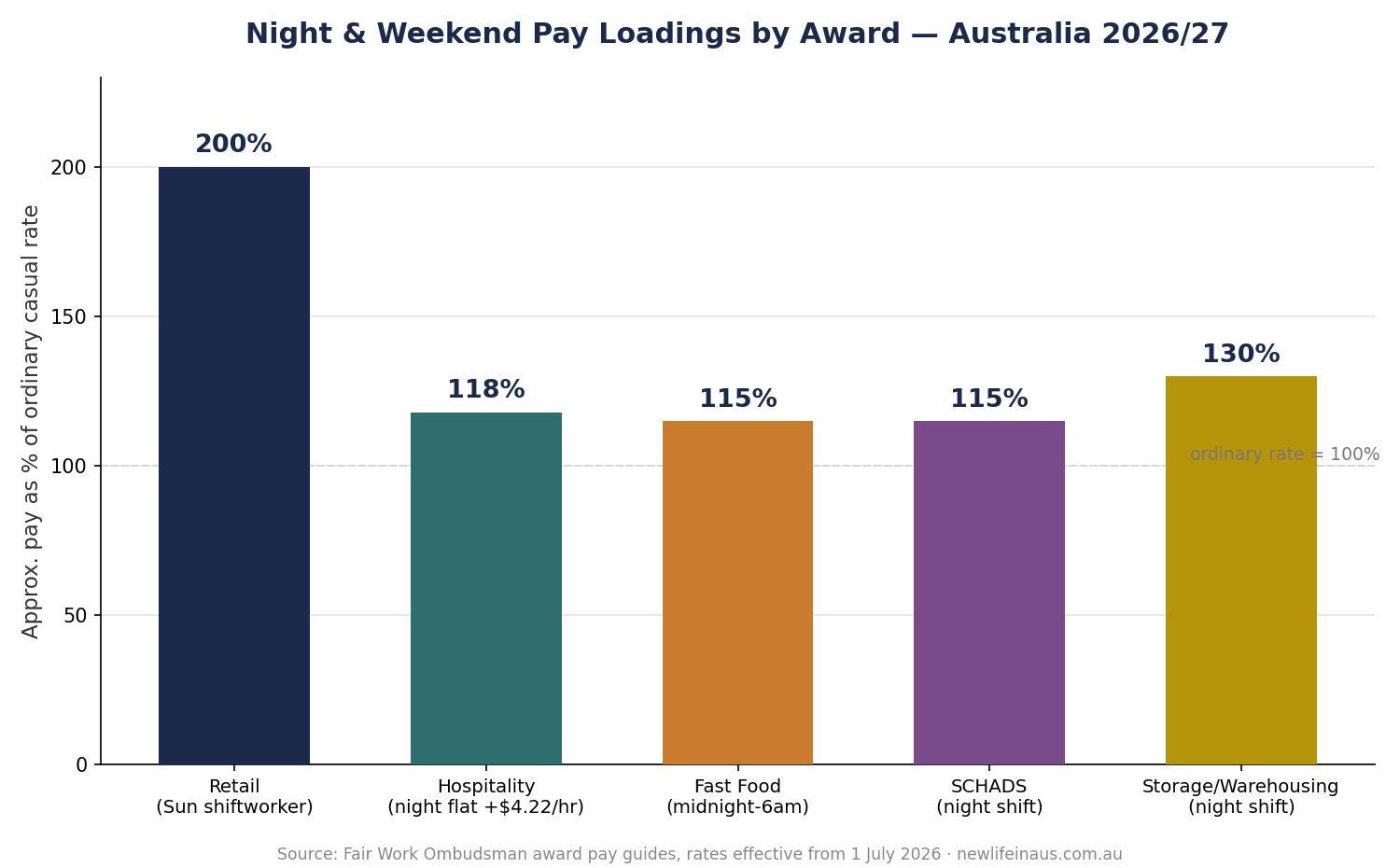
Quick facts: Under the Fair Work system, casual employees on the Hospitality Award earn a flat $4.22/hr loading for ordinary hours worked between midnight and 7am, on top of the standard 25% casual loading. The Retail Award pays casual shiftworkers 200% of the minimum rate for Sunday shiftwork and 155% for weeknight shiftwork. Student visa holders remain capped at 48 hours of work per fortnight while their course is in session, combined across every job they hold, not per employer. Source: fairwork.gov.au. Checked August 2026.
Which jobs actually put students on night and weekend rosters

Not every casual job offers night or weekend shifts, and not every night-shift job is realistically open to a student visa holder. Before getting into pay rates, it’s worth being clear-eyed about which parts of the economy actually run on a 24/7 or weekend-heavy roster and hire casual staff with visa work-hour conditions. The table below is based on how rosters actually work in these sectors, not just job titles.
| Industry | Typical night/weekend roles | Governing award | Realistic for student visa? |
|---|---|---|---|
| Supermarkets & retail | Overnight shelf-stacking, early opening crew, weekend floor staff | General Retail Industry Award | Yes — one of the most common entry points |
| Hospitality & fast food | Late-night kitchen/front of house, weekend brunch and dinner service | Hospitality Award / Fast Food Award / Restaurant Award | Yes — very common, especially in CBD and nightlife precincts |
| Aged care & disability support | Overnight active shifts, sleepovers, weekend personal care shifts | SCHADS Award / Aged Care Award | Yes, once qualified — usually needs a short certificate and often a police check/NDIS check |
| Warehousing & logistics | Overnight picking/packing, weekend distribution centre shifts | Storage Services and Wholesale Award | Yes — common around Amazon, Coles, Woolworths and 3PL distribution centres |
| Cleaning & facilities | Overnight office and retail cleaning contracts | Cleaning Services Award | Yes — often unsocial hours but flexible casual pools |
| Security | Overnight static guarding, event security | Security Services Award | No — a security licence in every state requires citizenship or a visa with unrestricted work rights; a student visa does not qualify |
| Rideshare & food delivery | Friday/Saturday night peak demand, late-night delivery surges | Not an employee award — independent contractor under the Fair Work “employee-like worker” minimum standards | Yes, with an ABN, though this counts as work for visa hour purposes if it is genuinely an employment relationship in substance |
The security industry line is worth pausing on, because it’s a common point of confusion. Security guard training providers advertise the Certificate II in Security Operations heavily to students because the pay looks attractive on paper, but every state and territory security licensing authority requires the applicant to be an Australian or New Zealand citizen, a permanent resident, or hold a visa that grants unrestricted work rights. A Subclass 500 student visa does not meet that bar, so the course fee (commonly $500 to $1,500 once training and the licence application are added together) would be money spent on a licence you cannot actually be issued. If a job board or a “recruiter” tells you otherwise, treat that as a red flag rather than good news.
What night and weekend shifts actually pay: the award-by-award breakdown
Australia’s minimum pay and conditions system is built around “modern awards” — industry-specific rulebooks registered with the Fair Work Commission that set minimum pay rates, casual loading, and penalty rates for evening, night, weekend and public holiday work. Casual loading (an extra 25% to compensate for not getting sick leave or annual leave) applies on top of the base rate, and then a separate penalty or loading applies for unsociable hours. These two things stack, which is why a Sunday night shift can end up paying close to double the weekday daytime rate. All figures below are minimum rates under the Fair Work pay guides current from 1 July 2026, when award rates rose 4.75% following the Fair Work Commission’s Annual Wage Review 2026. Always check the current Fair Work pay guide for your specific classification before relying on a figure, since pay points vary by role, experience and exact duties.
General Retail Industry Award (supermarkets, shops)
| When you work | Casual ordinary-hours rate | Casual shiftworker rate |
|---|---|---|
| Weekday, 7am–6pm | 125% of minimum rate (standard casual loading) | N/A |
| Weekday evening, after 6pm Mon–Fri | 150% of minimum rate | 155% of minimum rate (midnight Sun to midnight Fri) |
| Saturday | 150% of minimum rate | 175% of minimum rate |
| Sunday | 175% of minimum rate | 200% of minimum rate |
Source: Fair Work Ombudsman, “Casual penalty rates in the Retail Award” and “Casual shiftworkers & penalty rates in the Retail Award.” The shiftworker rates apply specifically to employees who are rostered across changing shift patterns, including night shift, rather than the standard casual loading — worth clarifying with your employer which category your roster falls under, since the difference between 155% and 200% on a Sunday night is substantial.
Hospitality Award (hotels, pubs, clubs, cafes)
| When you work | Loading |
|---|---|
| Evening work, 7pm–midnight | Flat allowance per hour on top of ordinary casual rate (varies by classification) |
| Night work, midnight–7am | Flat $4.22/hr loading on top of ordinary casual rate |
| Saturday | 150% of minimum rate (casual) |
| Sunday | 175% of minimum rate (casual) |
| Public holiday | 250% of minimum rate (casual) |
Source: Fair Work Ombudsman, “Evening & night work in the Hospitality Award,” Fair Work pay guide effective from the first full pay period on or after 1 July 2026. Where more than one penalty applies to the same hours — for example a Saturday night shift — you’re paid the higher single rate rather than both stacked together, so check which one actually benefits you before assuming the numbers simply add up.
Fast Food Industry Award (chains, quick-service)
| Classification | Adult ordinary hourly rate (2026/27) |
|---|---|
| Level 1 | $27.81 |
| Level 2 | $29.45 |
| Level 3 (in charge of no one or 1 other) | $29.91 |
| Level 3 (in charge of 2 or more) | $30.27 |
On top of these base rates, casual employees get the standard 25% casual loading, and early-morning work between midnight and 6am attracts an additional 15% loading on the base rate. Evening, weekend and public holiday penalties apply on top again, so a Saturday night closing shift stacks the casual loading, the applicable weekend penalty and, if the shift runs past midnight, the early-morning loading as well. Source: Fair Work Ombudsman, Fast Food Industry Award [MA000003] pay guide.
SCHADS Award (disability support and community services)

| Item | Rate/allowance |
|---|---|
| Casual loading | 25% on top of the base hourly rate |
| Night shift penalty | Additional 15% on the whole shift (not just the hours after midnight) |
| Sleepover allowance | Approximately $62.87 per sleepover shift (separate from active hourly pay) |
| Broken shift allowance | Approximately $21.81–$28.87 depending on the unpaid break length |
Disability support work is one of the more accessible night-shift entry points for students because demand is high and providers regularly hire casually, but it typically requires a Certificate III in Individual Support (or equivalent short course), a national police check, and often an NDIS Worker Screening Check before you can be rostered on. Aged-care personal care work is covered by the separate Aged Care Award rather than SCHADS, with its own comparable but not identical night and weekend rates — check which award applies to the specific employer before comparing pay. Source: Fair Work Ombudsman, “Pay and allowances in the Social, Community, Home Care and Disability Services Industry Award,” rates current from 1 July 2026 following the 4.75% Annual Wage Review increase.
Storage Services and Wholesale Award (warehousing, distribution centres)
| Item | Approx. rate |
|---|---|
| Level 1 base rate | $27.08/hr |
| Casual base rate (+25% loading) | $33.85/hr |
| Night shift loading | 30% on top of the base rate before casual loading is applied |
Warehouse and distribution centre work around major fulfilment hubs (Amazon, Coles, Woolworths, and third-party logistics providers) runs genuine overnight shifts to meet next-day delivery targets, and casual agency staffing is common, which makes entry relatively straightforward. The trade-off is that these are physically demanding shifts — regular lifting, walking long floor distances, and sustained standing — so factor physical fatigue into the same equation as pay. Source: Fair Work Ombudsman, Storage Services and Wholesale Award [MA000084] pay guide, rates effective 1 July 2026.
A worked example: how much difference does the roster actually make?
Numbers are easier to act on than percentages. Here’s a simplified comparison for a Fast Food Award Level 1 casual working the same 24 hours across a fortnight — the maximum allowed under the standard student visa condition — under two different rostering patterns. These are illustrative estimates using the 2026/27 base rate and standard loadings described above; your actual pay depends on your specific roster, employer and any enterprise agreement that might apply instead of the award.
| Scenario | Hours | Approx. gross pay (fortnight) |
|---|---|---|
| All daytime weekday shifts | 24 hrs @ ~$34.76/hr (base + 25% casual loading) | ~$834 |
| Mostly weekend + some evening shifts | 24 hrs blended across Sat/Sun/weekday evening rates | ~$980–$1,050 |
| Heavy weekend + some post-midnight shifts | 24 hrs including Sunday and early-morning loadings | ~$1,050–$1,150 |
That’s a difference of roughly $200 to $300 per fortnight for identical total hours, purely from shift timing — often the gap between a fortnight that covers rent comfortably and one that’s tight. This is exactly why weekend and night availability tends to make a casual applicant more attractive to employers too: managers are chronically short-staffed for the shifts nobody wants, so genuine availability for Friday/Saturday nights and Sunday can be a real point of leverage when applying, not just a pay bonus once you’re hired.
How night and weekend shifts interact with your 48-hour visa cap

The condition attached to a Subclass 500 student visa limits work to 48 hours per fortnight while your course is in session — including orientation, teaching weeks and exam periods — with no cap during your official scheduled course breaks. This is the detail that trips people up most often: the 48-hour limit is combined across every job you hold, not calculated separately per employer. If you work 30 hours at a supermarket and 20 hours at a restaurant in the same fortnight, that’s 50 hours total and you have breached your visa condition, even though neither individual job looks unreasonable on its own.
There has been ongoing public discussion about raising this cap to 60 hours per fortnight from 1 July 2026, originating from a Coalition election commitment reported by the Parliamentary Budget Office. As of August 2026, this remains a proposal only — there is no legislative instrument in force, and the Department of Home Affairs continues to enforce the existing 48-hour limit. Do not plan your rostered hours around a change that has not been legislated; if and when it is confirmed, check the official condition listed on your visa grant notice or ImmiAccount rather than relying on a news article, since visa conditions are what’s actually enforced, not policy announcements.
Night and weekend shifts don’t get any special exemption from this cap — a Saturday night shift counts the same as a Tuesday afternoon shift for hour-counting purposes. What they do change is the pay-per-hour-worked ratio, which is why many students deliberately concentrate their limited 48 hours into weekend and evening blocks rather than spreading smaller shifts across the whole week: the same visa-compliant hour total earns meaningfully more, and it also tends to interfere less with weekday class attendance and assignment deadlines. Working beyond your permitted hours while your course is in session is treated as a breach of your visa condition and can put your visa at risk, so track your rostered and actual hours across every employer, not just the one that pays the most.
What the official fatigue and safety guidance actually says
Safe Work Australia — the national body responsible for work health and safety policy — published a full model Code of Practice on managing the risk of fatigue at work in September 2025, replacing the older 2013 guide with specific, numeric limits rather than general advice. The core standards employers are expected to follow are directly relevant to anyone considering a night-shift roster:
- No more than three consecutive night shifts before a longer recovery break
- At least 12 hours between the end of one shift and the start of the next
- A 30-minute break at least every 5 hours during a shift
- At least 24 hours’ notice of night work where reasonably practicable, so you can adjust your sleep pattern in advance
- Avoiding safety-critical tasks between 2am and 6am where possible, since this is the window where alertness naturally drops lowest on the body clock
These aren’t just recommendations for you personally to follow — they’re standards your employer is expected to build into the roster. If you’re regularly being scheduled for four or more consecutive night shifts, given less than 12 hours between a night finish and the next start (“clopening” — closing then opening), or getting rosters with little to no advance notice, that’s worth raising directly with your manager, and in more serious or repeated cases, is something Safe Work Australia’s regulator in your state can be contacted about. Source: Safe Work Australia, “Guide for managing the risk of fatigue at work” and the 2025 model Code of Practice; Safe Work Australia fatigue fact sheet for workers, October 2025.
Practical fatigue management that actually fits student life
Shift work and irregular hours genuinely do affect sleep quality, concentration and mood — this isn’t just an inconvenience, it’s a recognised occupational health issue, which is exactly why a formal Code of Practice exists for it. A few evidence-based adjustments make a measurable difference if night or early-morning shifts are part of your routine:
- Protect a consistent sleep block even on non-shift days — constantly swinging between a night-shift sleep pattern and a normal daytime one for classes is harder on your body than either pattern alone would be
- Avoid stacking a night shift directly before an exam or assignment deadline where you have any choice in the roster — cognitive performance after a poor night’s sleep drops in ways that are easy to underestimate until you’re sitting the exam
- Use blackout curtains or an eye mask for daytime sleep — even modest light exposure disrupts the melatonin cycle your body needs to treat daytime sleep as real sleep
- Eat a proper meal before a night shift, not during it — heavy meals in the early hours of the morning are linked to worse sleep quality afterward and to the digestive discomfort many night workers report
- Talk to a GP if sleep problems persist — Safe Work Australia’s own guidance for workers explicitly recommends this rather than just “toughing it out,” and Australian universities’ student health services can usually see you without the cost of a private GP visit
Getting to and from a night shift safely
The commute is often the part of a night shift people plan for least, and it’s also where the actual safety risk is highest — not the workplace itself. This matters more for students who don’t yet have a car and are relying on public transport, walking, or rideshare late at night. A 2017 Australian Human Rights Commission report specifically found that students experienced disproportionate rates of harassment on public transport during commutes to and from study or work, so this isn’t a hypothetical concern.
- Wait for transport in a well-lit area with visible CCTV, not an isolated stop
- Choose the carriage or seat closest to the driver or guard when travelling alone at night on trains and trams
- Keep your phone charged and share your route and expected arrival time with a friend or housemate before you leave
- Know that buses, trains and trams carry onboard security cameras and emergency alarms you can use if you feel threatened
- If your shift regularly finishes very late, ask your employer whether a taxi voucher, subsidised rideshare, or a lift with a coworker heading the same direction is available — many hospitality and healthcare employers offer this specifically because they know the alternative is unsafe
For a full breakdown of night-time public transport safety across each capital city, including specific after-dark service changes and safety app options, see our dedicated guide to safe late-night public transport travel in Australia.
The real pros of night and weekend shifts
Meaningfully higher pay for the same hours. As the worked example above shows, concentrating your 48 fortnightly hours into weekend and evening/night shifts rather than spreading them evenly across the week can add $200 or more per fortnight without working a single extra hour — which matters directly against your visa’s financial capacity expectations and simply against rent.
Genuinely easier to get hired. Weekend and night availability is consistently the hardest gap for retail, hospitality and healthcare rosters to fill, because most domestic casual staff — school leavers, other students, parents — actively avoid these shifts. Being one of the few applicants who can genuinely commit to a Saturday night or an early Sunday opening shift is a real competitive advantage in your job search, not just a pay perk once employed.
Better fit around a weekday class timetable. If your lectures, tutorials and labs are concentrated Monday to Friday daytime, working nights and weekends avoids the constant negotiation of swapping shifts around a changing semester timetable, and reduces the number of times you have to choose between a shift and a class.
Quieter, often less customer-facing environments. Overnight retail restocking, warehouse picking, and late-night kitchen prep tend to involve less direct customer-facing pressure than a busy Saturday lunch rush, which some students genuinely find less draining than a loud, high-interaction daytime shift, particularly if English is not their first language and constant fast customer interaction is more tiring.
The real cons, honestly stated

Sleep debt accumulates faster than it feels like it does. The Safe Work Australia Code of Practice exists precisely because irregular and night-shift sleep patterns produce measurable fatigue effects on cognition, mood and long-term health — this isn’t just tiredness that a coffee fixes, and the effects compound over a semester if the roster isn’t managed carefully.
Academic performance risk is real if a night shift lands before an assessment. Sitting an exam or submitting a high-stakes assignment on a few hours of disrupted sleep after a night shift is a genuinely bad position to be in, and it’s avoidable with roster planning weeks in advance — but only if you actually do that planning rather than accepting whatever shifts are offered.
Social and support-network cost. Weekend nights are when most social events, cultural and religious gatherings, and catch-ups with friends happen. Consistently working through them can genuinely affect your sense of connection and support in a new country, which matters for mental health, not just social enjoyment.
Commute safety and logistics are a real, not hypothetical, consideration — particularly late at night in a city you may still be learning to navigate, and particularly if you don’t yet have your own transport.
Physically demanding roles feel harder overnight. Warehouse, cleaning and some hospitality roles involve sustained physical activity; doing that between 11pm and 6am, against your body’s natural circadian low point, is measurably more fatiguing than the same physical work during the day.
Tax and superannuation on your night-shift pay
Night, weekend and shift loadings are treated as ordinary assessable income for tax purposes — they’re not a separate tax-free bonus, and they’re taxed at your normal marginal rate along with the rest of your pay through the PAYG withholding your employer deducts each pay cycle. Where they do matter is for superannuation: from 1 July 2026, the Superannuation Guarantee rate is 12% of your ordinary time earnings, and shift and penalty loadings that form part of your regular ordinary hours generally count toward that base, meaning a consistently higher night/weekend pay rate also means a slightly higher super balance accumulating in your name over your studies, even though most international students won’t access it until they permanently leave Australia.
Keep your payslips regardless — they’re the easiest way to confirm your employer is actually applying the correct award loadings, and they’re what you’ll need at tax time to check your total income and any refund. For the full picture on how casual and part-time tax actually works and what you can expect back, see our guides to how much tax you actually pay on casual and part-time work, simple tax record keeping for students, and how superannuation works for international students.
Industry deep dives: what the shift actually looks like
Retail overnight and weekend
Supermarket overnight shelf-stacking crews typically run from around 10pm or midnight through to 6am, restocking shelves before the store reopens and handling deliveries. It’s repetitive, physically active work — lifting, bending, pushing trolleys — with less direct customer interaction than a daytime retail shift, which some students prefer. Weekend retail floor shifts, by contrast, are usually the busiest and most customer-facing hours of the week, so expect a genuinely different pace and skill set between the two.
Hospitality and fast food nights and weekends
This is the highest-volume sector for student casual employment in Australia, and Friday/Saturday night and weekend brunch/dinner service are consistently the shifts employers most need covered. Expect fast-paced, high-interaction work — this is genuinely useful for English fluency and workplace culture familiarity, which is part of why the site has a full separate breakdown in our guides to cafe and restaurant jobs in Australia and working in hospitality in Australia.
Disability support and aged care nights
Overnight shifts in this sector are either “active night shifts” (you’re awake, providing support and completing care tasks throughout) or “sleepover shifts” (you’re on-site and available to respond but paid a separate lower allowance rather than full hourly pay, on the basis you’re expected to sleep for most of it). The distinction matters significantly for what you actually earn, and it should be stated clearly in your contract before you accept a shift — if it isn’t, ask directly which category applies before you start.
Warehousing and distribution centre nights
Major online retail and grocery fulfilment runs genuinely 24/7 to meet next-day delivery promises, and casual staffing agencies supply a large share of the overnight and weekend workforce for these sites. Entry requirements are typically minimal (often just a short online induction and safety briefing), which makes this one of the more accessible night-shift options, but the work is physically demanding and shifts commonly run 8 to 10 hours with limited variety in tasks.
Which cities have the most night and weekend demand
Demand for night and weekend casual staff isn’t evenly spread across Australia — it tracks closely with each city’s nightlife, hospitality density, and 24-hour retail and logistics infrastructure.
| City | Where night/weekend demand concentrates | Notes for students |
|---|---|---|
| Sydney | CBD and Darling Harbour hospitality, Sydney Airport-adjacent logistics, Eastern suburbs nightlife precincts | Highest pay ceiling but also highest cost of living; strong late-night train network on weekends via the NightRide bus network when trains stop |
| Melbourne | CBD laneway hospitality, Docklands/Tullamarine logistics corridor, Chapel Street and Fitzroy nightlife | Dense tram network makes late shifts more manageable without a car than most other cities |
| Brisbane | Fortitude Valley and CBD hospitality, Australia TradeCoast logistics precinct near the airport | Smaller late-night public transport footprint than Sydney/Melbourne — factor commute planning in more carefully |
| Perth | CBD and Northbridge hospitality, Kwinana/Perth Airport logistics | More car-dependent; late-night public transport is comparatively limited outside the CBD core |
| Adelaide | CBD hospitality precinct, north/south logistics corridors | Smaller job market overall, but also less competition for weekend shifts specifically |
Balancing shift work with religious and cultural commitments
For students who observe regular religious practice — Friday congregational prayer, weekend worship, religious festivals, or fasting periods such as Ramadan — a night or weekend roster needs to be negotiated deliberately rather than left to chance. Australian workplace law doesn’t automatically guarantee a specific day off for religious observance the way it guarantees penalty rates, but reasonable requests for rostering around genuine religious commitments are generally something employers are expected to consider under general discrimination and fair treatment obligations, and in practice most casual employers in hospitality, retail and healthcare are used to negotiating this with a diverse workforce. The practical approach that works best: raise it clearly and early, in writing where possible (a message to your manager noting your regular commitment), rather than requesting time off late or repeatedly swapping shifts at the last minute, which understandably frustrates managers regardless of the underlying reason. If a shift roster genuinely cannot accommodate a fixed weekly commitment like Friday prayer, that’s worth weighing directly against the pay advantage of that specific role before accepting it, since the trade-off is a personal one only you can make.
If you're not being paid correctly: wage theft and how to report it
This is uncomfortable to state plainly, but it needs to be said with the actual numbers rather than softened: research from the Migrant Justice Institute has found that 77% of international students surveyed reported being paid less than the national minimum wage in their casual jobs, and wage theft is documented as particularly widespread specifically in hospitality, retail and horticulture — the same industries this guide covers for night and weekend work. Underpayment can mean being paid a flat “cash” rate below the award minimum, not being paid the correct penalty or night loading on top of base pay, having unauthorised deductions taken from your pay, or not being paid superannuation at all. If any of the pay rates in the tables above look higher than what you’re actually receiving for the same shifts, that’s worth checking properly rather than assuming the employer knows better.
The single biggest reason international students don’t report underpayment is fear that admitting to working more than their visa’s permitted hours will get their visa cancelled. This fear is understandable but historically has not reflected how the system is actually meant to work: the Fair Work Ombudsman and the Department of Home Affairs have operated an Assurance Protocol under which Home Affairs agreed not to cancel a visa for a work-hour condition breach if the breach was connected to workplace exploitation and the visa holder sought help from the Fair Work Ombudsman. As of the most recent published guidance, this long-standing Assurance Protocol has been paused while two newer, more targeted mechanisms — the Strengthening Reporting Protections Pilot and the Workplace Justice Visa Pilot — are being run instead. Because this area is actively changing, check the current, exact protection in place directly on fairwork.gov.au’s “Visa protections” page before assuming which one applies to your situation, rather than relying on outdated information (including, potentially, this paragraph by the time you’re reading it).
Practical steps if you suspect you’re being underpaid:
- Keep every payslip and, ideally, your own independent record of the hours and dates you actually worked
- Use the Fair Work Ombudsman’s free Pay and Conditions Tool (PACT) on fairwork.gov.au to check the award rate that should apply to your role and hours
- Call the Fair Work Infoline (13 13 94) for confidential advice — you don’t have to give your name to ask a general question
- If the employment has ended and you want to lodge a formal underpayment claim, note that some claim pathways through the Fair Work Commission have strict time limits (as short as 21 days in some cases), so don’t sit on it indefinitely
- University international student support offices and state-based community legal centres (several offer free advice specifically for temporary visa holders) can help you navigate a claim without going through it alone
Where to actually find night and weekend shift jobs
Knowing the pay rates doesn’t help until you actually land the role. A few channels consistently work better than others for night and weekend casual roles specifically, as opposed to general part-time work:
- Direct approach, in person, during the actual shift you want to work. Walking into a supermarket, café or fast food outlet at 9pm or on a Sunday afternoon and asking whether they need weekend or night casual staff — while showing you’re available right then — is genuinely one of the most effective methods in hospitality and retail, because it demonstrates the exact availability that’s hardest for managers to fill.
- Staffing and labour hire agencies for warehousing and logistics. Overnight distribution centre work is very commonly sourced through agencies rather than by applying to the retailer directly — search for logistics/warehouse staffing agencies operating near major fulfilment centres in your city.
- University career hubs and student employment boards. Most Australian universities run a jobs board specifically curated for enrolled students, and employers who post there are already aware of and generally comfortable with student visa work-hour conditions.
- Mainstream job boards with a shift filter. Seek, Indeed and Jora all allow filtering by “casual” and often by specific shift type — search directly for “night shift casual” or “weekend casual” rather than a generic job title to surface roles that specifically want your availability.
- Aged care and disability support providers’ own career pages. Because this sector is chronically short-staffed for overnight and weekend shifts specifically, providers often list these separately and prioritise them — search providers operating in your suburb directly rather than only checking general job boards.
What to say in the interview about your availability
Be specific and be upfront about your visa’s 48-hour fortnightly limit rather than treating it as something to hide — employers experienced with hiring international students expect this and plan rosters around it. Say clearly which specific nights and weekend shifts you can commit to consistently, rather than a vague “I’m flexible,” since a manager building a roster needs to know they can rely on you for Friday close or Sunday open specifically. If your course timetable changes each semester, say so directly and ask how far in advance rosters are published, since that affects whether the job will actually work around your study commitments long-term.
Common mistakes students make with night and weekend shifts
- Not tracking combined hours across multiple jobs. The 48-hour cap is a total across every employer, and it’s easy to lose track when you’re juggling two casual roles with different pay cycles and rostering software.
- Accepting a flat “cash” rate without checking the award minimum first. A flat rate that sounds reasonable in isolation is very often below what the relevant award actually requires once penalty rates are correctly applied — check the Fair Work Pay and Conditions Tool before accepting an offer, not after.
- Scheduling a night shift directly before an exam because it was the only shift offered. Once you understand your own sleep recovery pattern, proactively request the schedule change rather than assuming you’ll manage — most managers will accommodate a request made two or three weeks ahead, far fewer will forgive a missed exam after the fact.
- Assuming a training course guarantees a job that turns out to require a visa category you don’t have — the security licensing situation described earlier in this guide is the clearest example, but always confirm visa eligibility for a role before paying for any course or certification tied to it.
- Not asking how you’ll get home before accepting a late shift. Work out the actual commute — timetable, cost, and safety — before your first shift, not as you’re leaving the building at midnight.
How to decide if night or weekend shifts are right for you
There’s no universally correct answer here — it genuinely depends on your course timetable, your commute options, your sleep resilience, and your financial situation. A few honest questions worth answering before you commit to a regular night or weekend roster:
- Are your classes, labs and tutorials concentrated on weekdays, leaving weekends genuinely free, or do you already have weekend academic commitments?
- Do you have a safe, reasonably short way to get to and from the workplace at the shift’s actual start and finish time — not just in theory, but specifically at 11pm or 5am?
- Have you personally noticed you function reasonably well on disrupted sleep, or do you already know a bad night wrecks your next day?
- Can you realistically avoid scheduling a night shift directly before a major exam or assignment deadline, or does the employer’s roster leave you no say in this?
- Does the pay difference (use the award tables above for your specific industry) actually change your financial position meaningfully, or is it a marginal gain not worth the trade-off for you personally?
Bottom line
Night and weekend shifts in Australia genuinely do pay more — sometimes 50 to 100% more per hour than the equivalent daytime shift once casual loading and penalty rates stack — and they’re usually easier to get hired for precisely because most people avoid them. That’s a real, legitimate reason to take them. But the 48-hour visa cap doesn’t stretch to accommodate poor sleep or a missed assignment, and Safe Work Australia’s own guidance exists because fatigue from irregular shifts is a genuine, measurable health and safety issue, not a minor inconvenience. Use the award tables above to know exactly what you should be paid, plan your roster around your actual exam calendar rather than reacting to it, and treat your commute home as seriously as the shift itself.
You May Also Like

National Police Check in Australia (2026): How to Apply, Cost and Which Type You Need

Working with Children Check in Australia (2026): State-by-State Guide