Is Brisbane a Good Choice for International IT and Engineering Students?


Most “should I study in Brisbane” guides compare it to Sydney and Melbourne on rent alone and stop there. That misses the actual story for IT and engineering students specifically: Brisbane is sitting on top of an $11 billion, decade-long infrastructure build for the 2032 Olympics that’s already producing a documented worker shortfall, alongside a genuinely growing tech sector anchored by companies like Atlassian and Xero. This guide goes through the real salary numbers, the accreditation pathway advantage of graduating from an Australian-accredited engineering program, and the skilled migration mechanics — not just a vibe check on the city.



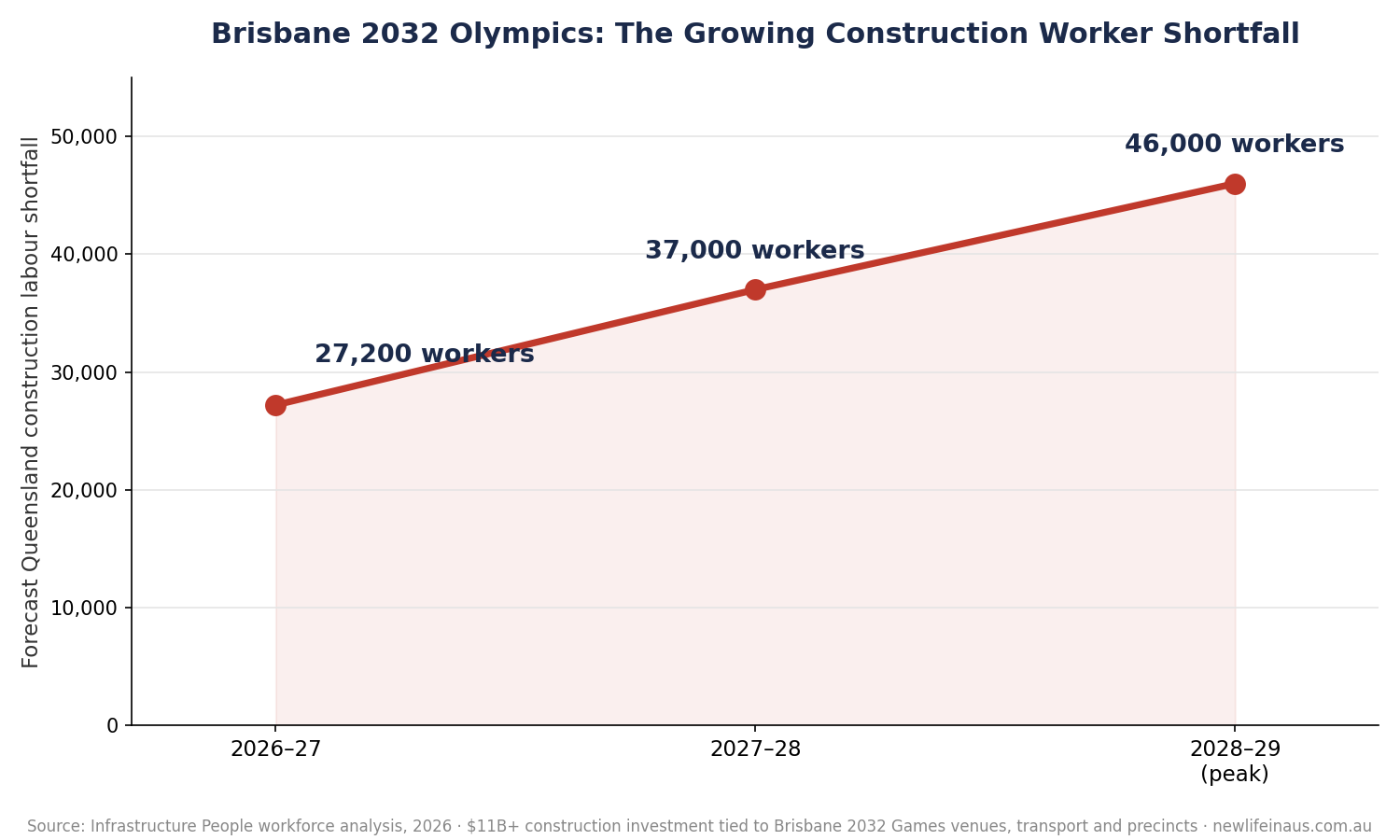
Quick facts: The Brisbane 2032 Olympics construction pipeline is projected to create 122,900 jobs nationally and 91,600 Queensland full-time-equivalent job-years, with a rolling labour shortfall forecast to grow from roughly 27,200 workers in 2026–27 to around 46,000 by 2028–29. Brisbane software engineers earn nominally less than Sydney counterparts but studies suggest developers often take home over 10% more effective income once lower housing and living costs are factored in. Source: Engineers Australia; Infrastructure People workforce analysis; Emanate Technology 2026 salary data. Checked August 2026.
Brisbane's universities for IT and engineering: rankings and accreditation
The two main options for IT and engineering specifically are the University of Queensland (UQ) and Queensland University of Technology (QUT), with Griffith University offering a solid alternative, particularly across its Brisbane and Gold Coast campuses.
| University | QS World Ranking 2027 | QS Engineering & Tech 2026 | Notes for IT/engineering |
|---|---|---|---|
| University of Queensland (UQ) | #40 globally | Top-tier, strongly research-intensive | Group of Eight member; deep research capacity, strong for postgraduate and research-track engineering |
| Queensland University of Technology (QUT) | #240 globally | =123rd | Industry-focused; offers civil, electrical, mechanical, aerospace and software engineering with strong internship and graduate-role support; 50,000+ students |
| Griffith University | #230 globally | =252nd | Strengths in environmental, electronic and civil engineering; Engineers Australia accredited; spread across Brisbane and Gold Coast campuses |
All three offer Engineers Australia-accredited engineering degrees and Australian Computer Society (ACS)-recognised IT and computer science programs, which matters far more than the ranking number for one specific reason covered in detail below: it changes your skilled migration assessment pathway entirely.
The accreditation advantage most guides don't explain properly
If you eventually pursue skilled migration as an engineer, your qualification needs to be assessed by Engineers Australia. There are two very different pathways, and which one applies to you depends heavily on where you studied. Graduates of a degree accredited by Engineers Australia — which includes QUT, UQ and Griffith’s accredited engineering programs — generally qualify for the more direct Washington Accord assessment pathway. Graduates of a non-accredited overseas qualification instead need the Competency Demonstration Report (CDR) pathway: a detailed written portfolio of three Career Episodes (1,000 to 2,500 words each, written in first person describing your own engineering contributions), a Summary Statement and a Continuing Professional Development list — a genuinely demanding piece of work that costs AUD 1,034 (from 1 July 2026) just in assessment fees and commonly takes 10 to 16 weeks to process, on top of the work of writing it.
Studying your engineering degree in Brisbane at an accredited institution means you can generally skip the CDR pathway entirely when you eventually apply for skilled migration — a real, practical advantage over migrating later with an unaccredited overseas engineering degree, separate from any argument about the city itself. For IT specifically, ACS is the equivalent assessing authority for roles like Software Engineer (ANZSCO 261313), and Australian degrees from ACS-accredited computer science and IT programs are recognised on the same logic.
Salary reality: Brisbane vs Sydney and Melbourne
| Role | Brisbane (approx.) | Sydney (approx.) | Note |
|---|---|---|---|
| Software Engineer | $113,750–$144,654/yr | Typically 10–20% higher nominally | Brisbane is roughly 13% below the national average nominally for this specific role |
| Cloud Engineer (AWS/Azure) | $130,000–$160,000/yr | $140,000–$180,000/yr | Cloud skills command a premium in both cities |
| General Engineer (civil/mechanical) | ~$100,000/yr | Broadly comparable to slightly higher | Brisbane is actually ~11% above the national average for general engineering roles, unlike software specifically |
The nominal salary gap tells only half the story. Once lower housing, transport and everyday living costs are factored in, Brisbane developers reportedly take home over 10% more effective income than the raw salary comparison to Sydney would suggest — a meaningful adjustment when you’re weighing where to build a career, not just where the headline number is largest.
The 2032 Olympics: a decade-long, documented infrastructure demand signal
This is the single biggest structural advantage of studying engineering in Brisbane specifically right now, and it’s backed by published workforce forecasting rather than marketing copy. More than $11 billion in construction investment is tied directly to Olympic venues, transport upgrades and precinct development, including new athletes’ villages with planned long-term residential use, Bruce Highway upgrades, and expanded rail and public transport links across South East Queensland.
| Metric | Figure |
|---|---|
| Total jobs created nationally | 122,900 |
| Queensland full-time-equivalent job-years | 91,600 |
| Construction investment tied to the Games | $11 billion+ |
| Forecast labour shortfall, 2026–27 | ~27,200 workers |
| Forecast peak labour shortfall, 2028–29 | ~46,000 workers |
| Additional civil construction workers needed by 2027 | ~23,000 |
The roles in specific, documented demand include civil engineers, project managers, quantity surveyors, commercial managers, procurement specialists and health and safety leaders — and demand is forecast to increase steadily through the late 2020s as projects move from planning into peak construction phases. For a civil, structural or project-management-track engineering student, graduating into this specific labour market timing in this specific city is a genuinely unusual structural tailwind, not something you’d get by studying the same degree in a city without a fixed, government-committed infrastructure program on this scale.
Brisbane's tech sector beyond construction
For software and IT specifically, Brisbane’s tech sector has grown enough to be described as an emerging talent hub rather than a satellite of Sydney and Melbourne. Established software companies including Atlassian, Xero and REA Group have expanded operations in the city, and mining technology — resource-sector software, automation and remote operations systems, reflecting Queensland’s broader mining economy — is a specific, locally distinctive area of demand not replicated in the same way in Sydney or Melbourne’s tech scenes. Sector growth is estimated at around 18% in 2026, with premium demand specifically for AWS and Azure cloud skills.
The honest trade-off: Sydney and Melbourne still have larger absolute tech job markets and a wider range of employers, including most Australian startup activity and the bulk of large multinational tech company local offices. If your priority is the broadest possible range of employer options immediately after graduation, that trade-off is real. If your priority is a lower cost of living, a genuinely growing (not just large) market, and specific strength in infrastructure, resources-adjacent tech and an emerging software scene, Brisbane compares favourably.
Skilled migration pathway: what actually counts
Software Engineer (ANZSCO 261313), Business Analyst (261111) and Civil Engineer (233211) all currently sit on the Medium and Long-term Strategic Skills List (MLTSSL), the list of occupations eligible for the points-tested Subclass 189 visa, which — unlike the 190 and 491 streams — doesn’t require state nomination or employer sponsorship. Being on the list doesn’t guarantee an invitation: the points cut-off for competitive occupations is set by demand, and an occupation can technically be listed while still receiving very few invitations over a 12-month period if the required points score is high. ACS is the assessing authority for most ICT occupations, and Engineers Australia for engineering occupations — the same body discussed above in the accreditation section, reinforcing why the accredited-degree pathway matters twice over: once for the assessment itself, and again for how much of that assessment work is already done for you by graduating from an accredited Australian program.
For the practical first steps after graduation — the Temporary Graduate visa, building local experience, and how the points system fits together — see our guides to the 485 Temporary Graduate visa and engineering jobs, salaries and PR pathways in Australia.
Getting your first IT or engineering role in Brisbane
QUT in particular emphasises industry-focused teaching and actively supports international students in securing internships and graduate roles as part of its engineering and IT programs — worth weighing seriously if practical industry placement matters to you as much as the classroom curriculum. Across all three universities, the standard advice holds: apply for internships and vacation programs from your second year onward rather than waiting until final year, build a portfolio of real projects (not just coursework) for software roles specifically, and treat networking events, industry panels and careers-service employer visits as genuine opportunities rather than optional extras. For the specifics of what Australian recruiters actually screen for and how to present yourself, see our guides to common requirements for IT jobs in Australia and getting your first professional IT job as an international student.
What the degree actually costs, and what living in Brisbane costs on top
| Item | Approx. cost |
|---|---|
| QUT undergraduate tuition (annual) | AUD $42,700–$48,600 |
| UQ undergraduate tuition (annual, engineering/IT) | AUD $30,000–$45,000 |
| Sharehouse room (weekly) | $230–$380 |
| Median whole unit rent (weekly) | ~$660 |
| Groceries (weekly) | $80–$130 |
| Public transport with concession Go Card (weekly) | $25–$45 |
| Total living costs (annual estimate) | $22,000–$37,000 |
Note the current Brisbane rental market is genuinely tight — vacancy rates around 0.6% to 0.8% as of 2026, meaning you should start your accommodation search well before semester starts rather than assuming you’ll find something quickly on arrival. Weighed against Sydney or Melbourne tuition and rent at broadly similar or higher levels for equivalent-ranked programs, the total four-year investment in a Brisbane engineering or IT degree is competitive to meaningfully lower, on top of the salary and infrastructure-demand advantages already covered above.
Living in Brisbane while you study: the practical side
Beyond the career numbers, day-to-day life in Brisbane matters for how sustainable four-plus years of an engineering or IT degree actually feels. Our companion guides cover the full picture: living in Brisbane — lifestyle, weather and vibe, and where to find international groceries and restaurants in Brisbane if maintaining access to home-country food and community is a priority for you, as it is for many international students.
Is Brisbane the right choice for you specifically?
- Choose Brisbane if: you’re leaning civil, structural, project management or infrastructure-adjacent engineering and want to graduate directly into a documented, government-committed decade-long construction demand cycle; you want a lower cost of living without sacrificing real salary purchasing power; or resource-sector/mining tech interests you specifically.
- Weigh Sydney or Melbourne more seriously if: you want the largest possible immediate employer pool for software roles specifically, particularly at large multinational tech companies or the bulk of Australia’s startup ecosystem, and the higher cost of living is an acceptable trade-off for that market breadth.
- Either way: prioritise an Engineers Australia or ACS-accredited program over ranking prestige alone if skilled migration is part of your plan — it’s the detail that changes your post-graduation assessment pathway most concretely.
Bottom line
Brisbane’s case for IT and engineering students isn’t just “cheaper than Sydney” — it’s a documented, government-committed $11 billion infrastructure pipeline with a forecast labour shortfall peaking at roughly 46,000 workers by 2028–29, a genuinely growing tech sector with distinctive strength in mining technology, and — for engineering students specifically — a real accreditation advantage that can save you the CDR pathway entirely when you pursue skilled migration. It’s not automatically the right choice for every specialisation, particularly if you want the broadest possible software employer market immediately after graduation, but for infrastructure, civil and project-management-track engineering especially, the timing and the numbers are unusually well aligned.
You May Also Like

How to Become a Hairdresser in Australia (2026): Certificate III, TAFE Costs and Visa Pathway for International Students

Studying Accounting in Australia: Courses, Costs and Career Path