Uber Eats Driver Australia 2026: Pay, Requirements and Real Earnings

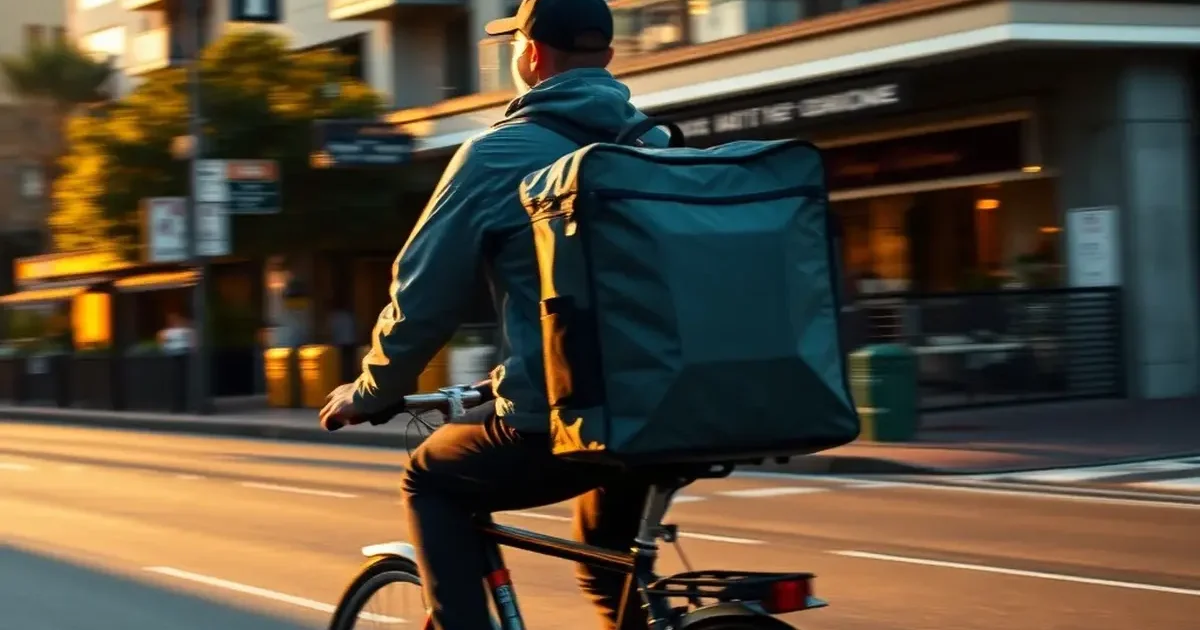
Uber Eats is the biggest food delivery platform in Australia by a wide margin – it holds roughly 54% of the market, and it just got bigger, because Menulog shut down completely in November 2025 and left about a quarter of the market up for grabs. For anyone new to Australia looking for income, it is often the first realistic job: no Australian work experience required, no references, no interview, and you can start on a bicycle without a driver’s licence.
It is also widely misunderstood. The internet will tell you Uber Eats drivers earn $38 an hour, and it will tell you they earn $18 an hour. Both figures get quoted constantly, and both are true – they are simply measuring different things, and almost nobody explains the difference. This guide does, and it gives you a calculator so you can work out your own real number.
Everything here is sourced from Uber’s own Australian pages, the Fair Work Commission, and the ATO. Where sources conflict – and on the age requirement, they badly do – we say so.
Last verified: 12 July 2026 – two things are about to change
The Live $500 Melbourne Sign-Up Bonus
Straight from Uber’s own Australian delivery page, with the terms attached – because an offer without terms attached is not an offer, it is bait.
| Offer | $500 bonus |
| Where | Melbourne only |
| Sign up by | 31 July 2026, 11:59pm AEST |
| What you must do | Complete 100 eligible deliveries in Melbourne within 60 days of signing up |
| Who is excluded | Anyone who has previously signed up as an Uber driver or Uber Eats delivery person – even if you never actually drove |
| Cancelled deliveries | Do not count |
The clock includes your onboarding – and that is the catch
Worth doing the sum: $500 across 100 deliveries is an extra $5 per delivery on top of what you would have earned anyway. Given a typical Australian delivery pays somewhere in the region of $8 to $13, that bonus is very substantial – it could lift your effective earnings on those first 100 trips by something like 40% to 60%. If you are in Melbourne and you were going to try delivery work at all, doing it before 31 July is worth real money.
Two honest caveats. This is a Melbourne offer – Uber runs different promotions in different cities, so check what is showing for your own city on the Uber sign-up page rather than assuming. And it excludes anyone who has ever completed a sign-up form with Uber before, which catches a surprising number of people who registered years ago, never drove, and forgot.
Where Uber Eats Stands in Australia in 2026
| Platform | Market share | Status |
|---|---|---|
| Uber Eats | ~54% | The clear leader. Now also has Coles exclusively. |
| DoorDash | ~15% | Growing hard. Has Woolworths, ALDI (Canberra) and Costco. |
| CLOSED – ceased Australian operations 26 November 2025 after 19 years. | ||
| – | Exited Australia in 2022. |
This matters more to you as a driver than it might look. Menulog’s exit means roughly a quarter of Australia’s delivery demand redistributed to the two surviving platforms – and it also means a large pool of experienced couriers went looking for work on those same two apps. More orders, but also more riders competing for them.
The practical implication: most serious Australian couriers now run both Uber Eats and DoorDash simultaneously, accepting whichever offer is better at that moment. We cover exactly how that works, and whether it is worth it, near the end of this guide.
You are a contractor, not an employee
Before anything else, understand what you are signing up to. Uber Eats engages delivery people as independent contractors. That means:
- No hourly wage paid by an employer. You are paid per delivery.
- No superannuation, no annual leave, no sick pay, no penalty rates.
- No tax withheld – you will owe income tax on your profit at the end of the year.
- You need an ABN. You are running a small business.
- Your costs are your own – fuel, servicing, insurance, phone, bike repairs.
That is the trade you are making for total control of your hours. It is a real trade, and whether it is a good one depends entirely on numbers we work through below – not on the headline figures Uber puts on its billboards.
Uber Eats Driver Requirements: The Age Maze
Search this and you will be told you need to be 18. You will also be told 19, 20 and 21. Every one of those numbers appears somewhere, and the reason is that the requirement depends entirely on what you ride or drive – and most guides simply do not distinguish. Here is the actual structure, taken from Uber’s own Australian help centre.
| How you deliver | Minimum age | Licence needed? |
|---|---|---|
| Bicycle or e-bike | 18 | No licence at all. Just proof of ID. |
| Car | 19 | Full Australian licence required in NSW, ACT and NT. Other states differ – see below. |
| Scooter / moped (under 50cc) | 19 | Valid licence, scooter registration and vehicle insurance. |
| Motorbike | 19 | Full Australian licence required – no exceptions. |
| Uber rideshare (carrying passengers) | 20 – or 21 in NSW, VIC and TAS | Full licence. A completely different product. |
The bicycle is the reason this job is open to almost anyone
Can you do Uber Eats on your P-plates?
Thousands of Australians search this every year and get a vague answer. Here is the precise one, and it is state-dependent.
Uber’s own delivery requirements state that a full Australian driver’s licence is required for motorbikes, and for cars in NSW, ACT and NT. Read that carefully, because of what it implies:
- NSW, ACT, NT – car: a full licence is required, so a provisional (P-plate) licence will not get you approved for car delivery.
- Other states – car: Uber does not list the same full-licence requirement, which suggests provisional licence holders may be able to deliver by car. Confirm this in the app for your own state before you rely on it – requirements vary by city and change without notice.
- Motorbike, anywhere: full licence required. No P-platers.
- Bicycle, anywhere: completely irrelevant – you do not need any licence, so your P-plates do not matter at all.
Even where P-plates are allowed, your insurance may not be
What documents you actually need
| Bicycle / e-bike | Car, scooter or motorbike |
|---|---|
| Proof of ID | Driver licence |
| Criminal background check (Uber arranges this) | Proof of ID |
| VEVO visa entitlement check | Vehicle Registration Certificate |
| Pass the bicycle safety test | Vehicle insurance |
| Complete the Impairment Education module | Complete the Impairment Education module |
ImmiCard is accepted as proof of ID – and that matters
Uber checks your visa through VEVO
Take note of this, because it is the single most important line in the requirements list and it is buried. Uber’s delivery sign-up includes a VEVO check – Visa Entitlement Verification Online, the Australian government system that confirms a person’s visa and their work rights.
In plain terms: Uber verifies your right to work directly with the Department of Home Affairs. This is not an informal cash job where nobody asks questions. Your visa conditions are known to the platform, your delivery hours are logged in the app, and there is a permanent digital record of both. We deal with exactly what that means for student visa holders in the next section, and it deserves your full attention.
Vehicle rules people get caught by
- Recreational e-scooters are NOT accepted. Uber states this plainly. The e-scooter you ride around the city is not a delivery vehicle, no matter how convenient it seems.
- Scooters and mopeds must be under 50cc to qualify in that category, and need registration and insurance like any other motor vehicle.
- A car can be 2-door or 4-door. This is a real difference from Uber rideshare, which requires four doors and a vehicle under 15 years old. For delivery, your small old two-door car is fine – food does not need a back seat.
- E-bikes must be compliant. Uber runs an e-bike marketplace partner scheme; an illegally fast e-bike is not a delivery vehicle and will cause you serious problems.
That two-door point is worth pausing on. A lot of people assume they cannot deliver because their car would not qualify for rideshare. Delivery requirements are much looser than rideshare requirements. If your car is old, small, and only has two doors, it may still be perfectly acceptable for Uber Eats.
How to sign up, step by step
- Get your ABN first – free, from the Australian Business Register, in minutes. Never pay a website for one.
- Confirm your visa work rights (and if you will drive, ring your insurer).
- Register on the Uber delivery sign-up page. Add your personal details and select your vehicle: bicycle or e-bike, motorbike or e-moped, or car.
- Upload your documents for that vehicle type.
- Complete the Impairment Education module, and if you chose bicycle, pass the bicycle safety test.
- Consent to the background check and the VEVO check.
- Wait for activation, then go online in the Uber Driver app.
You can switch delivery mode later – Uber has a process for moving from bicycle to car, or the reverse – so picking a bicycle to get started fast does not lock you in. A lot of people begin on a bike while their car documents are being sorted out.
Visa Work Rights: The Part That Can Cost You Everything
If you are in Australia on a student visa, this is the most important section on this page – more important than the pay, more important than the bike. Get it wrong and you do not lose a job. You lose your visa.
And the thing people cling to – “it is gig work, it is not a real job, nobody is counting” – is simply false. Remember from the previous section: Uber runs a VEVO check on you at sign-up, verifying your visa and work rights directly with the Department of Home Affairs. And every hour you spend online is timestamped in the app. Your visa status is known, and your hours are recorded. There is no grey zone here, only people who have not thought about it.
Student visa (subclass 500): 48 hours per fortnight
The rolling fortnight trap that almost nobody explains
Here is where people get caught, and it is a genuinely subtle rule. A “fortnight” does not mean your fortnight, or your pay cycle, or a neat block on a calendar. It means any period of 14 days beginning on a Monday.
Read that again. Every Monday starts a new fortnight. Which means the fortnights overlap, and your hours must stay under 48 in every single one of those overlapping windows – not just in the ones you happen to be counting.
A worked example of how someone breaches without ever feeling like they did:
| Week | Hours worked |
|---|---|
| Week 1 | 0 (exam week – no work) |
| Week 2 | 45 (catching up on income) |
| Week 3 | 45 (still catching up) |
| Week 4 | 0 |
Check the fortnights. Weeks 1-2 = 45 hours: fine. Weeks 3-4 = 45 hours: fine. It looks completely legal, and this is exactly how people reason about it.
But weeks 2-3 are also a fortnight – it begins on a Monday, it runs 14 days. And that fortnight contains 90 hours. That is a breach of nearly double the cap, sitting inside a pattern that felt entirely reasonable.
The safe rule: think in weeks, not fortnights
What counts as an hour of gig work?
This is a genuinely grey area, and we are going to be honest that it is grey rather than pretend to a certainty nobody has.
Your visa condition limits hours worked. For a normal job that is obvious – it is on your payslip. For delivery, is an “hour worked” the time you spent actively on deliveries, or all the time you were logged in and available, including sitting in a car park waiting for an offer?
There is no comfortable answer, so take the conservative one: count all the time you are logged in and available for work. Two reasons. First, being online and ready to accept jobs looks a great deal like working – you are not free to do something else. Second, and decisively: online time is precisely what the app records. If your hours are ever examined, the record that exists is the one Uber holds, and it is not a record of your active minutes only.
Do not build your plans around the most generous possible interpretation of an ambiguous rule when the downside is losing your visa and the upside is a few extra dollars.
The multi-job trap
The 48 hours is a total across everything you do. It is not 48 hours per employer.
So if you work 30 hours a fortnight in a restaurant and then deliver for 25 hours on top, you are at 55 hours and in breach – even though neither job individually came close to the cap, and even though nobody at either place has done anything wrong. This is the single most common way students breach their conditions, because each job looks harmless on its own.
Add up everything: the cafe shift, the tutoring, the delivery hours, the cash job you thought did not count. All of it counts.
When the cap does not apply
| Situation | Work limit |
|---|---|
| Student visa – official course break | Unlimited. This is when delivery work pays best – go hard during semester breaks. |
| Masters by Research or Doctoral student | Generally no limit once your course has commenced. |
| Working Holiday (417 / 462) | No fortnightly cap – but these visas carry their own conditions on how long you can work in one place. Check yours. |
| Temporary Graduate (485) | Generally full work rights. |
| Permanent resident or citizen | No limit. |
| Bridging visa | Varies enormously. Some carry full work rights, some carry none at all. Read your own grant notice. |
Semester break is your earning window
Please get this checked
We are a guide written by people who have been through this system, not migration lawyers, and your circumstances are your own. Confirm your specific conditions with the Department of Home Affairs, or with a registered migration agent (a MARA-registered agent – check the registration). You can look up your own visa conditions yourself through VEVO, using the same system Uber used to check you.
None of this is meant to frighten you off delivery work. It is meant to make sure that the job you take to support your studies does not end them. Thousands of international students deliver food in Australia perfectly lawfully, every single week. Just be one of the ones who counted their hours.
How Uber Eats Pay Actually Works
You are not paid by the hour. You are paid per delivery, and the amount is calculated from estimated time and distance, plus whatever promotions are running and whatever the customer chooses to tip. Understanding how that fare is built is the difference between earning well and grinding for scraps.
| Component | What it is |
|---|---|
| Base fare | Calculated on the estimated time and distance of the trip. |
| Promotions | Quests and surge-style boosts. Often where the real money is. |
| Tips | Optional for the customer. You keep 100% – Uber takes none of it. |
| Sign-up bonus | Currently $500 in Melbourne for 100 deliveries. See the top of this guide. |
Upfront pricing: the single most important feature of the job
Uber shows you upfront trip information before you accept an order, including the estimated earnings for the completed trip. This sounds like a small convenience. It is not. It is the entire skill of the job.
Because you can see what an offer pays and roughly where it goes before committing, you are not obliged to take bad work. And there is a great deal of bad work. Two offers can pay the same and be worth wildly different amounts:
| Offer A | Offer B | |
|---|---|---|
| Pays | $9 | $9 |
| Distance | 2 km | 8 km |
| Realistic time | ~10 minutes | ~30 minutes |
| Earnings per hour | ~$54 | ~$18 |
| Fuel burned | Almost none | Meaningful |
| And afterwards | You are still in the busy zone | You are stranded in a quiet suburb |
Identical money. One of them is three times the job. And Offer B has a hidden second cost that new couriers never price in: it dumps you somewhere with no orders, so you either drive back empty or sit waiting. The dead time after a long delivery is part of that delivery’s true cost.
Stop thinking in dollars per delivery. Think in dollars per kilometre.
Does declining orders hurt you?
This is the question every new courier worries about, and the honest answer is: much less than they fear, and far less than the cost of accepting every terrible offer that appears.
Delivery is not rideshare. You are not obliged to accept a set proportion of offers to keep working, and the platform will keep sending you orders. A low acceptance rate is not a moral failing, it is a business decision – and you are, formally, a business. The couriers who earn well are ruthless about what they say no to.
What genuinely does matter is your completion rate: accepting an order and then cancelling it. That is a different thing entirely, it inconveniences a real customer and a real restaurant, and it can affect your standing on the platform. Decline freely. Cancel rarely.
Promotions: where the money actually is
Base fares alone are ordinary. The couriers doing well are the ones building their week around promotions, which typically come in two shapes.
- Quests – complete a set number of trips in a window and earn a bonus on top. Australian couriers report offers in the region of $80 for 20 trips, $120 for 35 trips, and smaller ones like $9 for 3 trips. Note what that does to the arithmetic: a $120 bonus over 35 trips is an extra $3.43 on every single delivery – which can be a third of the base fare.
- Surge and boosts – higher pay in busy areas at busy times, usually the Friday and Saturday dinner rush, and reliably when it rains.
But do not let a Quest make you take bad orders
Tips: keep 100%, but do not budget on them
Customers can tip in the app, and Uber passes 100% of tips to you. That is genuinely good policy.
The problem is volume. Australia has no tipping culture, and couriers here consistently report that tips are uncommon. If you have read American delivery advice – where tips can be the larger part of a courier’s income – discount it entirely. Australian delivery earnings are essentially the platform’s payment. Treat any tip as a pleasant surprise, never as part of your plan.
When and how you get paid
- Standard: earnings are deposited to your bank account weekly.
- Earlier, on request: Uber lets you cash out ahead of the weekly payment, subject to fees and availability. There is a weekly cap – reported around $3,500, resetting each Monday – and the permitted number of daily cash-outs has changed over time, so check the current terms in your own app rather than trusting any article, including this one.
- You need an Australian bank account in your own name.
One piece of advice worth more than it sounds: do not cash out daily out of habit. If instant cash-outs carry a fee, taking one every day quietly shaves a slice off earnings that were already thin. Use it when you actually need the money, not as a default.
Batched orders
Uber will sometimes offer you two deliveries at once, picked up from the same place or nearby and dropped off on a similar route. When the drop-offs genuinely are close together, these are excellent – you are paid for two jobs while doing not much more than one.
When the drop-offs are not close together, they are a trap, because the second customer’s food is going cold while you deliver the first and you take the rating hit for it. Look at where both are going before you accept, not just the combined fare.
What Uber Eats Drivers Actually Earn in Australia
Here are the numbers currently circulating for Australian Uber Eats couriers. Every one of them is real, published, and sourced.
| Source | Figure |
|---|---|
| Indeed (self-reported) | ~$30.00 / hour |
| Glassdoor | ~$24 / hour (~$50,098 a year) |
| Couriers on Reddit | $28-29 / hour, and $30-40 / hour |
| An optimising courier on Facebook | $43 / hour |
| Transport Workers’ Union surveys | ~$18 / hour, some as low as $12 |
$12 an hour and $43 an hour, for the same job, in the same country. Someone must be lying.
Nobody is lying. They are measuring three completely different things, and once you separate them the entire contradiction dissolves.
The three hourly rates
| Rate | What it measures | Who quotes it |
|---|---|---|
| 1. Active | Earnings ÷ time spent actually on deliveries. Ignores waiting. | The app. Couriers posting good nights. Uber’s marketing. |
| 2. Online | Earnings ÷ all time logged in, including sitting waiting for an offer. | Almost nobody. This is the honest one. |
| 3. Net | What is left after fuel, vehicle wear, insurance, phone – and tax. | Unions. Accountants. Anyone who has done a tax return. |
A courier saying “$40 an hour” and a union saying “$18 an hour” can be describing the same shift. One counts active hours before costs. The other counts every hour, after costs. The gap between those two numbers is your car, your waiting time, and the tax office.
The only number that matters is Net, on an Online basis
Uber Eats Australia earnings calculator
Enter a typical week. The calculator uses 2026-27 Australian tax rates and works out your true hourly rate after vehicle costs and tax – then compares it to the minimum wage and to the proposed gig safety-net rate.
What do you really earn per hour?
The comparison Uber would rather you did not make
Now put the proposed reforms next to the wages an ordinary Australian employee is legally entitled to. This is where it gets uncomfortable.
| Rate | Amount | Who pays vehicle costs? | Superannuation? |
|---|---|---|---|
| National Minimum Wage (from 1 July 2026) | $26.44 / hr | Employer | Yes |
| Casual minimum wage (incl. 25% loading) | $33.05 / hr | Employer | Yes |
| Proposed gig safety net (DRAFT – not law) | $31.30 – $32 / hr | You do | No |
The landmark gig pay rise still lands BELOW the casual minimum wage
Answers to the questions everyone asks
- Can you make $1,000 a week on Uber Eats? Gross, yes – but it needs roughly 40+ hours online, which is full-time work and would breach a student visa cap during semester. After costs and tax, a $1,000 gross week on a car is realistically more like $600-$700 in your pocket.
- Can you make $200 in a day? Yes, on a good day – a Friday or Saturday dinner rush, with promotions running, ideally in the rain. It is not a typical day, and it is a long one.
- How much per delivery? Australian couriers commonly report somewhere around $8 to $13, varying hugely by city, distance and promotions.
- Is it worth it? Read the next section. It depends almost entirely on your vehicle.
ABN, Tax, GST and Insurance: The Money Mechanics
This is the unglamorous section, and it is worth more money to you than any tip about which suburb to sit in. Two of the items below are worth thousands of dollars to the average delivery courier, and most people get both of them wrong.
Your ABN
You need one. It is free, it takes minutes, and you get it from the Australian Business Register. Never pay a website to get an ABN for you – the outfits charging $50 are filling in a free government form on your behalf and pocketing the difference.
Because you hold an ABN and work as a contractor, no tax is withheld from your earnings. Every dollar Uber pays you arrives whole, and the tax bill arrives later. Put money aside as you go, into a separate account you do not touch. The single most common disaster in gig work is spending the tax.
Tax residency: the mistake that costs students thousands
Most international students ARE Australian residents for tax purposes
Play with the residency toggle in the calculator above and watch what happens to your net hourly rate. On a modest delivery income, the difference between being taxed as a resident and a non-resident is enormous – because the resident’s first $18,200 is tax-free and the non-resident’s is taxed at 30%.
Deductions: the 5,000km trap
Here is the second expensive mistake, and it catches almost every car-based courier.
There are two ways to claim car expenses in Australia:
| Cents per kilometre | Logbook method | |
|---|---|---|
| How it works | A flat rate per business kilometre (88 cents for 2025-26 – check the current year’s rate). Covers fuel, rego, insurance, servicing, repairs and decline in value, all in one number. | Keep a 12-week logbook to establish your business-use percentage, then claim that percentage of your actual car costs. |
| Records needed | Minimal – you just have to show how you worked out the kilometres. | The logbook, plus receipts for everything. |
| The catch | CAPPED AT 5,000 KM. That is a maximum claim of about $4,400 – no matter how far you drove. | No cap. |
Now look at that cap against reality. Take the calculator’s default week: 260 kilometres. Do that for 40 weeks and you have driven 10,400 business kilometres – more than double the cap.
If you deliver by car, the cents-per-km method is probably losing you money
What you can claim, in either method’s world:
- Vehicle running costs – fuel, servicing, tyres, repairs, registration, insurance, and decline in value (depreciation).
- Phone and data – the work-related portion. You cannot claim the half you spend on Instagram.
- Equipment – your delivery bag, phone mount, bike lights, helmet, wet-weather gear.
- Bicycle costs – if you deliver by bike, its purchase (via depreciation), servicing, tyres and repairs.
- Platform fees and any commissions Uber deducts.
- Accounting fees, and the cost of managing your tax affairs.
What you cannot claim: the private portion of anything. If your car is 70% delivery and 30% personal, you claim 70%. Making that split honestly, and being able to prove it, is the whole game.
GST: you probably do not need to register – unlike Uber rideshare drivers
Food delivery is NOT taxi travel – and that changes everything
But if you do BOTH Uber Eats and Uber rideshare, this flips completely
Insurance: two completely different problems
Almost every article on this topic muddles these together. They are separate, and only one of them is handled for you.
Problem 1: your body – partly covered, free
Good news, and it is more generous than most couriers realise. Eligible Uber Eats delivery people in Australia are automatically covered, at no cost, by a Chubb insurance policy for certain injuries arising from an on-trip accident. Reported benefits include:
- A $400,000 lump sum for accidental death or permanent disability
- Up to $2,000 for fractured bones
- Up to $10,000 for funeral expenses
- $150 per day if you are temporarily unable to work, for up to 30 days – capped at $4,500
- An income supplement reported at $1,500 for bodily injury
To claim, report the incident through the app as soon as you can. Uber passes it to Chubb, who contact you within about two business days.
Read the words ON-TRIP very carefully
Problem 2: your vehicle – NOT covered, and this is the big one
Uber’s injury cover protects you. It does not protect your car, and it does not protect the car you hit.
Your private car insurance may not cover you while delivering
This applies to scooters and motorbikes too. And it is one more reason the bicycle keeps coming out ahead: no registration, no fuel, no depreciation worth arguing about, and no commercial-use insurance problem at all.
Your five-minute setup checklist
- Get your ABN free from the Australian Business Register.
- Check whether you are an Australian resident for tax purposes. You probably are, and it is worth thousands.
- Open a separate bank account and move a slice of every payout into it for tax.
- If you drive, ring your insurer and ask about delivery use. Get the answer in writing.
- If you drive, start a 12-week logbook on day one. You cannot create it retrospectively.
- Keep every receipt, and download your Uber earnings statements each week.
- Do not register for GST unless you cross $75,000 – or unless you also drive rideshare, in which case you must.
None of this is tax advice, and your circumstances are your own – see a registered tax agent. But a courier who does these seven things keeps meaningfully more of what they earn than one who does not, and it costs an afternoon.
Bike, Scooter or Car? The Choice That Decides Your Earnings
Almost everyone assumes a car is the serious option and a bike is what you do when you cannot afford a car. The arithmetic says the opposite.
Take the identical week – same 60 deliveries, same $650 gross, same 20 hours online, same 260 kilometres – and change nothing but the vehicle:
| Vehicle | Cost per week | Net per week | Your real hourly rate | vs $26.44 minimum wage |
|---|---|---|---|---|
| Bicycle | $7.80 | $614.12 | $30.71 | +$4.27 |
| E-bike | $15.60 | $607.49 | $30.37 | +$3.93 |
| Scooter / moped | $31.20 | $594.23 | $29.71 | +$3.27 |
| Small car | $117.00 | $521.30 | $26.06 | -$0.38 |
| Large car / SUV | $169.00 | $477.10 | $23.86 | -$2.59 |
Identical work. Identical earnings on the app. And a $6.85 per hour difference in what you actually keep, between the bicycle and the SUV.
Look at the right-hand column again, because it is the whole story of this job. The bicycle courier beats the minimum wage. The car courier does not. Same city, same night, same app – and the car driver is working below the legal floor that protects every employee in the country, because their vehicle is quietly eating the difference.
One honest caveat on that table
So which should you choose?
| If you are… | Use | Why |
|---|---|---|
| Living in or near a CBD or dense inner suburb | Bicycle or e-bike | Near-zero costs, no insurance problem, no parking, no licence needed. This is the best-paying way to do the job. |
| A student with no car and no licence | Bicycle | You can start this week. It is the whole reason this job is accessible. |
| Covering a mid-density suburb, longer distances | Scooter or moped | Much cheaper per kilometre than a car, still covers ground, easy to park. |
| In a spread-out outer suburb or a regional city | Car – but go in with open eyes | You have no real choice, but the economics are the worst on this list. Watch your cost per kilometre closely. |
| Already own a large car or SUV | Reconsider entirely | At these numbers you may be working for less than a supermarket casual, while adding wear to an expensive vehicle. An e-bike could pay for itself in weeks. |
An e-bike may be the single best investment you can make
City by City: Where Uber Eats Works
| City | Best vehicle | Notes |
|---|---|---|
| Melbourne | Bicycle in the inner suburbs | Dense, flat, huge restaurant scene, excellent bike infrastructure. Also where the $500 sign-up bonus currently runs – sign up before 31 July 2026. |
| Sydney | Bicycle in the inner city, car further out | Very dense inner core, but hilly, and the suburbs sprawl a long way. Parking is punishing for cars. |
| Brisbane | Scooter or car | More spread out than Melbourne, and the heat and hills are real factors on a bike. |
| Perth | Car or scooter | Low density and long distances. Watch your cost per kilometre carefully here. |
| Adelaide | Bicycle in the CBD, car in the suburbs | Flat and compact in the centre – genuinely good for cycling. Smaller market overall. |
| Canberra | Car | Very spread out and built for driving. Fewer restaurants, longer trips. |
| Gold Coast | Car or scooter | Strung out along the coast. Highly seasonal – tourist peaks matter. |
The general rule: the denser your city, the better this job pays – because density means short trips, short trips mean low costs, and low costs mean the money reaches you instead of your fuel tank.
How to Earn More: What Actually Works
- Only work the rush. Lunch (roughly midday to 2pm) and dinner (roughly 6pm to 9pm), and above all Friday and Saturday nights. Delivering at 3pm on a Tuesday is how you produce a $15 online hour. The busiest hours pay several times the quiet ones, so if your visa caps you at 24 hours a week, spend every one of them in a peak.
- Work in the rain. Demand spikes, surge kicks in, and fewer couriers turn out. It is the most reliably profitable condition there is – but ride within your limits, and see the safety note below.
- Position, do not chase. Park yourself near a cluster of busy restaurants and wait for offers. Driving around hunting burns fuel and time for nothing.
- Decline mechanically. Set a personal minimum per kilometre and hold to it without emotion. This is the single biggest lever on your hourly rate.
- Do not get dragged out of the zone. A long delivery to a quiet suburb costs you the trip back as well. Price that in before accepting.
- Run both apps at once. Most serious Australian couriers have Uber Eats and DoorDash open simultaneously and take whichever offer is better. It roughly halves your dead time. Just never accept two live jobs you cannot both deliver hot.
- Take Quests only if they fit hours you were working anyway. Never let a bonus push you into bad trips.
- Get an insulated bag. Cold food means bad ratings. Bad ratings cost you.
- Do not cash out daily. If instant transfers carry a fee, a daily habit quietly shaves your margin.
- Go hard on semester break. If you are on a student visa, your work cap lifts during official course breaks. That is when this job actually pays.
A word about safety, because it matters more than the money
The Pay Rise That Has Not Happened Yet
You may have seen headlines saying Australian delivery riders are getting a 25% pay rise, or that a minimum wage now applies to gig workers. Neither is true yet. Here is exactly where it stands, because getting this right matters if you are deciding whether to take this job.
What is actually happening
Australian law created a category of “employee-like” workers – people who are not employees, but are not really independent businesses either. Delivery riders are the textbook case, and the Fair Work Commission can set minimum standards orders for them.
The Transport Workers’ Union, together with Uber Eats and DoorDash themselves, jointly proposed a package of minimum standards. That the platforms co-proposed it rather than fighting it is genuinely remarkable, and tells you something about which way the wind is blowing.
Exactly where it stands, as of 12 July 2026
What would be in it
The draft would cover employee-like workers who mainly do on-demand delivery of consumables – food, beverages, liquor – or supermarket groceries, and the platforms that engage them. If you deliver for Uber Eats, that is you.
Per the Fair Work Commission’s own fact sheet, the draft contains terms about minimum rates, insurance, vehicles, records, fines, dispute resolution, consultation (including a feedback forum), delegates’ rights, a right to unpaid time away, information sharing, and a “gig worker information statement”.
Reported safety-net rates run from $31.30 to about $32 an hour, varying by class of vehicle – which is roughly a 25% lift on the ~$24 an hour many riders are said to earn now.
But look past the headline rate, because the rest may matter more. Insurance and dispute resolution speak directly to the two worst features of this job: riders injured with no adequate cover, and riders deactivated by an algorithm with no way to appeal. If the order is made, that is a real shift.
You can still have your say – until 4pm on 29 July 2026
And keep the comparison from earlier in mind. Even at $31.30 to $32, the proposed floor sits below the $33.05 an hour a casual employee is entitled to – and out of it you still buy your own fuel, vehicle and insurance, and receive no superannuation. It is a real improvement. It is not parity.
Uber Eats vs DoorDash: Which Should You Deliver For?
Since Menulog closed, these are the only two that matter. The honest answer to which is better is both – and we will explain why – but here is how they differ.
| Uber Eats | DoorDash | |
|---|---|---|
| Market share | ~54% – far more orders | ~15%, growing fast |
| Minimum age | 18 by bicycle, 19 by car, scooter or motorbike | 18 |
| Licence for bicycle | None needed | None needed |
| Background check | Criminal check + VEVO visa check | National Crime Check |
| Injury cover | Free Chubb cover for on-trip injuries | Check current terms in-app |
| Tips | You keep 100% | You keep tips |
| Sign-up bonus | $500 in Melbourne – sign up by 31 July 2026 | Varies by city and campaign |
| Grocery work | Coles | Woolworths, ALDI (Canberra), Costco |
The single biggest practical difference is volume. Uber Eats has more than three times DoorDash’s market share, which means more orders, shorter waits between offers, and a better chance of staying busy in a quieter suburb. If you are only going to run one app, run Uber Eats – simply because it will keep you working.
The real answer: run both at once
Most serious Australian couriers do not choose. They sign up to both, go online on both, and accept whichever offer in front of them is better. There is nothing improper about this – you are an independent contractor, and neither company has any claim on your exclusivity.
The reason it works comes straight from the three-rate model. Remember that your online hourly rate is destroyed by waiting time. Running two apps roughly halves your dead time, because you are drawing offers from two order pools instead of one. It also means you can be far more ruthless about declining – you are no longer choosing between a bad offer and nothing.
One iron rule of multi-apping
And a small point that is worth real money: your visa hours still count once, not twice – but they count for all the time you are online on either app. Multi-apping does not let you dodge the 48-hour fortnightly cap. If anything it makes it easier to lose track, because you now have two sets of hours to add up. Keep a running total.
Is it worth it? An honest verdict
- As a bicycle courier in a dense city, on semester break: genuinely good. You beat the minimum wage, your costs are near zero, and you control every hour. This is delivery work at its best.
- As a car driver in a spread-out suburb: be careful. Our own calculator shows you can land below the minimum wage once fuel, wear and tax come out, while putting kilometres on a vehicle you have to keep.
- Against a casual hospitality or retail job: the pay is usually comparable or worse once costs are counted, and you get no super, no leave and no penalty rates. What you get instead is total control of when you work – which around exams is worth a great deal.
- Against nothing at all: excellent. You can start within days, on a bicycle, with no licence, no car, no Australian experience and no references, and nobody has to take a chance on you. For a great many new arrivals it is the first money they earn in this country – and that matters more than any hourly rate.
Go in with your eyes open, count your visa hours, ring your insurer, keep your logbook, and use the calculator above rather than the number the app flashes at you. Do those things and delivery is a decent, flexible way to support yourself. Skip them and it can quietly cost you more than it pays.
Frequently Asked Questions
Related Guides
- DoorDash Australia: Promo Codes, Fees, Groceries and Dasher Pay
- Food Delivery Jobs in Australia: Uber Eats, DoorDash and More
- Tax Deductions for Uber and DiDi Drivers in Australia
- ABN Work and Tax Guide for International Students
- How Much Do Uber Drivers Make in Australia?
Weighing up other options? See what else pays, and the legal limits that apply to all of it, in our side hustles in Australia guide.
You May Also Like

National Police Check in Australia (2026): How to Apply, Cost and Which Type You Need

Working with Children Check in Australia (2026): State-by-State Guide